
How to Raise Your Freelance Rates (Without Losing Clients)
The Rate Increase Fear That Stops Most Freelancers
How to Raise Your Freelance Rates (Without Losing Clients). You’ve been charging $40/hour for a year. You’ve improved. Your portfolio is stronger. You’re turning down projects. But you’re still charging $40/hour.
The fear is simple: “If I raise my rates, I’ll lose all my clients.”
Here’s what actually happens: You raise your rates. Some clients leave (usually the bad ones). Some stay. You fill the freed-up time with better clients at higher rates. Your monthly income goes up.
The freelancers making $5,000+ per month didn’t get there by charging $40/hour forever. They raised their rates. Multiple times. And each time, they lost clients. And each time, their income went up.
This guide shows you the exact framework for raising rates without losing the clients you want to keep, the scripts to use when announcing increases, and what to do with clients who leave (spoiler: you don’t want them anyway).
The Paradox of Rate Increases: Raising rates causes you to lose low-paying clients and attract high-paying ones. This is exactly what you want to happened.
Why You Should Raise Your Rates (Right Now)
Reason 1: You’re Undervalued
Most freelancers charge less than their market value. A study of freelancers shows the average raises their rates 15-25% when they finally do. This means they were undercharging by 15-25%.
The math: If you’re charging $40/hour and the market rate for your skill is $55/hour, you’re giving away $15/hour. Over a year at 1,000 billable hours, that’s $15,000 in lost income.
Reason 2: Inflation Eats Your Income
If you charged $40/hour last year and charge $40/hour this year, you actually took a pay cut. Inflation averages 3-4% annually. Your purchasing power decreased.
Reason 3: Your Skills Improved
You’ve completed 50 projects. You know your processes. You deliver faster. You solve problems clients can’t. This is more valuable than it was a year ago.
Reason 4: You’re Losing Time to Low-Payers
Low-paying clients take the same time as high-paying clients. A $25/hour client project takes the same 10 hours as a $50/hour client project. That’s $250 vs. $500 for the same work.
Reason 5: You Can Replace Low Clients Instantly
If you’re at capacity (fully booked), raising rates is risk-free. When you lose a $40/hour client, you can replace them with a $50/hour client. Income: +25%.
Real Example: Designer charges $45/hour. Raises to $55/hour. Loses 3 clients out of 8. Has 5 clients at new rate (220 hours/month). Plus 1 new $55/hour client. Total: $13,200/month (vs. $9,000/month before). Income increase: 47% from rate increase alone.
Also Read: Freelance Contracts That Actually Work: Templates & Protection Strategies
When to Raise Your Rates (4 Timing Signals)
Signal 1: It’s Been 12+ Months Since Your Last Increase
Baseline rule: Raise rates annually. Minimum. If it’s been a year since your last increase, you’re overdue.
Signal 2: You’re at Capacity (Fully Booked)
If you’re saying “yes” to every project and still turning down work, you’re underpriced. Raise rates until you have 20% idle capacity (time to rest and pursue new clients).
Signal 3: Your Portfolio Has Dramatically Improved
You landed a Fortune 500 client. You won an industry award. You got published. Your portfolio is now worth more. Your rates should reflect this.
Signal 4: You’ve Developed a Specialty
You now specialize in “Shopify stores for e-commerce brands under $10M revenue.” This specificity allows you to charge 25-50% more than generalists.
Timeline Check: If you can answer “yes” to any of these, it’s time to raise rates TODAY. Don’t wait for the “perfect” time. The perfect time was 3 months ago. The second-best time is now.
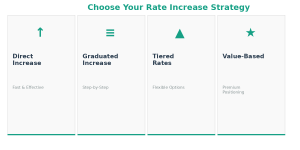
4 Rate Increase Strategies (Pick One)
Strategy 1: The Direct Increase (Fastest, Most Effective)
How it works: Increase rates immediately. Send email to all current clients. New rate applies to new projects only (existing projects stay at old rate).
When to use: You’re fully booked. You have good clients who value you. You have 10+ clients (losing 1-2 is okay).
Example: $50/hour → $60/hour (+20%)
Result: Immediate income increase on new work. Some clients leave (expected). Staying clients show they value you.
The Increase Formula:
Current Rate + (Current Rate × Percentage Increase) = New Rate
Example:
$50 + ($50 × 0.20) = $60
Recommended increase: 15-25% for annual raise
Conservative: 10-15%
Aggressive: 25-35% (only if market supports)
Strategy 2: The Graduated Increase (Safest)
How it works: Increase rates in steps over 3-6 months.
Month 1: Announce 10% increase coming in 3 months
Month 4: Implement 10% increase, announce next 10%
Month 7: Implement second 10% increase
When to use: You’re nervous about losing clients. You have mostly long-term clients. You’re not at capacity yet.
Benefits: Clients adjust gradually. You get income boost without the shock. Lower churn rate.
Strategy 3: The Tiered Increase (Complex, Flexible)
How it works: Different rates for different client types.
Example:
• New clients: $65/hour
• Existing clients: $50/hour (grandfathered)
• Long-term clients (2+ years): $50/hour (lock in lifetime)
• Clients who left: $65/hour when they return
When to use: You want to reward loyal clients. You want to attract higher-paying new clients. You have mixed client quality.
Benefit: Retains good clients while increasing income. Encourages client loyalty.
Strategy 4: The Value-Based Increase (Premium Positioning)
How it works: Stop charging hourly. Move to project-based pricing or value-based pricing.
Example: Instead of $50/hour, charge $2,000 for a landing page (regardless of hours). A project that takes 20 hours = $100/hour effective rate.
When to use: You’re experienced. You know your process. Clients care about results, not hours. You want to stop time-tracking.
Benefit: Unlimited earning potential. Clients focus on value, not hours. You get rewarded for efficiency.
How to Calculate Your New Rate
Method 1: Percentage Increase (Simplest)
Current Rate × (1 + Desired Increase %)
Example: $50/hr × 1.20 = $60/hr (20% increase)
Recommended: 15-25% annually
Conservative: 10%
Aggressive: 30%+
Method 2: Market Rate Research
Steps:
1. Research your market rate (PayScale, Upwork benchmarks, freelance surveys)
2. Identify where you fall (entry, mid, senior level)
3. Set rate 10-15% below market (so you’re competitive but not desperate)
4. Plan next increase for when you’re at market rate
Example:
Market rate for your skill: $65/hour
Your current rate: $50/hour
Your new rate: $60/hour (market rate – 7%)
Next increase in 12 months: $68/hour
Method 3: Value-Based (What Results Are Worth)
Steps:
1. Calculate the value you deliver ($10,000 revenue for client)
2. Charge 10-15% of value ($1,000-$1,500)
3. Compare to hourly equivalent (80 hours = $12.50-$18.75 per hour)
4. If lower than market rate, increase
Announcing Your Rate Increase (Scripts)
Script 1: The Professional Increase Announcement
Subject: Updated Rates Effective [DATE]
Hi [Client Name],
I’m writing to let you know about an update to my rates, effective [DATE].
I’ve been working with you since [DATE] and deeply appreciate our partnership. Over the past year, I’ve improved my skills, expanded my portfolio, and taken on more challenging projects. These improvements directly benefit you through faster delivery, better solutions, and higher quality work.
Effective [DATE], my rate will be:
OLD: $[old rate]/hour → NEW: $[new rate]/hour
This rate applies to all new projects. Your current projects at [OLD rate] remain unchanged.
I’m committed to continuing our excellent working relationship. Let me know if you have any questions.
Best regards,
[Your Name]
Script 2: The 30-Day Notice (Generous)
Subject: Friendly Heads-Up on Rate Change (30 Days Notice)
Hi [Client Name],
Quick heads-up: My rates are increasing by 15% effective [DATE, 30 days from now].
If you have any projects in the pipeline, now is the time to lock them in at the current rate. After [DATE], new projects will be at the new rate.
This gives you a full month to plan. I’ll send a detailed email 1 week before with my new rate card.
Thanks!
[Your Name]
Script 3: The New Client Rate (Fresh Start)
Subject: Project Proposal – [Project Name]
Hi [Client Name],
Thanks for reaching out. I’d love to work on [PROJECT].
Based on the scope you described, here’s my proposal:
PROJECT: [Details]
TIMELINE: [Dates]
INVESTMENT: $[amount] at my rate of $[new rate]/hour
EST. HOURS: [X] hours
This rate reflects my current market positioning and experience level.
Let me know if you’d like to move forward.
Best,
[Your Name]
Script 4: The Loyal Client Exception (Keep Good Ones)
Subject: Rate Update (Grandparent Price for You)
Hi [Client Name],
I’m raising my rates effective [DATE], but I wanted to give you a heads-up before the change.
You’ve been a valued client for [X years/months] and I appreciate our partnership. Here’s what I’m offering:
• New base rate: $[new rate]/hour
• Your locked-in rate: $[old rate]/hour (honored indefinitely)
This is my way of saying thank you for being a reliable, quality client. Your rate stays locked even as I raise rates for new work.
Looking forward to continuing our work together.
Best,
[Your Name]
What Happens When You Lose Clients (and Why It’s Good)
The Reality of Rate Increases
When you raise rates, some clients will leave. This is not a failure. This is a success.
Here’s why: You’re filtering for price-sensitive clients (bad) and keeping value-focused clients (good).
Who Leaves (And You Want Them To)
Price-sensitive clients: “You cost too much now” → You’re better off without them
Scope-creeping clients: They disappear because you now have real pricing
Time-wasting clients: They can’t afford you anymore
Flaky clients: They move to cheaper options
The Bad News: You will lose clients when you raise rates. Expect to lose 10-30% depending on how aggressive the increase.
The Good News: The clients you lose are the ones costing you money in stress, revisions, and slow payment.
Who Stays (And Why You Want Them)
Value-focused clients: They care about quality, not price
Stable clients: They budgeted for your services and continue
Growing clients: They’re making money from your work and happy to pay more
Professional clients: They understand that quality costs more
The Income Math When You Lose Clients
Example Scenario:
BEFORE:
• 10 clients
• $50/hour
• 150 billable hours/month
• Monthly income: $7,500
YOU RAISE RATES TO $60/HOUR
RESULT (Losing Clients):
• 7 clients (lost 3)
• $60/hour
• 130 billable hours/month
• Monthly income: $7,800
NET: +$300/month (+4%) while having fewer clients!
How to Keep Clients When Raising Rates
1. Give Advance Notice (30-60 Days)
The more warning, the less shock. Clients who know a rate increase is coming adjust their expectations and budgets.
2. Explain the “Why”
Not “I want more money” but “I’ve improved, my work is faster/better/more valuable.”
Good reason: “I’ve cut project timelines 25% while improving quality”
Bad reason: “I need more income”
3. Lock in Prices for Loyal Clients
Offer long-term clients a “grandfathered rate” — they keep the old rate forever. This costs you nothing (they’d leave at new rates anyway) but keeps them happy.
4. Improve Delivery Before Increasing Rates
Don’t raise rates then improve service. Improve service, then raise rates. Clients see the increase as justified.
5. Create “Premium” Service Tiers
Instead of one rate increase, offer options:
Standard: $50/hour (old rate)
Express: $65/hour (48-hour turnaround, priority scheduling)
VIP: $80/hour (24-hour turnaround, unlimited revisions)
Clients can choose. Many stay with standard. Some upgrade to express. Everyone’s happy.
Negotiating with Pushback
Client Says: “Your rates went up too much”
“I understand the increase might feel steep. Let me explain what’s changed:
– I’ve cut project turnaround from [X] days to [Y] days
– My portfolio includes [major work] now
– I’m delivering [specific improvement]
The new rate reflects this increased value. I’m happy to discuss project structure if cost is a concern.”
Client Says: “I’ll find someone cheaper”
“That’s completely fair. I’d suggest requesting samples from cheaper options—compare the quality. I’m confident my work justifies the investment.
If budget is tight this month, we can split the project across two months. Happy to work with your timeline.”
Client Says: “Can you keep my old rate?”
“I appreciate what we’ve built together. For long-term partners like you, I can offer: lock your current rate for [next 6/12 months], then move to new rate.
This gives you time to adjust budgets while maintaining our working relationship.”
Phased Rate Increase Strategy (The Safe Path)
For Freelancers Who Are Nervous
If you’re worried about losing clients, use this phased approach:
Month 1: Announce + Prepare
- Email all clients: “Rates increasing 10% in 90 days”
- New clients: Quote at new rate immediately
- Update portfolio with recent wins
Month 2: Let It Settle
- Listen to client reactions
- Take new projects at new rate
- Improve your delivery
Month 3: Implement First Increase
- Current clients: Old rate (for ongoing work)
- New projects: New rate
- New clients: New rate
Month 6-9: Plan Second Increase
- Announce second 10% increase coming
- Position it as market adjustment
- Let clients adjust
Month 12: Implement Second Increase
- New projects at 20% higher rate
- Long-term clients still grandfathered
- Reassess again in 12 months
Result: Two 10% increases = 20% total increase, with minimal client churn.
Setting Rates for New Clients vs. Existing
The Two-Tier Approach (Recommended)
Existing Clients: Old rate (at least until contract ends)
New Clients: New rate (immediately)
Why this works:
• Rewards loyalty without costing you money
• New clients don’t know your old rate
• Creates incentive for clients to stay long-term
• Simplifies the transition
Selling New Rate to New Clients
New clients don’t compare to your old rate. They compare to competitors. When you quote the new rate, position it confidently:
“My rate for this project is $[new rate]/hour because:
– 10+ years of experience
– [specific achievement]
– Average project turnaround: [timeframe]
– Client satisfaction: [metric]
This is in the [mid/premium] market range for this work.”
5 Rate Increase Mistakes
Mistake 1: Increasing Rates Too Frequently
Raising rates every 3 months trains clients to expect constant increases. Stick to annual increases unless there’s a major business change.
Mistake 2: Not Communicating the Increase
Clients should hear about rate increases from you, not when they’re invoiced. Announce increases 30+ days in advance.
Mistake 3: Raising Rates While Underworked
If you have 10 billable hours/week, raising rates is risky. First: get to capacity, then raise rates.
Mistake 4: Using Inflation as the Only Justification
“Inflation is 3% so I’m raising rates 3%” sounds weak. Better: “My skills improved 25%, so I’m raising 15%.”
Mistake 5: Not Offering Grandfathered Rates to Good Clients
A $50 “retention discount” for a client generating $500/month in revenue is the best investment you can make.
Also Read: Freelance Networking Playbook: Build Your Referral-Based Business
30-Day Rate Increase Implementation Plan
Week 1: Research & Decision
- Day 1: Research market rates in your niche
- Day 2: Decide what strategy you’ll use (direct, phased, tiered, value-based)
- Day 3: Calculate your new rate
- Day 4: Create list of all current clients (20+ people)
- Day 5: Identify which clients to grandfather/retain (top 5-10%)
- Day 6-7: Draft announcement email
Week 2: Announcement & Reaction
- Day 8: Send rate increase announcement to all clients
- Day 9-14: Wait for client responses
- Day 10-12: Respond to all client questions/concerns
- Day 13-14: Offer grandfathered rates to best clients who push back
Week 3: Implementation Prep
- Day 15: Update all rate cards and proposals
- Day 16: Update Upwork/Fiverr/Freelancer rates
- Day 17: Update website pricing
- Day 18: Prepare new contract templates with new rates
- Day 19-21: Test new rate with new client inquiries
Week 4: Lock It In
- Day 22: Implementation date arrives (start charging new rate)
- Day 23-30: Quote all new inquiries at new rate
- Day 25: Existing client projects continue at old rate
- Day 28: Track client responses and churn
- Day 30: Assess impact (income, client retention, pipeline)
Week 4 Success Looks Like: 3-5 new client inquiries at new rate (some convert). 1-2 old clients leave (expected). Overall income stable or increased. No regrets about the decision.
Final Thought
Undercharging Is a Choice
Every day you charge below market rates, you’re voluntarily paying yourself less. This is a choice, but it’s not a necessity.
Clients aren’t asking you to charge less. The market isn’t forcing you. You’re choosing to.
Raise your rates. You deserve it. Your clients can afford it. And your future self will thank you.
One more thing: After you raise your rates, the next barrier to income growth isn’t price. It’s capacity. Once you’ve optimized pricing, the next step is delegating/scaling to take on more work. But that’s another article.
About The Author
