
Building a Freelance Business Plan: Strategy for Success
Why Freelancers Need Business Plans (And Why They Don’t Have Them)
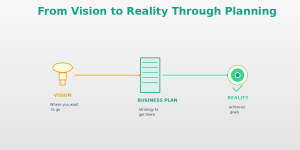
Building a Freelance Business Plan. Most freelancers don’t have a business plan. They react to opportunities. They work on projects as they come. They grow by accident.
Some of this works. You can stumble into success. But without a plan, you’re relying on luck, not strategy.
Here’s what a business plan does:
- Clarifies your vision: Where are you actually going? (Not just “make more money”)
- Sets measurable goals: How will you know if you’re succeeding?
- Guides decisions: When opportunities come, you have a framework to say yes or no
- Tracks progress: Are you moving toward your vision or away from it?
- Enables growth: You can’t scale what you don’t measure
- Reduces stress: You have a plan instead of constant uncertainty
The Planning Paradox: The freelancers who plan are less stressed about the future. Not because things go perfectly, but because they know what they’re working toward and can adjust when needed.
Define Your Vision (Not Just Goals)
Vision is different from goals. Goals are specific and measurable. Vision is your direction—what you’re building toward.
The Vision Question
Answer this: “If my freelance business was exactly where I wanted it in 5 years, what would that look like?”
Not in vague terms. Specifically:
- How much income? ($X per year)
- How many hours per week? (20? 30? 40?)
- What type of clients? (Size, industry, personality)
- What type of work? (Projects that excite you)
- What’s your lifestyle? (Flexibility, travel, location)
- What does success feel like? (Stability, growth, impact, freedom)
Example Visions
Vision A: “I want a $150K/year freelance business working 30 hours per week with 3-4 retainer clients who pay monthly. I want to work from anywhere and take 4 weeks off per year without guilt.”
Vision B: “I want to be known as the top designer in my niche, working with premium clients who value quality over price. I want to build a small team and transition to agency ownership.”
Vision C: “I want passive income from digital products alongside my freelance work. In 5 years, 40% of my income is passive, 60% is freelance, and I work 25 hours per week.”
Each vision is different. Each one changes how you build your business.
Also Read: Burnout Prevention for Freelancers: Build Sustainable Energ
Create Your Mission Statement
Your mission statement answers: Why does your business exist? What value do you provide?
This is not your tagline. It’s the core purpose of your work.
Mission Statement Formula
“I help [target client] [solve problem / achieve goal] by [your unique approach].”
Examples
Content Writer: “I help coaches and consultants build credibility through high-quality content that attracts ideal clients.”
Designer: “I help small businesses stand out in crowded markets through distinctive brand identity and design.”
Developer: “I help nonprofits and social enterprises leverage technology to scale their impact.”
Your mission guides every decision. When a project opportunity comes that doesn’t fit your mission, it’s easier to say no.
Define Your Target Client
You can’t serve everyone. The more specific your target, the easier your business becomes.
Target Client Profile (Not Just a Description)
Create a profile with:
- Company/Role: What type of business? What size? What industry?
- Problem: What specific problem do they have that you solve?
- Budget: What can they afford? (This matters)
- Communication style: Are they quick-moving or detail-oriented? Professional or casual?
- Values: What do they care about? (Quality, speed, price, impact, innovation)
- Ideal engagement: Do they want retainers or projects? Short-term or long-term?
Example Target Client
B2B SaaS Founders — $2-5M revenue, 20-50 employees, raised Series A funding, need content to establish thought leadership, value quality over price, prefer retainer relationships, want quarterly check-ins, communicate via Slack.
This specific profile lets you:
- Know exactly who to target in marketing
- Communicate in their language
- Tailor pricing to their budget
- Build a portfolio of similar clients
Clarify Your Services & Positioning
Services: What exactly do you offer?
Positioning: How are you different from other freelancers doing the same thing?
Service Clarity
Don’t list everything you can do. List what you DO do professionally.
If you’re a designer, choose: Logo design + brand identity? Or website design? Or both? Be specific.
Clarity allows you to:
- Build deeper expertise in specific areas
- Charge premium rates (specialists earn more than generalists)
- Turn down work outside your scope
- Build a clear portfolio
Positioning: Your Unique Angle
Positioning answers: Why should someone hire you instead of another freelancer with similar skills?
- Industry expertise: “I only work with SaaS founders. I understand their business model.”
- Unique approach: “I use a specific framework that guarantees measurable results.”
- Audience: “I work specifically with women entrepreneurs who prefer female freelancers.”
- Quality standard: “I work with premium brands who care more about quality than price.”
- Speed: “Fast turnaround with unlimited revisions—quality that doesn’t slow you down.”
Set Financial Goals (3-Year Projection)
Money matters. Don’t be shy about it. Financial goals are just as important as mission.
Year 1 Goal
“In Year 1, I want to earn $X in revenue.”
Be specific. Break it down:
- $X revenue ÷ $Y average project/hourly rate = Z number of clients/projects needed
- Factor in: Sales time, admin time, learning time (actual billable work is 60-70% of your hours)
- Account for: Taxes, business expenses, growth investment
Year 2-3 Goals
Growth isn’t linear. Plan for:
- 15-30% revenue growth per year (conservative estimate)
- Increase rates as you gain experience (+ 10-15% per year)
- Shift toward higher-paying clients or retainers
- Diversify income (retainers, products, courses, etc.)
Financial Goals Table
| Timeframe | Revenue Goal | Average Rate | Hours/Week | Client Type |
|---|---|---|---|---|
| Year 1 | $60,000 | $100/hour | 15-20 | Mix: Projects + small retainers |
| Year 2 | $85,000 | $115/hour | 15-20 | Mostly retainers (70%) |
| Year 3 | $120,000 | $135/hour | 20-25 | Retainers (80%) + premium projects |
Build Your Revenue Model
How do you make money? Most freelancers have one revenue stream. Better businesses have multiple.
Revenue Stream Options
- Hourly work: Time-based billing for projects or retainers
- Project-based: Fixed price per project (most common)
- Retainers: Monthly payment for ongoing availability/work
- Productized services: Package your service at a fixed price (e.g., “$5K website package”)
- Digital products: Templates, courses, guides (passive income)
- Speaking/training: Workshops, masterclasses, speaking fees
Ideal Revenue Mix (Year 3)
Sustainable example:
- 60% from retainer clients ($72K/year from 3-4 retainers @ $2K/month)
- 30% from project work ($36K/year from 4-5 premium projects @ $7-9K)
- 10% from products/passive income ($12K/year from courses, templates, etc.)
Why this mix? Retainers provide income stability. Projects provide growth opportunities. Passive income provides breathing room.
Plan Your Marketing Strategy
How will your target client find you?
3-Channel Marketing Plan
Don’t do everything. Pick 3 channels and master them:
- Channel 1 – Organic/Content: Blog, SEO, LinkedIn, Twitter (slow, high-value)
- Channel 2 – Referrals/Network: Past clients, partnerships, community (high-trust, sustainable)
- Channel 3 – Paid/Direct: Ads, email, outreach, cold calls (quick, controllable)
Marketing Goals (Year 1)
- Generate 10-15 qualified leads per month
- Convert 20-30% of leads to clients (2-4 clients/month)
- Build email list of 500+ people in your target market
- Establish at least 2 referral partnerships
Design Your Growth Strategy
How do you go from Year 1 to Year 3?
Growth Paths
- Geographic expansion: Service new markets
- Vertical expansion: Go deeper in one industry (become the expert)
- Service expansion: Add complementary services
- Price increases: Raise rates as you build authority
- Passive income: Build products, courses, communities
- Team building: Hire contractors, build team, transition to agency
- N Year 1-3 Growth Plan
Year 1: Focus on nailing your core service with your target client. Build portfolio. Get testimonials.
Year 2: Increase rates 10-15%. Shift toward retainer clients. Start productizing services.
Year 3: Consider team building, passive income, or specialization deeper. Plan next phase.
Plan Your Operations & Systems
How do you actually run the business day-to-day?
Operations Checklist
- Client onboarding: How do you bring on new clients? What’s the process?
- Project management: How do you track projects, deadlines, deliverables?
- Communication: How do you stay in touch? (Email, calls, updates)
- Invoicing/payments: How do you bill? What’s your payment terms?
- Tools/software: What tools do you use? (Project management, time tracking, invoicing)
- Contracts: Do you have a contract template? What are your terms?
- Processes: What’s your workflow? Can you document it?
Identify Risks & Mitigation
What could derail your plan?
Common Freelance Risks
- Income instability: Mitigation: Build emergency fund (3-6 months), diversify clients, raise rates
- Client dependency: Mitigation: Limit any one client to 30% of income, build pipeline, referral system
- Burnout: Mitigation: Set boundaries, plan time off, manage workload
- Market changes: Mitigation: Stay current with skills, evolve services, diversify
- Health issues: Mitigation: Health insurance, disability protection, sick leave buffer
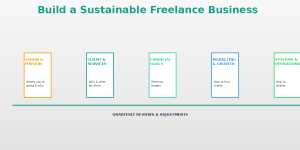
Build in Quarterly Reviews
A business plan that never gets reviewed is just a document. Review it every quarter.
Quarterly Review Questions
- Am I on track toward my annual financial goal?
- What worked this quarter? (Keep doing it)
- What didn’t work? (Change or drop it)
- What surprised me? (Opportunity or challenge?)
- What should I focus on next quarter?
- Do I still believe in my vision? (Or does it need adjustment?)
Note: Your plan should evolve. Quarterly reviews let you adjust as you learn. A rigid plan is useless. A flexible plan that you review and adjust quarterly is powerful.
The One-Page Business Plan Template
You don’t need a 50-page business plan. Here’s what fits on one page:
FREELANCE BUSINESS PLAN (One Page)
VISION (5 years):
[Your 5-year vision in 2-3 sentences]
MISSION:
I help [target client] [solve problem] by [unique approach]
TARGET CLIENT:
[Client profile: industry, size, values, budget]
SERVICES & POSITIONING:
[What you offer + why you’re different]
FINANCIAL GOALS (Year 1):
Revenue: $X | Average rate: $Y | Hours/week: Z
REVENUE STREAMS:
% Retainers | % Projects | % Products/Other
MARKETING CHANNELS:
1. [Channel + goal]
2. [Channel + goal]
3. [Channel + goal]
Also Read: Overcoming Imposter Syndrome: Build Real Confidence
GROWTH STRATEGY (Years 2-3):
[How you’ll grow: rate increases, retainers, products, team]
KEY RISKS & MITIGATION:
[1-2 biggest risks and how you’ll handle them]
QUARTERLY CHECK-IN:
[Schedule for Jan 1, Apr 1, Jul 1, Oct 1]
That’s it. One page. Print it. Put it on your wall. Review it every quarter.
The Real Power of Planning
A business plan doesn’t guarantee success. But it does:
✓ Clarifies your thinking — When you write your vision down, you discover what you actually want
✓ Guides decisions — When an opportunity comes, you have a framework to say yes or no
✓ Reduces stress — You know where you’re going instead of reacting constantly
✓ Enables growth — You can’t scale what you don’t measure
✓ Improves results — Intentional business beats accidental business every time
The best business plan is the one you actually use. Don’t aim for perfection. Aim for clarity.
Spend 2-3 hours writing your one-page plan. Then spend 30 minutes every quarter reviewing and adjusting it.
That’s the difference between a freelancer who drifts and a freelancer who builds an intentional business.
About The Author
