
Freelance Networking Playbook: Build Your Referral-Based Business
Why Networking Is The Most Valuable Business Skill You’re Ignoring
Freelance Networking Playbook. You think you’re competing on skills. You’re not. You’re competing on relationships.
The freelancers earning the most money aren’t always the most skilled. They’re the ones with the strongest networks. They get referrals. Opportunities come unsolicited. Clients know who they are before they pitch.
Freelancers without networks are forced to hustle constantly. They bid on projects. They compete on price. They’re always searching for the next client. Freelancers with strong networks have the opposite problem: too many opportunities.
Here’s what most freelancers get wrong about networking: they think it means attending events or being “out there.” It doesn’t. Networking is simply building and maintaining genuine relationships with people who can help you and people you can help.
This guide covers the exact networking playbook that turns casual connections into referral-based income. You’ll learn which relationships matter most, how to build them genuinely, how to ask for referrals without being awkward, and the systems that keep your network alive and engaged.
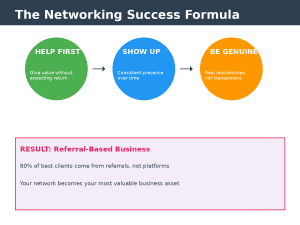
The Networking Truth: 80% of freelancers’ best clients come from referrals, not platforms. Your network is your most valuable business asset. Yet most freelancers spend zero time building it.
Also Read: Freelance Time Management: Earn More While Working Less (The System That Works)
The Network Foundation: Know Your Network Types
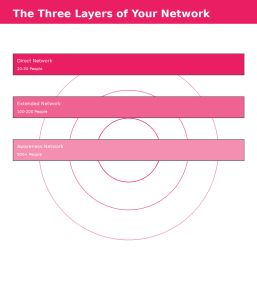
Not all relationships are equal. Your network has layers. Each layer serves a different purpose.
Layer 1: Direct Network (20-30 People)
Who they are: People you have active relationships with. You’ve worked together, communicate regularly, or know each other well.
Their value: These people refer you consistently. They know your work. They understand your ideal client. They’re your core network.
Examples:
- Past clients who loved working with you
- Collaborators or other freelancers you partner with
- Friends who know your work well
- Colleagues from previous jobs
- People you meet regularly (meetup group, coworking space)
Your job: Keep these relationships warm. Check in monthly. Share wins and challenges. Refer them when you can.
Layer 2: Extended Network (100-200 People)
Who they are: People you’ve met and connected with but don’t interact with regularly. They know you exist and what you do.
Their value: They’re potential referrers if opportunity arises. They might refer you to one person who becomes a major client.
Examples:
- LinkedIn connections you’ve engaged with
- People from conferences or events you’ve attended
- Twitter/social media followers who interact with you
- Acquaintances through mutual friends
- Former clients you worked with less closely
Your job: Stay visible. Post content they see. Engage with their work. Show up occasionally.
Layer 3: Awareness Network (500+ People)
Who they are: People who know of you but don’t have direct relationship. They’ve seen your content or heard about you.
Their value: Brand recognition. Reputation. If they need your service, they remember you.
Examples:
- Email list subscribers
- Social media followers
- People who’ve read your articles
- People who’ve heard about you through others
Your job: Show up consistently with valuable content. Be visible and memorable.
Who To Network With (The Right People)
Networking with everyone is exhausting. Networking with the right people is efficient.
The Four Types of High-Value Network Contacts
Type 1: Ideal Clients (Direct Business)
Who they are: Decision-makers at companies that fit your ideal client profile.
Why network with them: Direct work. They can hire you directly.
Where to find them: LinkedIn (searched by company/role), industry events, online communities where your ideal clients gather
How to approach: Help first, sell later. Share insights. Answer questions. Build genuine relationship before pitching work.
Type 2: Referral Partners (Indirect Business)
Who they are: People and businesses that work with your ideal clients but don’t compete with you.
Examples: If you’re a freelance designer, referral partners might be marketing consultants, web developers, copywriters, brand strategists
Why network with them: They regularly interact with companies that need your service. When their client asks for a designer, they recommend you. You do the same for them.
Where to find them: Industry communities, LinkedIn, networking events for your niche, online forums
How to approach: Start by asking “how do I help you?” Understand their business. Then share your expertise naturally. Referral partnerships work when it’s mutual and genuine.
Type 3: Influencers & Connectors (Reach & Credibility)
Who they are: People with large audiences or strong networks in your niche.
Why network with them: Their endorsement matters. If they recommend you, their network listens. You gain credibility by association.
Where to find them: They’re usually visible in your industry. Active on social media. Speaking at events. Writing content.
How to approach: Don’t ask for favors upfront. Add value first. Engage with their content. Share their work. Build genuine relationship. Then they’ll naturally refer you or collaborate.
Type 4: Peers & Collaborators (Support & Opportunities)
Who they are: Other freelancers or service providers doing similar work. They’re not competitors—they’re potential partners.
Why network with them: They refer overflow work. You collaborate on projects. You support each other’s growth. You share knowledge.
Where to find them: Freelancer communities, online forums, coworking spaces, social media groups
How to approach: Be generous. Share knowledge freely. Refer them when you can. Support their launches and wins.
How to Actually Build Relationships (Not Fake Networking)
Most “networking advice” focuses on events and forced conversations. That’s backward. Real networking is about genuine connection.
The Three Pillars of Real Networking
Pillar 1: Help First, Expect Nothing
The fastest way to build a network is to be useful.
What this looks like:
- Answer someone’s question with no expectation of return
- Share a resource that helps their business
- Introduce two people who should know each other
- Give feedback on their work without being asked
- Refer business to them when they solve a problem for someone
The psychology: When you help someone without expecting anything, they naturally want to reciprocate. Over time, helping becomes a pattern and the relationship strengthens.
“I noticed you were asking about [topic] recently. I found this resource that really helped me: [link]. Thought you might find it useful. No strings attached—just wanted to help.”
Pillar 2: Show Up Consistently (Online & Offline)
Networking isn’t a one-time event. It’s consistent presence over time.
What this looks like:
- Engage with people’s content regularly (like, comment, share)
- Attend the same events repeatedly (people notice you)
- Participate in online communities consistently
- Share your own content regularly so people see you
- Follow up periodically with people in your network
The psychology: Familiarity builds trust. The more people see you showing up, helping, and being present, the more they think of you when opportunities arise.
Pillar 3: Be Genuine (Not Transactional)
People can sense when you’re being transactional. It doesn’t work.
What genuine networking looks like:
- You’re interested in people as humans, not just what they can do for you
- You remember details they’ve shared and follow up on them
- You’re happy for their wins even if they don’t benefit you
- You stay connected even during slow periods (not just when you need something)
- You recommend others without keeping score
The difference: Transactional networking: “Can you refer me?” Genuine networking: “How’s your business going? What are you working on?”
Asking for Referrals Without Being Awkward
Most freelancers never ask for referrals. They’re afraid it’s awkward or pushy. But asking directly is actually the most respectful approach.
The Science of Asking for Referrals
Research shows that people WANT to refer you if they know how to help. The problem is they don’t know you want referrals or what kind of client to send you.
Making it easy to refer you:
- Tell them explicitly: “I’m looking to work with [specific type of client]”
- Describe your ideal client with specifics: “Companies spending $5K+ on [service], typically led by [type of person]”
- Tell them how to refer: “If you know someone, just introduce us via email and I’ll take it from there”
- Offer to do the same: “I’ll do the same for you if I meet anyone who needs [their service]”
The Five Referral-Asking Formulas
Formula 1: After Great Project Completion
“I’ve really enjoyed working with you and getting to see [specific thing you did well]. I’m actively looking to work with more companies like yours. If you know anyone in your network who needs [your service], I’d love an introduction. No pressure—just thought I’d ask.”
Formula 2: Direct Ask in Conversation
“Hey [Name], quick question: I’m building my ideal client base around [specific type of work]. Do you know anyone in your network who might need this? I’d love an introduction if so.”
Formula 3: With Incentive
“I’m looking to work with more [ideal client type]. If you refer someone who becomes a client, I’ll give you a 10% discount on your next project, or send you a $200 gift card—your choice. Easy way to help each other.”
Formula 4: Leveraging Existing Relationships
“You know me and you know my work. Who in your network do you think could really benefit from working with someone like me? I’m open to any introduction.”
Formula 5: The Value-First Ask
“I’ve been working in [niche] for [time], and I’ve noticed [specific problem your ideal client faces]. I’ve developed [your solution]. I’m looking to work with more companies facing this challenge. Anyone in your network you think I should talk to?”
Maintaining Your Network (The Forgotten Part)
Most people build relationships once then let them die. Maintenance is what separates successful networkers from ones who fail at networking.
The Four Maintenance Activities
1. Monthly Check-Ins (Direct Network, 20-30 people)
What: Simple message to people in your core network
Frequency: Once per month
Example messages:
- “How’s business going? Saw you launched [thing]—congratulations!”
- “Thinking of you. How’s [project they mentioned] coming along?”
- “This reminded me of you [article/resource]. Thought you’d find it valuable.”
2. Quarterly Value Sharing (Extended Network, 100-200 people)
What: Share something valuable with your extended network
Frequency: Once per quarter
Format: Email, article, resource, invitation to webinar, announcement of new service
Goal: Keep you visible and remind them what you do
3. Annual Deep Dives (20-30 people)
What: Coffee call, video chat, or extended conversation
Frequency: At least once per year with your core network
Purpose: Strengthen relationships, understand where they are now, explore how you can help
How to suggest it:
“It’s been a while since we connected. I’d love to hop on a call and catch up. How’s [area] going for you? Any challenges I might be able to help with?”
4. Win Celebrations (Everyone)
What: Acknowledge when people in your network have wins
Examples:
- They launch a new product
- They’re mentioned in press/media
- They hit a milestone
- They post about accomplishment
Your response: Genuine message of celebration. No ask. No expectation. Just acknowledgment.
“Saw you hit $1M in revenue—that’s incredible. You deserve it after all the work you’ve put in. Genuinely proud of you.”
Online vs Offline Networking (Where to Focus)
Different channels serve different purposes. Most freelancers focus on the wrong ones.
Online Networking Channels (Where Most Opportunities Live)
LinkedIn (Highest ROI for B2B Freelancers)
Best for: Building credibility, connecting with ideal clients, engaging thoughtfully
Strategy: Post valuable content consistently. Engage deeply with others’ posts (not just liking). Send personalized connection requests. Join relevant groups and contribute.
Realistic results: 1-2 quality conversations per 100 connections per month. Takes 6 months to see real traction.
Email (Highest Conversion for Networking)
Best for: Maintaining relationships, consistent value sharing, direct outreach
Strategy: Build email list. Send monthly updates. Share insights and resources. Ask for feedback.
Realistic results: 2-5% of list engages with each email. But that engagement is higher quality than social media.
Slack/Discord Communities (Best for Peer Networking)
Best for: Building relationships with peers, finding collaborators, peer support
Strategy: Join 1-2 relevant communities. Show up regularly. Answer questions. Build friendships.
Realistic results: Strong peer relationships, occasional referral, collaboration opportunities
Offline Networking Channels
Industry Events & Conferences
Best for: Meeting new people, deepening relationships, visibility
Strategy: Attend events where your ideal clients or referral partners gather. Go to same events repeatedly (people notice). Take genuinely interested in people. Follow up afterward.
Realistic results: 1-2 quality connections per event if you’re intentional
Coworking Spaces & Meetups
Best for: Building core network, peer relationships, daily visibility
Strategy: Show up consistently. Get to know people. Collaborate. Refer work to others.
Realistic results: Regular referrals over time, strong peer community
Your Networking System (The Mechanics)
Without a system, networking is chaotic and inconsistent. With a system, it becomes automatic.
The Three-Tier Networking System
Tier 1: Weekly Networking Activities (30 minutes)
- Engage with 3-5 people’s content on LinkedIn or Twitter
- Send one personalized message to someone in extended network
- Respond to comments and messages in one online community
Tier 2: Monthly Networking Activities (2-3 hours)
- Check in with 5-10 people in direct network (genuine messages)
- Attend one networking event or virtual meetup
- Write and send monthly email to list (or newsletter)
- Identify and reach out to 2-3 new potential connections
Tier 3: Quarterly Networking Activities (4-5 hours)
- Schedule deep-dive calls with 5 people in core network
- Audit your network (who’s quiet, who needs follow-up)
- Create value (resource, guide, referral list) to share
- Plan strategy: who do I need to connect with more?
The Networking CRM (Simple Tracking System)
Use a simple spreadsheet or note-taking system to track:
| Name | How You Met | What They Do | Last Interaction | Next Action | Referral Opportunity |
|---|---|---|---|---|---|
| Sarah Chen | LinkedIn connection | Marketing consultant | 3 weeks ago | Send article about her niche | Refers startups needing design |
| James Rodriguez | Client project | Founder at Tech Co | 2 months ago | Schedule coffee call | Hires contractors regularly |
| Lisa Park | Meetup group | Fellow freelancer (dev) | 1 week ago | None needed (staying in touch) | Refers design work to me |
Update this quarterly: Note new interactions, update last contact dates, identify who to reach out to.
Common Networking Mistakes Freelancers Make
Mistake 1: Only Networking When You Need Work
The problem: People can sense desperation. If you only reach out when you need something, relationships feel transactional.
The fix: Network consistently, even during busy periods. Stay in touch whether you’re seeking work or not.
Mistake 2: Networking Only Online (Never in Person)
The problem: Online connections are weaker than in-person relationships. You’re competing with thousands of digital messages.
The fix: Balance online with offline. Attend one event per month. Coffee calls. Video chats (better than email).
Mistake 3: Trying to Build Relationship With Wrong People
The problem: Networking with people who don’t serve your business is wasted energy.
The fix: Be intentional about who you network with. Focus on ideal clients, referral partners, and quality peers.
Mistake 4: Not Following Up After Meeting
The problem: Most people meet someone, exchange contact info, then never follow up. Connection dies.
The fix: Follow up within 48 hours of meeting someone. Remind them of conversation. Suggest next step or send value.
Mistake 5: Being Invisible Between Interactions
The problem: People forget you exist if you disappear between meetings.
The fix: Maintain visibility. Share content. Engage with others’ work. Show up consistently.
Also Read: Freelance Income Journey: From $0 to $5,000+/Month (The 6 Phases)
30-Day Networking Action Plan
Week 1: Audit Your Current Network
- Day 1-2: List 30 people in your direct network (past clients, collaborators, friends who know your work)
- Day 3: Identify 3-5 “dream clients”—companies you want to work with
- Day 4: Identify 10 potential referral partners (complementary services to yours)
- Day 5: Find 5 people in your niche who have strong networks (influencers/connectors)
- Day 6-7: Set up simple tracking system (spreadsheet with names and details)
Week 2: Start Online Networking
- Day 8: Optimize LinkedIn profile with clear positioning
- Day 9: Connect with 10-15 ideal clients on LinkedIn (personalized messages)
- Day 10: Connect with 10-15 referral partners (explain why you’re connecting)
- Day 11: Set up email list or newsletter (simple tool like Substack)
- Day 12: Join 1-2 online communities relevant to your niche
- Day 13-14: Engage in communities (answer questions, add value)
Week 3: Personal Outreach
- Day 15: Send personalized messages to 5 people in your dream client list
- Day 16: Schedule coffee calls with 3 people in your direct network
- Day 17: Attend one networking event (virtual or in-person)
- Day 18: Follow up with new connections from event within 48 hours
- Day 19: Send referral requests to 3 ideal people (“I’m looking to work with…”)
- Day 20: Make 3 referrals to people in your network
- Day 21: Plan your first monthly email/update to share with network
Week 4: Build Your System
- Day 22: Schedule weekly networking tasks in calendar (30 min/week minimum)
- Day 23: Create monthly networking checklist (people to reach out to, value to share)
- Day 24: Set quarterly deep-dive calls with 5 core network members
- Day 25: Create referral ask template and practice delivering it
- Day 26: Review your tracking system and update with recent interactions
- Day 27-28: Commit to your ongoing networking routine
- Day 29-30: Reflect: which networking activities felt most natural? Where should you focus?
30-Day Results to Expect: 20-30 quality LinkedIn connections made. 2-5 coffee calls scheduled. 1-2 serious referral conversations started. First evidence of referral working. Foundation for systematic networking in place.
The Long-Term Impact of Networking
Networking isn’t about quick wins. It’s about building relationships that pay off over years.
After 6 months of consistent networking: You know 50+ quality people. Referrals start flowing. Opportunities come to you.
After 1 year: Your network is actively referring work. You have 2-3 core relationships that generate ongoing revenue. You’re known in your niche.
After 3 years: 50%+ of your income comes from referrals. Your network is self-sustaining. You spend less time hustling for clients.
This is why networking matters. It’s the path from constant hustling to sustainable business.
About The Author
