
Scope Creep Mastery: Protecting Your Time and Profitability
The Silent Profit Killer
Scope Creep Mastery. You quote a client $5,000 for a website redesign.
Initial scope: 5 pages, 10 revisions, 2 weeks delivery.
Midway through, they ask for changes. “Just minor tweaks.” Then they want to add new features. “While you’re at it, can you…” Then they want a blog. Then they want SEO changes. Then they want a different color scheme.
You finish the project. 6 weeks later. You’ve done 2x the work. You’re paid the same $5,000.
Your effective hourly rate? Cut in half.
This is scope creep. And it’s the #1 profit killer for freelancers.
Here’s what most freelancers don’t realize: Scope creep doesn’t happen because clients are malicious. It happens because you didn’t define the boundary clearly enough.
And the good news? It’s completely preventable.
The Scope Creep Reality: For every $1,000 of scope creep you allow, you lose approximately $300-500 in profit (depending on your margins). A $5K project with 50% scope creep = $2,500 lost profit. Stop this on 5 projects and you’ve recovered $12,500 of annual income.
Also Read: The Retainer Advantage: Building Recurring Revenue with Long-Term Clients
What Is Scope Creep (and Why It Happens)
Definition
Scope creep: The addition of features, requests, or work that wasn’t in the original project agreement. The scope keeps expanding without compensation.
Types of Scope Creep
1. Request creep
Client asks for “just one more thing.” Then another. Then another. Small additions that seem minor but add up.
2. Expectation creep
Client expected something that wasn’t explicitly discussed. “I thought that was included.”
3. Feature creep
Client decides mid-project they want additional features. “While you’re building this, can you also build that?”
4. Revision creep
You quoted 5 revisions. Client uses 15. Each “just one more revision” adds time.
Why It Happens
- Unclear initial scope: You didn’t define what’s included and what’s not
- Clients don’t know what they want: They discover needs as they see the work
- You’re too accommodating: Saying yes to small asks to keep the client happy
- No change management process: No formal way to handle scope additions
- Client budget constraints: They can’t afford the full project, so they ask for free add-ons
- Poor communication: Misunderstandings about what was promised
The Real Cost of Scope Creep
Let’s do the math.
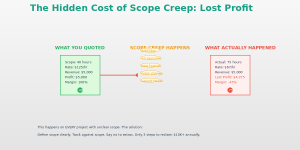
Example 1: The Website Redesign
Original Quote: $5,000
Timeline: 2 weeks
Estimated hours: 40 hours
Hourly rate implied: $125/hour
What Actually Happened:
✓ 5 pages (as promised)
✓ 15 revisions (quoted 10, they asked for 5 more)
✓ Blog addition (not in original scope)
✓ SEO optimization (not in original scope)
✓ 3 new feature requests mid-project
✓ Color scheme change request (after 80% complete)
Actual Time Spent: 75 hours
Actual Hourly Rate: $5,000 ÷ 75 = $66.67/hour
Lost Profit: 35 hours × $125 = $4,375
Effective Discount Given: 47% (you essentially gave away half your profit)
The Hidden Costs
Beyond lost profit, scope creep costs you:
- Stress and frustration: Working longer for same pay
- Resentment: You start resenting the client
- Quality drops: You rush to get done, quality suffers
- Opportunity cost: Time on this project = time away from better-paying work
- Delayed other projects: You miss deadlines on other client work
- Difficult client relationship: Future projects become painful
Defining Scope Clearly From the Start
The best time to prevent scope creep is before you start. In the proposal and contract.
The Scope Definition Framework
1. What IS included
Be specific. Not “website design.” Instead: “Homepage, About page, Services page, Contact page, Blog landing page. Each page includes hero section, feature sections, and footer.”
2. What IS NOT included
This is critical. Explicitly state what’s excluded: “Does NOT include: Blog posts, SEO copywriting, logo design, photography, database setup, e-commerce functionality, advanced integrations.”
3. Number of revisions
“2 rounds of revisions per page, up to 3 changes per revision. Additional revisions: $200/round.”
4. Timeline and milestones
“Week 1: Discovery and wireframes. Week 2: Design mockups. Week 3: Development. Week 4: Testing and launch.”
5. Change management process
“Any requests beyond original scope will be documented and quoted separately. Approval required before work begins.”
The Scope of Work Document
SCOPE OF WORK DOCUMENT
PROJECT: [Project Name]
CLIENT: [Company Name]
EFFECTIVE DATE: [Date]
PROJECT COST: $[Amount]
TIMELINE: [Start Date] to [End Date] ([X weeks])
DELIVERABLES (INCLUDED):
✓ [Specific deliverable 1]
✓ [Specific deliverable 2]
✓ [Number] revisions per deliverable
✓ [Weekly/bi-weekly] status updates
✓ [Specific format] of final deliverables
NOT INCLUDED:
✗ [Service/feature not included]
✗ [Service/feature not included]
✗ Additional revisions beyond [X]
✗ [Timeline/scope item not included]
REVISION POLICY:
• [Number] rounds of revisions included
• Up to [X] change requests per round
• Additional revisions: $[Amount]/hour or $[Amount]/revision
CHANGE MANAGEMENT:
Any requests outside original scope must be submitted in writing. A new quote will be provided before work begins. Client approval required. No work on out-of-scope items until agreed in writing.
TIMELINE:
• [Date]: Project begins
• [Date]: Milestone 1 due
• [Date]: Milestone 2 due
• [Date]: Final delivery
PAYMENT:
[Payment terms – typically 50% upfront, 50% on delivery]
By signing below, client agrees to this scope.
Red Flags During Projects
Even with a clear scope, clients sometimes push boundaries. Watch for these red flags:
Red Flag 1: “Just one more thing”
Response: “That’s outside our original scope. I can add it for $[price], or we can add it to the next phase.”
Red Flag 2: “I thought that was included”
Response: “I see the confusion. Let me show you where it says [what’s included]. This task is actually [out of scope/requires additional investment]. Let’s discuss options.”
Red Flag 3: They keep adding features mid-project
Response (after 2nd additional request): “I notice we’re adding items regularly. Let’s pause and discuss. We can document these as Phase 2 items, quote them separately, and deliver them after this phase is complete.”
Red Flag 4: Revision requests are getting extensive
Response (after hitting limit): “We’ve used all [X] included revisions. Additional rounds are [additional cost]. Would you like to proceed, or would you prefer to finalize with current version?”
Red Flag 5: Timeline keeps slipping because they’re slow to provide feedback
Response: “I’ve noticed feedback is taking [X days]. To stay on timeline, I need feedback within [Y hours] of submission. Otherwise, we’ll need to adjust the delivery date.”
How to Say No (Without Losing the Client)
The key is framing it as a business process, not rejection.
The Formula
Step 1: Acknowledge the request
“I love that idea. It’s a great addition.”
Step 2: Explain why it’s out of scope
“But it’s outside our original scope. Here’s what our scope includes: [list]. What you’re asking for is: [describe].”
Step 3: Offer options
“Here are your options: (1) We can add it for $[price]. (2) We can add it as Phase 2 after this launches. (3) We can skip it and finalize now.”
Step 4: Make the decision easy
“What works best for your timeline and budget?”
Example
Client: “Can you also build an email signup form on the homepage?”
You: “Great idea! That would increase signups. That’s actually not in our original scope—our scope includes the homepage layout and basic design. An email form with integration would require additional work—approximately [X hours]. I can add it for $[price], or we can prioritize it for Phase 2 after launch. Which would you prefer?”
Why this works:
✓ Validates their idea (shows you care)
✓ Explains the boundary (it’s about scope, not your willingness)
✓ Provides options (not “no”)
✓ Gives price (allows informed decision)
Handling Scope Change Requests
Even with clear scope, clients will ask for changes. Have a process.
The Change Request Process
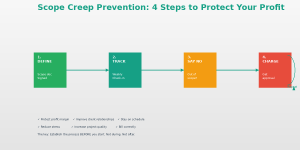
Step 1: Document in writing
“Can you send me a written request for this change? Include what you want changed and why.”
Step 2: Assess impact
“This will require approximately [X hours]. It impacts [timeline/other features]. Cost would be $[amount].”
Step 3: Get approval
“Can you approve the cost and timeline impact before I start?”
Step 4: Update timeline/contract
“New deadline is now [date]. I’ve updated your timeline above.”
Never do work without approval first
This is critical. If you do work first and ask permission later, you’ve already committed the time. You’ll be more tempted to accept the scope creep rather than demanding payment.
Critical Rule: Get written approval for additional scope BEFORE starting work. If client says “just start and we’ll figure out payment later,” walk away or charge them when it’s complete.
Protecting Your Retainers From Creep
Retainers are especially vulnerable to scope creep because there’s no defined endpoint.
How Retainer Creep Happens
“You have 20 hours/month. Can you…” keeps expanding until you’re doing 35 hours of work for 20 hours of payment.
How to Prevent It
1. Define scope clearly in retainer agreement
“20 hours/month includes: 2 blog posts, 10 revisions, weekly calls. Does NOT include: new features, design work, integrations.”
2. Track hours weekly
“This week: 5.5 hours. Remaining: 14.5 hours.” Let them see the balance.
3. Have a conversation at 80% hours used
“You’re at 16 hours of your 20. Current requests would take about 6 hours. Want to increase retainer or save these requests for next month?”
4. Be strict about overages**
“You’re over 20 hours. Additional work is billed at $[rate]/hour. Approve before I proceed?”
Building Buffers Into Timelines
A small buffer prevents major problems when scope creep happens (and it will).
The Buffer Strategy
When you estimate 2 weeks for a project, quote 2.5 weeks and charge based on 2 weeks.
This gives you:
- Buffer for unexpected requests (small scope creep absorbed)
- Buffer for client delays (slow feedback, missing information)
- Buffer for quality improvements (you can refine work)
- Space to stay sane (not working nights to hit deadline)
If no scope creep happens, you finish early. Client is happy. You have breathing room.
Also Read: Getting Testimonials and Case Studies: Build Powerful Social Proof That Wins Clients
Setting Client Expectations (The Preemptive Strike)
The best way to prevent scope creep is to educate clients upfront about how you work.
In Your Proposal, Include:
“How Change Requests Work”
“This project has a defined scope. If you want to add features or make changes beyond the original scope, we handle this through a simple change request process. You submit the request in writing, I provide a quote and timeline impact, you approve, and then we proceed. This keeps projects on track and prevents surprises.”
“Revision Policy”
“You get [X] rounds of revisions. Each round includes up to [Y] changes. This allows collaboration while protecting project timeline. Additional revisions are billed at [rate].”
“Timeline Protection”
“To hit the [date] delivery date, I need your feedback by [date]. If feedback is delayed, the delivery date shifts. This protects quality and fairness for both of us.”
The Scope Creep Prevention Checklist
- ☐ Detailed scope document created and approved before starting
- ☐ Explicitly stated what’s NOT included
- ☐ Revision limits defined and documented
- ☐ Timeline with milestones created
- ☐ Change management process explained to client
- ☐ Hourly or hourly overage rates specified
- ☐ Communication frequency established (weekly updates)
- ☐ Red flags identified and response template created
- ☐ Buffer time built into estimate (without charging for it)
- ☐ Contract signed with clear scope
The Scope Mastery Truth: Every project that goes over budget can be traced back to unclear scope. Stop allowing scope creep and you instantly become more profitable. Your hourly rate doesn’t change—your actual earnings do.
Your next move: Review your last 3 projects. How much scope creep happened on each? What could have been different at the start?
About The Author
