
Freelance Contracts That Actually Work: Templates & Protection Strategies

Why Freelancers Without Contracts Get Taken Advantage Of
Freelance Contracts That Actually Work: Templates & Protection Strategies. A client says “we’re all friends here, we don’t need anything formal.” Six months later, they haven’t paid you, they’re demanding endless revisions, and they’re claiming ownership of your work.
Contracts aren’t about being unfriendly. They’re about being clear. Contracts protect both you and the client by making expectations explicit. When something goes wrong—and something always goes wrong—a contract is the difference between resolving it quickly or getting taken to small claims court.
Most freelancers either have no contract or use a generic template that doesn’t actually protect them. Bad clients exploit this. They negotiate terms verbally, then claim you agreed to something you didn’t.
This guide covers the exact contract structure that protects your business, the essential clauses every freelancer needs, red flags in client contracts, how to negotiate terms confidently, and ready-to-use templates you can adapt for your specific work.
The Contract Truth: 73% of freelancers experience payment disputes. Most could be prevented with a simple written agreement. A five-minute contract saves you from five-month headaches.
Also Read: Freelance Networking Playbook: Build Your Referral-Based Business
What a Contract Actually Does
A contract isn’t a legal document meant to intimidate. It’s a mutual agreement that clarifies exactly what will happen and what happens if something goes wrong.
Your Contract Accomplishes Three Things:
1. Clarity: Both parties know exactly what you’re doing, when it’s due, what’s included, and what’s not. No surprises.
2. Protection: If the client disputes payment or scope, you have written proof of what you agreed to. This protects both of you.
3. Professional Credibility: Clients who are serious about their business expect a contract. The absence of one makes you look inexperienced or unprofessional.
The 12 Essential Contract Elements
Every freelance contract should include these twelve sections. If any are missing, you’re exposed to risk.
Element 1: Project Description & Deliverables
What to include: Exact description of what you’re delivering. Not “website design” but “5-page website with custom design, mobile responsive, including navigation menu, blog section, and contact form.”
Why it matters: This prevents scope creep. If the client later asks for something not listed, you can point to this section and charge extra.
Element 2: Acceptance Criteria
What to include: How will the client know it’s done? What does “complete” look like?
Example: “Project is considered complete when: (a) all deliverables meet technical specifications, (b) client approves final version, (c) all revisions are incorporated.”
Element 3: Timeline & Milestones
What to include: Start date, milestone dates, and final delivery date. Not “end of month” but “December 15, 2026.”
Why it matters: Prevents clients from saying “you took too long” when dates were never specified.
Element 4: Total Project Fee
What to include: Exact total amount client will pay. Whether it’s $2,000 flat or $50/hour for 40 hours, state it clearly.
What NOT to include: Open-ended pricing like “to be determined” or “we’ll figure it out later.”
Element 5: Payment Schedule
What to include: When payments are due. Examples:
- 50% upfront, 50% upon completion
- Three equal payments: upon signing, at midpoint, upon delivery
- 100% upfront (for projects under $1,000)
- For ongoing work: Net 15 (due within 15 days of invoice)
The standard that protects you: 50% deposit before starting work prevents clients from disappearing after you’ve invested time.
Element 6: Late Payment Clause
What to include: What happens if client doesn’t pay on time.
“Invoices are due on the date specified. If payment is not received within 15 days of invoice date, a late fee of 1.5% per month (18% annually) will be charged. Additionally, work will be paused until payment is received.”
Element 7: Revision Policy
What to include: How many rounds of revisions are included in the price? What happens after that?
“The project fee includes up to 2 rounds of revisions. Additional revisions beyond 2 rounds are billed at $75 per hour.”
Element 8: Change Order Policy
What to include: How scope changes are handled. Can the client just ask for more work, or do they need to request it formally?
“Any changes to the original scope of work must be submitted in writing as a change order. Approved change orders will result in adjusted timeline and/or fee. No changes will be implemented without written approval.”
Element 9: Intellectual Property Rights
What to include: Who owns the work after delivery? Does the client own it fully, or do you retain certain rights?
Standard language: “Upon receipt of full payment, the client owns all deliverables and the exclusive right to use them. The freelancer retains the right to use the work as a portfolio sample unless the client explicitly requests confidentiality.”
Element 10: Confidentiality
What to include: Both parties agree not to share confidential information about the project, pricing, or business relationship.
Element 11: Termination & Cancellation
What to include: What happens if someone wants to end the project?
“Either party may terminate this agreement with 5 days written notice. If client terminates, they owe payment for all work completed to date plus 25% of remaining contract value.”
Element 12: Dispute Resolution
What to include: If there’s a dispute, how will it be resolved? Arbitration or court?
Pro-freelancer language: “Any disputes arising from this agreement will be resolved through binding arbitration in [your location]. The prevailing party will be reimbursed for legal fees.”
Scope of Work (The Most Important Section)
Scope creep—where projects expand beyond the original agreement—is the biggest freelancer complaint. A clear scope of work prevents this.
What a Good Scope Looks Like
PROJECT SCOPE OF WORK
DELIVERABLES: – 5-page website with custom Figma designs – Mobile-responsive layout tested on iOS and Android – Contact form with form validation – Blog section with 5 sample posts – Integration with Mailchimp email signup – SSL certificate installation – Monthly updates for 3 months post-launch
NOT INCLUDED (Client will pay extra for): – Logo design – Product photography – Video production – E-commerce functionality – SEO optimization beyond basic setup – Third-party integrations beyond Mailchimp – Hosting or domain registration
TIMELINE: – Design approval: December 15, 2026 – Development complete: January 15, 2027 – Final revisions: January 22, 2027 – Launch: January 29, 2027
The “not included” list is crucial. It prevents clients from assuming everything is included.
Payment Terms That Protect You
Payment terms are how you get paid. Weak payment terms lead to late payments, non-payments, and disputes.
The Payment Schedule That Works (For 80% of projects)
50% Deposit Upon Signing
This shows the client is serious and gives you runway to start work.
25% at Midpoint
Confirms the project is on track before you’ve invested full time.
25% Upon Delivery
Final payment when work is complete and delivered.
Why this works: You’re never more than one payment period behind. If the client disappears after 50%, you’ve lost time but not money.
For Hourly Projects (Retainers, Ongoing Work)
Monthly retainer invoiced upfront (e.g., January 15 for January work)
Net 15 payment term (due by January 31)
Late fee of 1.5% per month if not paid by due date
For Smaller Projects (Under $1,000)
50% upfront, 50% upon delivery
OR
100% upfront (best option)
Clients expect this for small work and it eliminates dispute risk.
Revision & Change Order Policy
Revisions are the main source of scope creep. Without a clear policy, clients can ask for unlimited changes.
The Revision Policy Template
REVISION POLICY
The project fee of $[amount] includes [X] rounds of revisions/feedback cycles. Each revision round includes feedback on the current deliverable; revisions will be implemented and returned for approval within [X] business days.
Revisions are defined as: tweaks to design, copy edits, layout adjustments, color changes, etc.
Work that significantly changes the original scope (additional pages, new features, major redesigns) is not considered a revision and will be billed separately as a change order at $[hourly rate].
Revision requests must be submitted in writing. Verbal feedback will not be implemented. The client has [7 days] from receiving revisions to provide feedback for the next round.
The key phrase: “Significant scope changes are billed separately.” This prevents unlimited work on a fixed-price project.
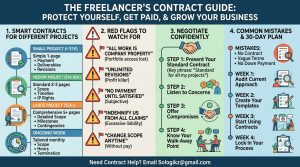
Different Contracts for Different Projects
You don’t need one massive contract. Use simpler contracts for small projects, comprehensive ones for large projects.
| Project Type | Project Size | Contract Complexity | Key Focus |
|---|---|---|---|
| Small one-off (logo, article, landing page) | Under $1,000 | Simple (1 page) | Payment terms, deliverables, revisions |
| Medium project (website, brand identity) | $1,000-$5,000 | Standard (2-3 pages) | Scope, timeline, payment schedule, IP rights |
| Large project (full rebrand, platform build) | $5,000+ | Comprehensive (5+ pages) | All elements, detailed scope, milestones, contingencies |
| Ongoing/retainer work | Monthly recurring | Tailored (2-4 pages) | Scope, monthly hours, payment terms, termination, adjustment clauses |
Red Flags in Client Contracts
Sometimes clients provide their own contracts. Before signing, watch for these red flags that are bad for freelancers.
“All work is property of the company”
This means you can’t use anything as portfolio samples. Counter with: “Client owns final deliverables. Freelancer retains right to use as portfolio sample unless explicitly marked confidential.”
“Unlimited revisions”
This is a cost killer. Specify: “Up to 3 revision rounds; additional revisions billed at $X/hour.”
“No payment until we’re satisfied”
“Satisfied” is subjective. Replace with: “Payment due [date]. Final approval required within [X days] of delivery.”
“Indemnify us against any claims”
This makes you liable for things beyond your control. Limit to: “Freelancer indemnifies for work that infringes third-party IP rights.”
“We can change the scope anytime”
Without compensation. Add: “Scope changes must be approved in writing and may result in timeline/fee adjustments.”
“No deadline specified”
This means they can drag it out forever. Insist: “Final deadline is [specific date]. Work will be considered complete by this date.”
Negotiating Contract Terms Confidently
Clients often push back on contract terms. Here’s how to negotiate without losing the project.
The Negotiation Framework
Step 1: Present Your Standard Contract Confidently
“I use a standard contract for all projects—it protects both of us. Here are the terms. Please review and let me know if you have questions.”
Key phrase: “Standard for all my projects.” This prevents them from thinking you’re difficult. It’s just your process.
Step 2: Listen to Their Concerns
They might say “we need unlimited revisions” or “we need to own everything.” Understand why.
Step 3: Offer Reasonable Compromises
If they want unlimited revisions: “We can include 3 revision rounds, or I can add 4 hours of revision time at my hourly rate.”
If they want to own everything including portfolio rights: “They own the final deliverables. I retain rights to show it as a case study with client name included.”
If they want a long payment term: “I invoice Net 15. For longer terms, I can adjust the project fee by [amount] to account for the extended cash flow impact.”
Step 4: Know Your Walk-Away Point
Some clients aren’t worth the compromise. If they demand:
- Unlimited revisions with no time cap
- Payment only after they’ve used the work for 30 days
- Complete work ownership including portfolio rights
- No down payment for a project over $2,000
Walk away. These are patterns that predict difficult relationships.
Ready-to-Use Contract Templates
TEMPLATE 1: Small Project Contract (Under $1,000)
═══════════════════════════════════════════════════
FREELANCE SERVICE AGREEMENT
═══════════════════════════════════════════════════
This agreement is entered into between [YOUR NAME] (“Freelancer”) and [CLIENT NAME] (“Client”).
PROJECT: [Project Description]
DELIVERABLES: [Exact list of what you’re delivering]
TOTAL FEE: $[Amount]
TIMELINE: Start [date] – Delivery [date]
PAYMENT TERMS:
– 50% ($[amount]) due upon signing this agreement
– 50% ($[amount]) due upon delivery
REVISIONS:
The fee includes 2 rounds of revisions. Additional revisions are $[hourly rate]/hour.
INTELLECTUAL PROPERTY:
Upon receipt of full payment, client owns all deliverables. Freelancer retains the right to use the work as a portfolio sample.
LATE PAYMENT:
Invoices are due on the date specified. If not paid within 10 days, project will be paused and a 1.5% monthly late fee will apply.
Agreed to and accepted:
Freelancer: _________________ Date: _______
Client: _________________ Date: _______
═══════════════════════════════════════════════════
TEMPLATE 2: Retainer/Ongoing Work Contract
═══════════════════════════════════════════════════
MONTHLY RETAINER AGREEMENT
═══════════════════════════════════════════════════
MONTHLY RETAINER FEE: $[Amount]
HOURS INCLUDED: [X] hours per month
MONTHLY DELIVERABLES: [list specific outputs]
SERVICES INCLUDED:
– [service 1]
– [service 2]
– [service 3]
SERVICES NOT INCLUDED (Billed Extra at $X/hour):
– [excluded service 1]
– [excluded service 2]
PAYMENT: Monthly invoice sent on the 1st, due by the 15th.
Late Fee: 1.5% per month if payment not received by due date.
TERM: This agreement continues month-to-month. Either party may terminate with 15 days written notice. Final month’s retainer is not refundable if terminated early.
Agreed to and accepted:
Freelancer: _________________ Date: _______
Client: _________________ Date: _______
═══════════════════════════════════════════════════
Common Contract Mistakes Freelancers Make
Mistake 1: Having No Contract
The risk: 73% of payment disputes happen when there’s no written agreement.
The fix: Use a simple contract for every project, even small ones.
Mistake 2: Contracts That Are Too Vague
The risk: Client says “I thought that was included” because you never specified.
The fix: Be specific about what’s included and what’s not.
Mistake 3: No Down Payment
The risk: Client disappears after you’ve invested 30 hours of work.
The fix: Require 50% down before starting work.
Mistake 4: Unlimited Revisions
The risk: Client keeps requesting changes, eating into your profit margin.
The fix: Specify revision rounds and charge hourly for extras.
Mistake 5: Vague Timeline
The risk: Client says you’re late when no deadline was ever set.
The fix: Use specific dates, not “end of month.”
Also Read: Freelance Time Management: Earn More While Working Less (The System That Works)
30-Day Contract Implementation Plan
Week 1: Audit Your Current Approach
- Day 1: Review your last 5 projects. Do you have written agreements for all of them?
- Day 2: Identify payment issues you’ve faced (late payments, scope disputes)
- Day 3: List which contract elements you’re currently missing
- Day 4: Research templates online (or use the ones in this article)
- Day 5-7: Draft your standard contract based on your typical project
Week 2: Create Your Templates
- Day 8: Create small project contract (under $1,000)
- Day 9: Create medium project contract ($1,000-$5,000)
- Day 10: Create large project contract ($5,000+)
- Day 11: Create retainer/ongoing work contract
- Day 12-14: Customize templates to match your exact services and terms
Week 3: Start Using Contracts
- Day 15: Send contract template to next prospect who inquires
- Day 16: Practice your pitch for presenting the contract
- Day 17: Handle any negotiation pushback with confidence
- Day 18: Get signed contract before starting any work
- Day 19-21: Use contracts on all new projects this week
Week 4: Lock In Your Process
- Day 22: Create a contract checklist (what to verify before starting)
- Day 23: Store contracts in organized folder (email or cloud)
- Day 24: Set reminder to send contract within 24 hours of project inquiry
- Day 25: Create payment tracking system (invoice dates, due dates, received dates)
- Day 26-30: Continue using contracts consistently on all projects
30-Day Results to Expect: Standard contracts for all project types. Confidence in presenting contract terms. Reduced payment disputes. Paper trail protecting your business. Clear expectations with clients from day one.
Final Thought
A Contract Is a Gift, Not a Threat
Position contracts correctly and clients will respect them. Don’t say “I have to protect myself.” Say “This is my standard process—it protects both of us by making expectations clear.”
Good clients appreciate clear agreements. Bad clients resist contracts. Guess which type of client you want to work with?
About The Author
