
How to Say No to Clients (Without Losing Sleep)
The Fear That Keeps Freelancers Broke and Burned Out
How to Say No to Clients (Without Losing Sleep). A client asks you to take on a project. It’s outside your expertise. The budget is 40% below your rate. The timeline is insane. They’ve been difficult before.
But you say yes anyway.
Why? Because you’re afraid. Afraid they’ll hire someone else. Afraid you’ll lose the income. Afraid they’ll leave a bad review. Afraid they’ll tell others not to hire you.
So you take the project. It’s a nightmare. They change the scope 12 times. They don’t pay on time. They demand endless revisions. You work 80 hours for what should have been 20.
By the time it’s done, you’ve lost money, lost sleep, and lost respect for yourself.
The freelancers making $5,000+ per month aren’t smarter than you. They just say no more often. And they sleep better because of it.
This guide teaches you the exact framework for saying no confidently, the scripts to use without guilt, how to identify which projects to decline, and the boundaries that protect your sanity and income.
The No Paradox: The more you say no to bad opportunities, the more good opportunities find you. Scarcity disappears when you stop accepting everything.
Why Saying No Is Saying Yes to Success
The Math of Saying No
When you say yes to a bad project, you’re saying no to:
- Your time (spent on low-paying work)
- Better clients (they can’t reach you, you’re booked with bad projects)
- Rest (you’re stressed and exhausted)
- Growth (you’re not learning or improving)
- Income (you’re undercharging and overworking)
When you say no to a bad project, you’re saying yes to:
- Your time (available for better clients)
- Better clients (they see you’re selective, therefore valuable)
- Rest (lower stress, better sleep)
- Growth (time to improve your skills)
- Income (available for higher-paying work)
The Opportunity Cost Is Real
When you’re booked with a $30/hour project for 40 hours, you can’t take the $75/hour project that needs those 40 hours.
The math: $30/hour × 40 hours = $1,200 (bad project)
vs. $75/hour × 40 hours = $3,000 (better project)
Lost opportunity: $1,800
Saying no to the $1,200 project isn’t a loss. It’s protecting a $3,000 opportunity you don’t even know about yet.
What Projects to Decline (The Decline Matrix)
| Project Type | Decision | Why |
|---|---|---|
| Low pay + High difficulty | DECLINE ✗ | Worst combination. Hard work for little money. |
| Below your hourly rate | DECLINE ✗ | Trains clients to undervalue you. Trains you to accept low pay. |
| Outside your expertise | DECLINE ✗ | You’ll spend extra time learning. Client expects expert work. Recipe for disaster. |
| From a difficult client | DECLINE ✗ | Past behavior predicts future behavior. If they were difficult once, they’ll be difficult again. |
| Unrealistic timeline | DECLINE ✗ | Impossible deadlines = stress, mistakes, resentment. Not worth it. |
| Unclear scope | DECLINE ✗ | Undefined work = endless revisions. Protect yourself with clear boundaries. |
| In your expertise + Fair price | CONSIDER ✓ | Right price and right skill. Depends on other factors (client, timeline, scope). |
| From a good client + Fair price | CONSIDER ✓ | Good past experience matters. But still verify timeline and scope are clear. |
| High pay + Your expertise | ACCEPT ✓ | Best combination. Good money for work you’re good at. |
| Strategic project (portfolio, learning) | ACCEPT ✓ | Sometimes a below-rate project is worth it for portfolio or learning. But set a limit (1 per year max). |
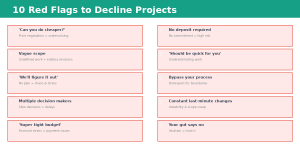
10 Red Flags That Signal “Decline This”
Red Flag 1: “Can you do it cheaper?”
Translation: “I don’t value your work.” Decline. Clients who negotiate on price become clients who demand free revisions.
Red Flag 2: Vague scope
They can’t clearly explain what they want. This means unlimited revisions. Decline.
Red Flag 3: “We’ll figure it out as we go”
Translation: “No clear plan. This will be chaotic.” Decline. Chaos wastes your time.
Red Flag 4: Multiple decision-makers
“I’ll need to check with [3 other people].” This means slow decisions and endless feedback loops. Decline.
Red Flag 5: “We’re on a super tight budget”
Combined with other red flags, this signals financial problems. Decline. Low-budget projects from struggling companies become payment disputes.
Red Flag 6: No deposit / “We’ll pay when it’s done”
They won’t invest upfront. This signals they’re flaky. Decline. Protect yourself with deposits.
Red Flag 7: “This should be quick for someone like you”
They’re underestimating the work (or your value). Decline. These clients always request extra work.
Red Flag 8: They bypass your process
They email random ideas, ignore your proposal, skip the contract. They don’t respect professional boundaries. Decline.
Red Flag 9: Constant last-minute changes
During proposal stage, they keep changing requirements. Imagine this during the actual project. Decline.
Red Flag 10: Your gut says no
Sometimes you just feel it’s wrong. Trust that feeling. Your instincts are protecting you. Decline.
Also Read: How to Raise Your Freelance Rates (Without Losing Clients)
The 3-Question Decision Framework
Before saying yes to any project, ask yourself three questions:
Question 1: Will This Pay Me What I’m Worth?
Not “will this pay me something” but “will this pay me what I’m actually worth.”
If no: Decline. Money below your rate trains clients (and you) to accept less.
Question 2: Can I Do Excellent Work?
Do you have the skills? Is the timeline realistic? Is the scope clear enough?
If no: Decline. Projects outside your expertise become expensive learning curves.
Question 3: Will Working With This Client Add Energy or Drain It?
Based on the proposal, the communication so far, the red flags you’ve noticed.
If drain: Decline. Money isn’t worth the stress.
All three must be yes. If even one is no, the answer is decline. This is your decision framework for life.
5 Scripts for Saying No
Script 1: The Professional Decline
Subject: Project Proposal – [Project Name]
Hi [Client Name],
Thank you for thinking of me for this project. I appreciate the opportunity.
After reviewing the details, I’ve determined this isn’t the right fit for me at this time. Here’s why: [specific reason — “it’s outside my current expertise,” “the timeline doesn’t align with my availability,” “it’s below my service minimum rate”].
I want to give you someone who’s the perfect fit for this work. I’d recommend [referral] — they specialize in [relevant area] and would likely be a better match.
Best of luck with the project.
[Your Name]
Script 2: The Honest No (For Close Clients)
Hi [Client Name],
I appreciate you thinking of me, but I need to be honest: this project isn’t going to work for us.
Here’s why: [specific reason]. Given that, I’d rather tell you now than struggle through the project and disappoint you.
I’m not a good fit for this one, but I’m always here if you have something that does align with my wheelhouse.
[Your Name]
Script 3: The Boundary Setting No
Hi [Client Name],
I appreciate the opportunity, but I need to be clear about something: I’m not available to take on new work at this time.
My current clients require my full attention, and I want to maintain the quality I’m known for. Once I have capacity, I’ll reach out.
I’ll be back in the market around [month]. If you’re still interested then, let’s reconnect.
[Your Name]
Script 4: The Rate Negotiation No
Hi [Client Name],
Thanks for the project proposal. I see your budget is $[X].
My rate for this type of work is $[higher amount]. I understand that might be outside your budget, so I totally get if you move forward with another option.
If your budget can accommodate my standard rate, I’m absolutely interested. Otherwise, I’d recommend [referral] who may be more aligned with your budget.
Either way, no hard feelings!
[Your Name]
Script 5: The Red-Flag No (When Something Feels Off)
Hi [Client Name],
I’ve given this a lot of thought, and I don’t think I’m the right person for this project.
A few things during our conversations made me realize this might be challenging: [if comfortable, mention specific concerns: vague scope, multiple stakeholders, timeline concerns]. Rather than commit and potentially disappoint, I’d rather be honest now.
I wish you the best with the project, and I’m here if anything changes.
[Your Name]
The Psychology of “No Guilt”
The Guilt Myth
You think saying no is selfish. You think you’re letting them down. You think they’ll hate you.
Here’s the truth: Professional clients respect the word “no” more than they respect “yes” followed by mediocre work.
When you say no, you’re doing them a favor. You’re telling them upfront instead of struggling through the project and delivering subpar work.
Reframe “No”
Old frame: “I’m rejecting this opportunity.”
New frame: “I’m protecting the quality this client deserves.”
Old frame: “They’ll think I’m not serious.”
New frame: “They’ll see I’m selective and therefore valuable.”
Old frame: “I’m losing income.”
New frame: “I’m freeing time for better income.”
The Professional Signal: Good clients don’t want a freelancer who says yes to everything. They want someone selective, professional, and realistic about what they can deliver.
What Happens After You Say No
Scenario 1: Client Respects It
Most professional clients will accept your decline gracefully. They might ask why, you explain briefly, they move on. Professional relationship intact.
Scenario 2: Client Pushes Back
Client: “Can we work something out?”
Your response (if you meant no):
“I appreciate that, but after thinking about it carefully, this isn’t the right project for me. I want to be honest rather than take it on and struggle. Best of luck!”
Don’t negotiate yourself into a yes. If you said no, stand by it.
Scenario 3: Client Gets Angry
Some clients will get upset. This is actually good information. It confirms you made the right choice. Difficult clients get angry when you set boundaries. Proceed with no guilt.
Setting Boundaries That Stick
Boundary 1: Scope Boundaries
Specify exactly what’s included. If it’s not in the contract, it’s not happening.
“Project includes 3 revision rounds. Additional revisions beyond 3 rounds are billed at $[hourly rate]. Out-of-scope requests require written approval and adjustment to timeline/fee.”
Boundary 2: Time Boundaries
Define work hours and response times.
“I’m available Monday-Friday, 9am-5pm [timezone]. Emails received after 5pm are answered the next business day. Emergency/rush requests are charged at 1.5x rate.”
Boundary 3: Communication Boundaries
How clients reach you and what channels you use.
“Project communication happens via email and weekly check-in calls. Ad-hoc Slack messages are not monitored. All requests go through the project management system.”
Boundary 4: Revision Boundaries
Clear revision policy (covered in Article 11, but reinforced here).
“Revision requests must be submitted in writing. Revisions are incorporated and returned within [X] business days. Simultaneous revision requests are batched and processed together.”
Boundary 5: Payment Boundaries
Clear payment terms and consequences for late payment.
“50% due before project start. 50% due upon delivery. Late payments accrue 1.5% monthly fee. Work pauses if payment is more than 10 days late.”
What to Do When Clients Violate Boundaries
First Violation: Gentle Reminder
Hi [Client Name],
Quick reminder: revision requests need to come through email [project management system]. This helps me track changes and keep everything organized.
Can you resubmit [request] through [channel]?
Thanks!
Second Violation: Firm Boundary Reset
Hi [Client Name],
I need to reset something we discussed at the start: all project communication needs to happen through [channel], not [method they’ve been using].
This isn’t about being difficult — it’s how I stay organized and ensure nothing falls through the cracks. I appreciate your understanding on this.
Going forward, all requests through [channel] will get my full attention.
Third Violation: Serious Conversation
If boundaries are repeatedly violated, this is a sign to end the project or the relationship.
Hi [Client Name],
I need to be direct about something: we agreed on [boundary], but it keeps being crossed. This is making it difficult for me to deliver my best work.
For us to continue working together, I need [boundary] to be respected going forward.
If this isn’t going to work, I’d rather be honest now so we can both move on to situations that are a better fit.
Also Read: Freelance Contracts That Actually Work: Templates & Protection Strategies
Saying No to Existing Clients
Saying no to a new client is one thing. Saying no to an existing, paying client is harder. But sometimes necessary.
Scenario: Additional Scope Request
Hi [Client Name],
Thanks for asking about [additional work]. I appreciate thinking of me.
We agreed the original project included [scope]. This request falls outside that. I can absolutely do it, but it would need to be a separate engagement at [rate].
Want me to send you a proposal, or would you like to just proceed with the original scope?
Scenario: Rush/Priority Request
Hi [Client Name],
I understand this is urgent. Unfortunately, my schedule is fully booked through [date]. I can’t take on this with the priority it deserves.
Options:
1. I can do it starting [later date]
2. Rush rate is 1.5x my standard rate — would that change things?
3. I can recommend [other freelancer] who specializes in this
What works for you?
Scenario: Scope Creep Mid-Project
Hi [Client Name],
I’ve noticed the scope has expanded since we started. The original project included [X]. We’ve now added [Y] and [Z].
At this pace, we’re going over budget and timeline. I want to deliver excellent work, but I need us to decide:
1. Reduce scope back to original agreement
2. Extend timeline and budget for new scope
3. Cut the new requests from this phase (and do them as Phase 2)
Let’s align on this so we’re on the same page.
5 Mistakes When Saying No
Mistake 1: Over-Explaining
“No” doesn’t need a 3-paragraph justification. The more you explain, the more they’ll try to argue with your reasons.
Bad: “I can’t do this because my schedule is full, and also I’m not as experienced in this area, and also the budget is low for the complexity, and also…”
Good: “This isn’t the right fit for me. Thanks for thinking of me though!”
Mistake 2: Apologizing
“I’m so sorry, but…” makes it sound like you’ve done something wrong. You haven’t. You’re being professional.
Remove: “I’m sorry, but…” and “I apologize, but…”
Replace with: “I appreciate the opportunity, but…” or just “No, this doesn’t work for me.”
Mistake 3: Leaving the Door Open When You Don’t Mean To
Don’t say “maybe later” unless you mean it. Clients will follow up in 2 weeks asking “so are you available now?”
Clear: “This doesn’t work for me.”
Wishy-washy: “Maybe in a few months?”
Mistake 4: Being Rude
You can be firm without being rude. Professional but clear beats harsh.
Rude: “I don’t work with people like you.”
Professional: “This doesn’t align with my services.”
Mistake 5: Saying Yes When You Mean No
The worst mistake. You say yes to avoid conflict, then spend weeks resenting the project. Don’t do this.
It’s okay to say “let me think about this and get back to you” to buy time. But once you decide it’s a no, say it clearly.
30-Day Boundary Implementation Plan
Week 1: Audit & Decision
- Day 1: List all current clients. Rate them 1-10 on how much you enjoy working with them.
- Day 2: Identify clients/projects below your rate or outside your expertise.
- Day 3: Create your “Decline Matrix” — which projects you’ll say no to going forward.
- Day 4: Write down your 3-question framework and post it somewhere visible.
- Day 5-7: Draft your decline scripts (customize the 5 provided).
Week 2: Practice & Preparation
- Day 8: Practice saying no out loud. It sounds awkward. That’s normal.
- Day 9-10: Identify 2-3 upcoming project inquiries where you’ll practice saying no.
- Day 11: Review your contracts. Add/strengthen your boundary clauses.
- Day 12-14: Update your project proposal with clear scope, revision policy, payment terms.
Week 3: Take Action
- Day 15: First no. New inquiry that doesn’t fit. Send decline email.
- Day 16-20: Decline 1-2 more inquiries that don’t meet your criteria.
- Day 21: Notice how it feels. (You’ll feel relieved, not guilty.)
Week 4: Boundary Setting
- Day 22: Set a boundary with one current client (could be communication channel, revision limit, etc).
- Day 23-28: Enforce that boundary when it’s tested.
- Day 29-30: Reflect on the past 30 days. How many projects did you decline? How does it feel?
Week 4 Results to Expect: Clearer boundaries. 2-4 declined projects. No regrets about declines. 1-2 clients adjusting to new boundaries. Better sleep. Less stress about the projects you did take.
Final Thought
Saying No Is Saying Yes to Your Future
Every yes to a bad project is a no to a good project. Every boundary you don’t enforce is a boundary that gets more violated.
The freelancers who are thriving aren’t taking more projects. They’re taking better projects. And the way you get better projects is by saying no to worse ones.
Start today. When the next mediocre client reaches out, use one of the scripts above. Notice that the world doesn’t end. Notice that you feel better. Then do it again.
Remember: Saying no now prevents burnout, resentment, and low-quality work later. Your future self will thank you for every professional decline you make today.
About The Author
