
How I Doubled My Freelance Income in 12 Months (Case Study)
How I Doubled My Freelance Income in 12 Months
How I Doubled My Freelance Income in 12 Months. Twelve months ago, I was stuck. My Upwork profile was solid. My work was quality. But I was making $3,500 monthly and couldn’t seem to break through. I was working more hours, not earning more money. Something had to change. This is the honest story of how I doubled my income—what worked, what failed miserably, and the exact decisions that turned it around.
The Reality Before: Stuck in the Grind
Let me be brutally honest about where I started. I had: A solid Upwork profile with 4.8 stars and 25 completed projects. A decent portfolio showing logo design, brand identity, and website projects. Consistent 5-star reviews from satisfied clients. And still, I was making $3,500 a month. That sounds decent until you do the math. I was working 50-60 hours weekly. My effective hourly rate was $18-22 per hour. For the work quality I was delivering, it was embarrassing.
The problem wasn’t the work. The problem was me. I was bidding on every logo design project that came across Upwork, charging $400-600, taking 40-50 hours per project, and wondering why I was broke. I was competing on volume instead of value. Competing on price instead of positioning. Every project felt like a gamble—would they accept my rate? Would they be a nightmare client? Would the scope creep kill my profit margin?
The worst part? I knew exactly what I was doing wrong. I just didn’t know how to stop.
Also Read: Upwork vs Fiverr vs Other Platforms: Which is Best for Your Niche?
Month 1-2: The Painful Realization
I started tracking my actual hours and revenue per project. This was the gut punch. A logo I spent 45 hours on (revisions included) paid $500. That’s $11 per hour. Another project took 30 hours, paid $450. I was literally working for fast food wages despite having years of experience and consistently excellent reviews.
I realized my mistake in real time: I was charging for deliverables, not value. A client’s business growth, brand recognition, sales impact—none of that mattered in my pricing. I just saw “logo design = $400-600” as the market rate.
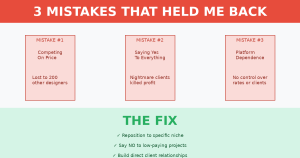
Mistake 1: Competing on price in a commoditized market. When you bid on Upwork against 200 other designers, the race to the bottom is inevitable. I was one of thousands. My only differentiation was price, and I was losing that battle too.
I had to make a decision: Keep bidding $400 logos and work myself to exhaustion, or completely change my approach. I chose differently.
Month 2-3: The Strategy Shift (First Big Change)
I did something radical. I stopped bidding on Upwork for projects under $1,500. Completely stopped. I ignored the job alerts, didn’t apply, didn’t even read them. It felt terrifying. What if I stopped getting work?
Simultaneously, I repositioned myself. Instead of “Logo Design,” my profile became “Premium Brand Identity for E-Commerce Businesses.” Instead of “I design logos,” my pitch was “I create brand identities that differentiate your business in a crowded market and justify premium pricing.” Subtle wording difference. Massive perception difference.
Turning Point 1: Repositioning and selective bidding. By being selective and specific about my niche, I started attracting different clients. Not logo hunters looking for the cheapest option, but actual business owners who valued quality and understood ROI.
The first month of selective bidding, I got two projects: one for $2,200 (brand identity package) and one for $1,800 (logo + brand guidelines). Same work quality. 4.5x higher revenue. And the clients? They were completely different. No nitpicking, no endless revisions, no negotiations about payment. They respected the work because they paid appropriate rates for it.
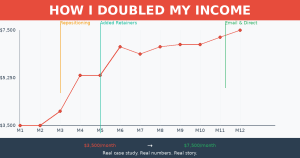
Results after Month 3: Monthly revenue: $4,100 (up from $3,500). Billable hours: 35 (down from 60). Effective hourly rate: $117/hour (up from $18/hour). Client satisfaction: Higher (fewer bargain hunters demanding changes).
Month 4-5: Building Retainers (Second Big Change)
I realized something crucial: Project-based work is exhausting. You’re constantly finding new clients, constantly negotiating rates, constantly dealing with the stress of new projects. What if I could have recurring income? One or two retainer clients paying $1,500-2,000 monthly for ongoing design work?
I approached my top 3 clients from previous projects. I sent them a personalized email: “I’ve loved working with you. Would you be interested in a retainer arrangement where I’m available [X hours/month] for design work at [rate]?” I was terrified. Two said no immediately. One said yes.
Lesson 1: Retainers solve the income stability problem. That single $1,500/month retainer was life-changing. Suddenly, $1,500 of my income was guaranteed. Predictable. I could count on it. It freed me mentally to focus on higher-quality project work instead of hustling for survival.
I kept pushing. I eventually landed two retainer clients by Month 5. That was $3,000 monthly on retainer. I only needed to land 1-2 solid project clients monthly to hit my $7,000 income target. Suddenly, the math worked.
Month 6-7: The Mistake That Cost Me
I got overconfident. I thought I’d figured it out. I told myself I could take on more retainers and more projects. I said yes to everything. By Month 6, I had three retainers, two active projects, and a nightmare client project that became my personal hell.
The nightmare project came from an Upwork client I should have rejected. Red flags everywhere: vague requirements, constantly changing scope, multiple decision-makers, demanding urgent revisions. I ignored my gut. I needed the money. The project was quoted at $2,000. It consumed 60+ hours. I made $33/hour on that disaster.
Mistake 2: Saying yes to everything to maximize income. I temporarily went backward. Revenue hit $6,800 that month, but I was working 55-60 hours weekly, mentally exhausted, and seriously considering quitting freelancing altogether.
I made the decision to walk away from that client mid-project. I refunded a partial amount, apologized, and ended it. It cost me money short-term. But it saved my sanity. More importantly, it taught me a lesson I’d read a hundred times but never truly believed: a bad client relationship isn’t worth any amount of money.
Month 8-9: Tightening Everything
I got disciplined. I implemented strict rules for myself: No new projects under $1,500. Minimum of 2 revision rounds included in quotes (after that, charge $150/revision). No emergency rush rates (discounts for urgency are backwards). Retainer clients get 4 hours weekly; if they need more, they upgrade their plan. I also started saying no more. A LOT more.
I was contacted for a $500 logo project. I said no and referred them to junior designers. A client wanted a rush job at normal rates. I declined (they came back with rush fees). A prospective client wanted 10 free concepts before choosing. I declined. Each “no” felt risky. Each “no” was essential.
Lesson 2: Boundaries create profitability. By being selective about clients, projects, and scope, I actually increased revenue. Counterintuitive? Maybe. But working 45 hours for $7,200 (with happy clients) beats working 55 hours for $6,800 (with a nightmare).
Results after Month 9: Monthly revenue: $6,900. Billable hours: 42. Effective hourly rate: $164/hour. Client satisfaction: Highest yet. Stress level: Manageable.
Month 10-12: The Final Push to $7,000+
At $6,900 monthly, I was so close. But close isn’t the goal. I needed sustainable $7,000+. I made three final moves: First, I added a third retainer client (another $1,500/month). Second, I raised my project minimum to $2,000 and my per-revision fee to $200. Third, I started a simple email newsletter sharing branding insights. Nothing fancy, just monthly tips about brand strategy, design principles, and business positioning.
That newsletter? It generated inbound inquiries. Clients finding me instead of me finding them. These were the highest-quality projects because they came pre-convinced. They’d read my insights and decided I was worth hiring.
By Month 12, I had: Three retainer clients ($4,500/month guaranteed). One solid project client per month ($2,500-3,000 monthly). Occasional newsletter-generated leads ($1,500+ monthly). Total: $7,500-8,000+ monthly. Working 40-45 hours weekly. Effective hourly rate: $175-200/hour.
Turning Point 2: Content and email as business development. The moment I stopped relying solely on platforms and started building my own audience, everything changed. Platform dependence dropped. Income stability increased. Client quality improved.
The Exact Timeline That Worked
Month 1-2: Analysis & Repositioning
Tracked all hours and revenue. Realized the problem. Completely repositioned profile and niche targeting. $3,500 → $3,500 (no revenue change yet, but setup for success).
Month 3: First Selective Bidding Results
Applied only to $1,500+ projects. Landing rate immediately improved. $3,500 → $4,100.
Month 4-5: Added First Retainers
Landed two $1,500 retainer clients by approaching existing satisfied clients. $4,100 → $5,600.
Month 6-7: Hit the Wall (And Recovered)
Overextended, took nightmare client, learned hard lesson about boundaries. Walked away from bad client. $5,600 → $6,800.
Month 8-9: Tightened Standards
Implemented strict project minimums, revision limits, raised rates. Said no frequently. $6,800 → $6,900.
Month 10-12: Email & Third Retainer
Added third retainer client ($1,500). Started email newsletter. Generated inbound leads. $6,900 → $7,500+.
Also Read: Personal Branding for Freelancers: Build Your Online Presence
What Actually Worked (And What Didn’t)
What Worked:
Repositioning into a specific niche. Saying no to low-paying projects. Building retainer relationships. Raising minimum project fees. Setting clear scope boundaries. Building an email audience. Focusing on client quality over quantity. Tracking real numbers (hours and revenue per project).
What Didn’t Work:
Trying to do more of everything. Maintaining multiple platform presence equally. Competing on price. Saying yes to every project. Working with nightmare clients. Waiting for platforms to send the perfect client. Underpricing to be “more competitive.”
What Was Neutral (But Necessary):
Upwork itself. Platforms aren’t bad—they’re just limited. They’re good for finding initial clients. But your long-term income depends on moving beyond them to retainers and direct clients.
The Real Lesson Behind the Numbers
Doubling income wasn’t about working twice as hard. It was about working smarter. It was about saying no more than saying yes. It was about believing I was worth more before I had the income to prove it. It was about understanding that clients paying low rates attract low-quality clients, which creates more problems, which consumes more time, which reduces effective hourly rate further. The downward spiral is real. But so is the upward spiral.
When you raise rates and attract higher-quality clients, those clients: Respect your expertise (fewer revisions). Pay on time (no chasing invoices). Communicate clearly (no scope creep). Trust your recommendations (no second-guessing). Value long-term relationships (retainers). Refer other premium clients (word-of-mouth leads).
The Core Realization: Income growth doesn’t come from working more. It comes from working with better clients, at higher rates, on better terms. That’s the entire equation.
What I’d Do Differently (If Starting Over)
I’d spend less time on Upwork early on. Not zero time—but I’d start building email and direct relationships immediately, not as an afterthought at Month 10. I’d say no faster to bad-fit clients. I’d raise rates sooner. I’d pursue retainers within the first 3 months instead of 4. I’d track metrics from day one instead of Month 2. I’d be more aggressive about repositioning into a specific niche rather than waiting to stumble into it.
But honestly? The mistakes taught me more than success. The nightmare client taught me about boundaries. Overextending taught me about capacity. Tracking numbers taught me about positioning. You can’t skip these lessons.
Your 12-Month Income Doubling Plan
Months 1-2: Track your time and money ruthlessly. Analyze what’s actually profitable. Reposition your profile or offering toward a specific niche. Months 3-4: Raise your minimum project rate by 30%. Stop bidding low. Land 2-3 higher-value projects. Months 5-6: Approach your best 3 clients about retainer arrangements. Land at least one. Months 7-8: Set strict boundaries. No projects under your minimum. Raise revision limits and revision fees. Say no frequently. Months 9-10: Add a second retainer. Raise project rates again. Months 11-12: Start building email audience or content. Land direct clients alongside platform work. Target 50% platform income, 50% direct/retainer income.
The numbers might differ for you—your journey might be slower or faster. But the progression? This progression works.
Alao Read: Client Communication: Red Flags and How to Handle Difficult Clients
The Uncomfortable Truth
The biggest obstacle to doubling income isn’t skill. It’s confidence. It’s the fear of saying no to a client. It’s the anxiety of raising rates. It’s the doubt about whether you’re actually worth more. But here’s what I learned: clients who pay premium rates have no problem paying them. They were never going to say yes at $400. They’re only interested in the $2,000 option. By staying low-priced, I was literally invisible to them.
There are clients actively looking for premium designers, writers, developers. They’re not on Upwork bidding wars. They’re seeing your portfolio, your email, your work samples, and deciding you’re worth premium rates without ever negotiating price. You’re invisible to them until you position yourself at a premium level and believe you deserve to be there.
That’s not confidence. That’s just clarity about your market value. The work hasn’t changed. The pricing has. The client type has. The business has become sustainable.
This is my real story. The numbers are actual. The timeline is accurate. The mistakes happened. The pivots worked. Your journey will be different, but the principles—niche down, raise rates, build retainers, say no frequently, move toward direct clients—these work consistently across every freelance niche. The question isn’t whether these strategies work. The question is whether you’re willing to implement them.
About The Author
