
Freelance Pricing Strategies: How to Charge What You’re Worth
How to Charge What You’re Worth
Published September 2026 | Read time: 9 minutes
One of the biggest mistakes new freelancers make isn’t technical—it’s financial. They undercharge. They accept the first rate offered. They watch more experienced freelancers earn triple their hourly rate and wonder what’s different. The answer? Strategic pricing. Let’s fix that.
Why Pricing Matters More Than You Think
Pricing isn’t just about earning money. It’s a signal to clients about your value, professionalism, and market position. Low pricing attracts low-quality clients, leads to scope creep, and creates burnout. Higher pricing attracts serious, repeat clients who value quality and respect boundaries.
The math is simple: if you’re charging $25/hour and working 40 hours weekly, you’ll earn $52,000 annually. If you charge $75/hour with the same hours, you’ll earn $156,000. That’s not 3x more work—it’s the same work, priced correctly.
This guide breaks down five proven pricing strategies, how to choose the right one for your situation, and how to raise your rates without losing clients.
The Five Freelance Pricing Models
Before choosing your strategy, understand the five main pricing models available to you:
Hourly Rate
How it works: You bill clients for every hour worked, typically with a minimum project fee.
- Best for: Ongoing projects, retainers, projects with undefined scope
- Advantages: Predictable income, automatic compensation for scope creep
- Disadvantages: Clients may worry about efficiency; encourages slow work
- Typical rates: $25-150/hour depending on skill level and niche
Project-Based Pricing
How it works: You quote a fixed price for the entire project, regardless of hours spent.
- Best for: Logo design, website builds, proposal writing, well-defined projects
- Advantages: Clear client expectations, rewards efficiency, easier selling
- Disadvantages: Risk of underestimating; scope creep without protection
- Typical rates: $500-5,000+ depending on complexity
Value-Based Pricing
How it works: You charge based on the value your work brings to the client, not hours or deliverables.
- Best for: Experienced freelancers; consulting; work with clear ROI
- Advantages: Highest profit potential; aligns with client success
- Disadvantages: Requires deep understanding of client’s business
- Typical rates: $2,000-10,000+ per project
Retainer Model
How it works: Client pays a fixed monthly fee for ongoing availability and work.
- Best for: Ongoing support, marketing, content creation, consulting
- Advantages: Predictable monthly income; strong client relationships
- Disadvantages: Limits availability for new clients
- Typical rates: $1,000-5,000+ monthly
Tiered/Package Pricing
How it works: You offer 3 price tiers (Bronze, Silver, Gold) with different scope levels.
- Best for: Services, freelance platforms, attracting different client types
- Advantages: Increases perceived value; attracts multiple client segments
- Disadvantages: Requires clear scope definition for each tier
- Typical rates: Bronze $500, Silver $1,500, Gold $3,000
Calculating Your Minimum Hourly Rate
Before pricing any project, know your minimum acceptable hourly rate. This becomes your foundation.
Simple Formula:
Annual Salary Goal ÷ Billable Hours Per Year = Minimum Hourly Rate
Example:
$60,000 ÷ 1,800 billable hours = $33.33/hour minimum
How to Calculate Billable Hours
Most freelancers work 40-50 hours weekly, but not all are billable. Account for:
- Administrative work (invoicing, email, proposals)
- Marketing and business development (5-10 hours/week)
- Vacation and sick days (2-3 weeks/year)
- Learning and skill development
Conservative estimate: 1,500-1,800 billable hours per year (about 30-35 hours/week)
Realistic estimate: 1,200-1,500 billable hours per year for newer freelancers
Pro tip: If you earn $60,000 and want $75,000, don’t just raise your rate 25%. You’ll work 25% more hours. Instead, increase rates and reduce low-paying clients or add a retainer to fill the gap.
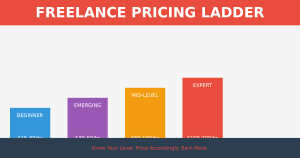
The Pricing Ladder: Know Where You Stand
Your experience, portfolio, and specialization determine your market position:
| Level | Experience | Hourly Rate | Project Typical |
|---|---|---|---|
| Beginner | 0-1 year, building portfolio | $15-30/hr | $300-1,000 |
| Emerging | 1-3 years, solid portfolio | $30-60/hr | $1,000-3,000 |
| Mid-Level | 3-5 years, proven results | $60-100/hr | $3,000-8,000 |
| Expert | 5+ years, recognized authority | $100-200/hr | $8,000-25,000+ |
| Specialist | Deep niche expertise, exclusive | $150-300+/hr | $25,000-100,000+ |
Where do you fit? Be honest. Clients smell false confidence. If you’re emerging but pricing like an expert, you’ll get rejected. If you’re mid-level but pricing like a beginner, you’ll attract penny-pinchers.
Pricing Strategy by Freelance Type
Logo & Brand Design
High competition market—pricing strategy matters enormously.
Beginner approach: $300-800 per logo
Better approach: $1,500-3,000 with 3 concepts, revisions included
Pro approach: $3,000-8,000 including brand guidelines, colors, fonts
Key insight: Most designers undercharge because they charge for deliverables (logo file) instead of value (brand identity that sells products).
Content & Proposal Writing
Project-based pricing works best here.
Article/blog post: $400-1,500 depending on research, length, and publication
Proposal writing: $1,000-3,000 depending on complexity and client size
SEO-optimized content: $600-2,000 per article (higher ROI = higher price)
Key insight: Charge more if content directly generates client revenue. A proposal that wins a $50,000 contract justifies a $3,000 fee.
Copywriting & Marketing
Retainer or value-based pricing yields best results.
Hourly: $50-150/hour
Retainer: $1,500-5,000/month for ongoing work
Performance-based: Percentage of sales generated (5-15%)
Key insight: If your copy generates sales, ask for a piece of that success through performance-based fees.
Common Pricing Mistakes (And How to Avoid Them)
First Mistakes: Charging by Deliverables Instead of Value
Wrong: “I’ll write a logo for $300.”
Right: “I’ll create a complete brand identity that positions your business as premium, justifying higher pricing.”
Second Mistakes: Accepting the First Rate Offered
Clients will always lowball. It’s their job. You need to counter-offer confidently. Research market rates first, then counter with reasons why you’re worth the premium.
Third Mistakes: Not Factoring in Revisions
Always include revision limits in project quotes (e.g., “2 rounds of revisions included”). After that, charge hourly or additional fees. This protects your profit margin.
Forth Mistakes: Underestimating Scope
Add 20-30% buffer to initial time estimates. Scope creep is inevitable. Build in breathing room.
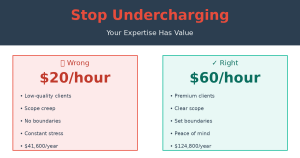
The Hidden Cost of Low Pricing: When you charge $20/hour, you attract clients who bargain-hunt, don’t value quality, and demand unpaid revisions. You’ll work twice as hard for half the money. Raise your prices. Lose the bad clients. Gain peace and profit.
How to Raise Your Rates Without Losing Clients
1st Strategy: Implement Rate Increases Gradually
- Increase rates by 10-20% annually, not 50% overnight
- New clients get new rates; existing clients stay on old rates (for now)
- After 3-6 months, notify existing clients of the increase
2nd Strategy: Create “Premium” Tiers
Don’t raise rates on your main service. Create premium options instead:
- Standard: $1,500 (3 concepts, 2 revisions)
- Premium: $3,000 (5 concepts, unlimited revisions, fast turnaround)
Existing clients stay on standard pricing. New clients often choose premium for the extra benefits.
3rd Strategy: Specialize and Raise Value
Instead of “logo design,” offer “luxury brand identity for e-commerce.” Specialization justifies 3-5x higher rates.
4th Strategy: Retainers Replace Projects
Stop taking one-off projects at low rates. Transition to retainer clients instead.
- Retainers = predictable income + higher total earnings
- Easier to justify premium pricing
- Stronger client relationships
5th Strategy: Add Value, Not Hours
If clients resist rate increases, don’t work more hours. Add value instead:
- Faster turnaround time
- Strategy consulting included
- Performance reporting and optimization
- Quarterly strategy reviews
Script for rate increases: “Due to increased demand and specialized expertise, my rates are moving to $[new rate] for new projects starting [date]. I’ll keep your existing rate at $[old rate] for 3 more months as a thank you for your loyalty. After that, we’ll transition to the new rate structure.”
Platforms vs. Direct Pricing
On Freelance Platforms (Upwork, Fiverr)
- Beginners: $15-30/hour or $200-800/project
- Platforms take 10-20% commission, reducing effective rate
- Build portfolio here, then move to direct clients
Direct Client Work
- Same skill, 20-50% higher rates (no platform fees)
- Better for long-term income stability
- Relationship-based = easier to raise rates
Example: $50/hour on Upwork (after 20% fee) = effective $40/hour
Same freelancer on direct work: $75/hour = $75 effective
One direct client at $3,000/month > three Upwork clients at $1,200/month each
Your 30-Day Pricing Action Plan
- Day 1-2: Calculate your minimum hourly rate using the formula above
- Day 3-4: Research what freelancers at your level charge (check Upwork, local rates, industry benchmarks)
- Day 5-7: Audit your current clients. Identify which 20% generate 80% of your happiness
- Day 8-10: Create 3 pricing tiers for your service (Bronze, Silver, Gold)
- Day 11-14: Update your rates on all platforms and in your proposals
- Day 15-21: Start quoting new clients at the higher rate. Track acceptance/rejection
- Day 22-30: Reach out to 2-3 most valuable clients about upgrading to new rates or retainers
The Confidence Factor
Here’s what most guides won’t tell you: your ability to hold your price depends entirely on confidence. Clients sense hesitation. They negotiate aggressively when they smell doubt.
If you quote $2,000 and seem apologetic about it, they’ll counter at $1,200. If you quote $2,000 and explain the value clearly, they often accept it immediately or negotiate down only 10-15%.
Your price communicates your belief in your own value. Set it high. Defend it respectfully. Let poor-fit clients walk away. The ones who say yes will respect you and pay on time.
Final Thoughts
Pricing isn’t about greed. It’s about sustainability. Low rates lead to burnout, poor client relationships, and constant stress about money. Higher rates attract better clients, create breathing room for quality work, and let you build a sustainable, enjoyable freelance business.
You don’t have to raise your rates all at once. Start with new clients at 15-20% higher rates. Let some low-paying clients go. Build retainer relationships with your best clients. In 12 months, you’ll earn significantly more doing the same work.
Your expertise has value. Stop giving it away.
About the author: Based on years of freelance experience on platforms like Upwork, helping dozens of clients with branding, design, and content projects. This guide reflects real-world pricing strategies that have consistently helped increase income without losing quality clients.
About The Author
