
Scaling Your Freelance Business Beyond Hourly Limits
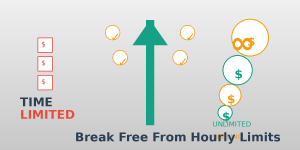
The Hourly Trap: Why You’re Leaving Money on the Table
Scaling Your Freelance Business Beyond Hourly Limits. You’re good at what you do. Really good. So you’ve optimized your hourly rate. Maybe you’ve gone from $25/hour to $50/hour to $75/hour.
Congratulations. You’ve also built a ceiling.
An invisible wall that says: “To make more money, you must work more hours.” And your body has a finite number of hours. Even if you work 10-hour days, 6 days a week, you hit that ceiling fast.
The math: $75/hour × 40 hours = $3,000/week = $156,000/year
That’s good income. But what if you wanted $300,000/year? Double your hours? Work 80 hours a week? For how long?
Here’s what you’re not seeing: Freelancers making $300K, $500K, $1M+ per year aren’t doing it with hourly rates. They’ve scaled beyond the hourly model entirely.
This guide shows you exactly how. The five proven strategies that break the hourly ceiling and let you multiply income without multiplying hours. Same result: more money. Different model: not your time.
The Scaling Paradox: The more you focus on your hourly rate, the more trapped you become by hours. The path to freedom is moving away from hourly entirely.
The Hourly Trap (And Why It Limits You)
How Hourly Rates Created a Prison
Hourly rates made sense when you started. You were building skills. You didn’t know how long projects took. Charging hourly seemed “fair.”
But as you got better, hourly rates became a trap.
Here’s why:
- Time is finite. You have 168 hours in a week. Even if you worked all of them (you won’t, you’ll burn out), that’s your ceiling.
- You get penalized for efficiency. If you get faster at a task, you make less. Get 2x faster? Make 50% less on that task. Efficiency = income reduction.
- Scale is impossible. You can’t duplicate yourself. Can’t work 200 hours a week. Can’t serve 500 clients simultaneously.
- Clients focus on price. “Can you do it for $40/hour instead of $75?” With hourly rates, everything becomes a negotiation about time.
- Income is unpredictable. Some months you’re booked. Some months, you’re not. Feast or famine cycle.
The Real Cost of Staying Hourly
Say you’re comfortable at $75/hour. That feels like success. But let’s look at 10-year cost:
| Scenario | Annual Income | 10-Year Total | Problem |
|---|---|---|---|
| Stay hourly ($75/hr) | $156,000 | $1,560,000 | Burning out after 5 years |
| Scale to hybrid model | Year 1: $180K, Year 10: $400K | $2,900,000 | Working smarter, not harder |
| Scale aggressively | Year 1: $200K, Year 10: $600K | $4,000,000 | Building a business, not trading time |
The difference between staying hourly and scaling? Over 10 years: $1.3 – $2.4 million in lost income.
Also Read: How to Say No to Clients (Without Losing Sleep)
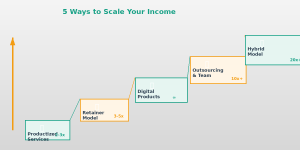
The 5 Proven Scaling Methods
These aren’t theoretical. Thousands of freelancers use these to escape the hourly trap.
| Method | Model | Effort to Set Up | Income Potential | Best For |
|---|---|---|---|---|
| Productized Services | Fixed-price packages | Medium | 2-3x hourly | Copywriters, designers, developers |
| Retainer Model | Monthly recurring revenue | Medium | 3-5x hourly | All services (predictable best) |
| Digital Products | Templates, courses, tools | High (initial) | Unlimited (passive) | Designers, developers, educators |
| Outsourcing & Team | Hire others, take markup | High (management) | 10x+ hourly | Agency-style service providers |
| Hybrid Combination | Mix of all above | Very high (complex) | 20x+ hourly | Advanced practitioners |
Method 1: Productized Services (Easiest Entry Point)
What Is a Productized Service?
Instead of “I’ll write a custom landing page for $75/hour,” you offer: “Professional Landing Page: $3,000 flat.” Fixed scope. Fixed price. Fixed timeline.
The client knows exactly what they get. You know exactly what you’re delivering. No surprises. No scope creep.
Why This Works
- Clients prefer fixed prices (no budget surprises)
- You get paid for expertise, not hours
- You can refuse scope creep (“that’s outside this package”)
- Easy to market (clear packages with benefits)
- Quick transition from hourly
The Formula
Hourly rate: $75/hr Estimated hours: 20 hours Base cost: $1,500 Add profit margin: 50% ($750) Package price: $2,250 Round up: $2,500 (looks better, easier to sell)
Real Example
Service: Blog Post Package
Includes:
- 1,500-word SEO-optimized blog post
- Keyword research
- 2 revision rounds
- Formatted for WordPress
Old model: “I charge $75/hour. This post takes 15 hours = $1,125”
New model: “Blog Post: $1,500. We handle everything. You get publication-ready content.”
Client preference? Nearly 100% prefer the productized version. Predictable. Clear. Professional.
Method 2: Retainer Model (The Predictable Income)
What Is a Retainer?
Client pays you a monthly fee. In return, they get access to your services (usually up to a set number of hours/projects per month).
Example: “$3,000/month. You get 40 hours of web design work. Can be one project or five. Your choice.”
Why Retainers Are Gold
- Predictable income. Same amount every month. Plan your life around it.
- Recurring revenue. Month 2 is automatic. You don’t have to sell again.
- Better hourly rate. $3,000/40 hours = $75/hour. But hours are variable, not fixed. Some months you do 30 hours, some 50.
- Deeper client relationships. Working with same client every month = deeper understanding = better work.
- Easier to scale. 5 retainer clients × $3,000 = $15,000/month with predictability.
The Retainer Sweet Spot
Most successful freelancers with retainers find this structure works best:
- 3-5 retainer clients. Not too many (unmanageable), not too few (unstable).
- $2,000-$5,000/month per retainer. Anywhere in this range is viable.
- Mixed hours allocation: Some months 30 hours, some 50. Averages out. Client knows this is normal.
- One “anchor” client. A large retainer ($5,000+) that covers your base expenses. Rest is profit.
Retainer Pricing Formula
Monthly retainer = (Hourly rate × 40 hours) + 30% Example: Hourly rate: $75 Base: $75 × 40 = $3,000 Add 30%: $3,000 × 1.3 = $3,900 Offer: $3,500/month (You win if average hours < 40/month)
Method 3: Digital Products & Templates (True Passive Income)
What Counts as a Digital Product?
- Email templates (Figma files)
- Canva design templates
- Spreadsheet templates (Google Sheets, Excel)
- Notion templates
- Code snippets (for developers)
- Online courses
- Stock photos or illustrations
- Plugins or tools
Why Designers & Developers Love This
You create once. It sells forever. Sell 100 copies? Make 100x. No extra hours.
Real Numbers
Figma Email Template:
- Time to create: 10 hours
- Selling price: $29
- If you sell 50 copies: $1,450 profit for 10 hours = $145/hour
- If you sell 500 copies: $14,500 profit for 10 hours = $1,450/hour
Online Course (Design Basics):
- Time to create: 40 hours
- Selling price: $97-$297 per student
- If 50 students enroll: $4,850-$14,850 profit for 40 hours
Method 4: Outsourcing & Team Building (The Agency Model)
The Principle
You don’t do the work. You manage people who do the work. You charge clients, pay team members, keep the difference.
Simple Example
You: Web design specialist
Client project: Website design ($5,000)
You outsource to freelancer: $2,000
You earn: $3,000 (project management, quality control, client relationship)
Your time invested: 5 hours (scoping, QA, client communication)
Your effective hourly rate: $600/hour
The Outsourcing Math
| Setup | You Earn | Your Time | Effective Rate |
|---|---|---|---|
| Do work yourself | $5,000 | 40 hours | $125/hour |
| Outsource 50% | $3,500 | 20 hours | $175/hour |
| Outsource 60%, manage | $3,000 | 8 hours | $375/hour |
Why This Scales
Once you hire 1 person, 2 people, then 3 people, you’re no longer limited by your personal hours. You can take on 10x the work. Earn 10x the money.
Method 5: Hybrid Combination Model (The Ultimate Scaling Strategy)
What This Looks Like
3 retainer clients: $12,000/month (120 hours/month, ~30 hours each)
2-3 productized projects: $6,000/month (30-40 hours/month)
Digital product sales: $2,000/month (passive, no time)
Total: $20,000/month (~150 hours/month working time)
Average hourly equivalent: $133/hour
But wait—the digital products don’t require ongoing hours. So realistic working hours: ~120/month = **$167/hour effective rate**.
Why The Hybrid Model Wins
- Diversified income: If one retainer ends, you have 4 other income streams
- Predictable + variable: Retainers = baseline. Projects/products = bonus
- Scalable at every level: Add retainers OR projects OR improve product sales
- Client relationships vary: Retainers keep you connected. Projects let you showcase skills.
- Income grows exponentially: As you optimize one stream, scale another
Real Case Studies (Income Transformation)
Case Study 1: Sarah (Copywriter)
Starting point: Freelance copywriter, $50/hour, $60K/year
Month 1-3: Moved to productized services ($2K per sales page)
Result: 2-3 projects/month = $4-6K/month = $60-72K/year
Month 4-6: Added first retainer (email copy, $2.5K/month)
Result: $2.5K retainer + 1-2 projects = $4.5-5.5K/month = $54-66K/year (increasing)
Month 7-12: Added second retainer ($2K/month) + maintained projects
Final result: $4.5K/month retainers + 1-2 projects = $6-7K/month = $72-84K/year
Outcome: 40% income increase. Same work hours. More predictable.
Case Study 2: Mike (Web Designer)
Starting point: Web designer, $75/hour, 40 hours/week, ~$160K/year
Year 1: Productized website packages ($4K each), started selling Figma templates ($25 each)
Result: 3-4 projects/month + template sales = $15-17K/month = $180-200K/year
Year 2: Hired first freelancer to handle smaller projects. Took markup.
Result: Managed $5-7K/month in client work. Earned $2-3K markup = $200-220K total
Year 3: Hired second person. Created Framer template course ($197).
Final result: $25-30K/month through hybrid model. Same 35 hours/week of personal work. 50-60% income increase.
How to Transition From Hourly to Scaled (Without Losing Income)
The Transition Trap
Most freelancers stay hourly because they’re afraid: “What if I switch and nobody buys my packages? I lose income.”
Smart transition: Keep hourly clients while you build scaled income.
The Safe Transition Plan
Phase 1: Keep What Works (Months 1-3)
- Keep all hourly clients (don’t disrupt income)
- Create 1 productized service (test the model)
- Market the productized service (cold outreach, portfolio)
- Goal: Get 1-2 productized clients
Phase 2: Expand Slowly (Months 4-6)
- Keep retainer clients (they’re predictable)
- Convert 1-2 hourly clients to retainers (usually possible)
- Launch digital product or second productized service
- Goal: 1 retainer + 1-2 productized services running
Phase 3: Phase Out Hourly (Months 7-12)
- Stop taking new hourly clients
- Convert or end remaining hourly relationships
- Focus on retainers + projectized work + products
- Goal: 100% non-hourly income
5 Mistakes When Scaling
Mistake 1: Scaling Too Fast
You launch 5 productized services at once. Clients buy. You can’t deliver. You burn out and go back to hourly. Don’t do this. Scale one thing at a time.
Mistake 2: Underpricing Productized Services
You think “if I charge $1,500 instead of $2,500, I’ll get more clients.” You might. But you also trained the market that you’re cheaper. Stick with the premium price.
Mistake 3: Trying to Scale Without Systems
Retainers work great until you have 5 clients all asking for urgent changes. You need systems. Templates. Processes. Build these before you scale.
Mistake 4: Outsourcing Before You Have Profitable Projects
You hire someone to help, but your projects aren’t profitable enough to absorb the labor cost. You lose money. Profitable first, outsource second.
Mistake 5: Ignoring Your Original Strength
You’re a great copywriter. You try to build products in areas you’re not expert in. They fail. Scale your core strength first.
Also Read: How to Raise Your Freelance Rates (Without Losing Clients)
30-Day Scaling Action Plan
Week 1: Audit & Decision
- Day 1: Calculate your true hourly rate (including non-billable hours)
- Day 2: Identify your most common project type (what you do repeatedly)
- Day 3: Estimate the hours for your most common project
- Day 4: Calculate a productized price (using the formula above)
- Day 5-7: Decide which scaling method suits you (productized, retainer, products, outsourcing, or hybrid)
Week 2: Foundation
- Day 8: Create a service description for your first scaled offering
- Day 9: List what’s included (specific deliverables)
- Day 10: Set a price and write it down
- Day 11: Create one case study / before-after example
- Day 12-14: Update your website or portfolio with the new offering
Week 3: Launch & Test
- Day 15: Send email to past clients about the new offering
- Day 16-20: Outreach to 10-15 potential clients with the scaled service
- Day 21: Record your first scaled project
Week 4: Optimize & Next Step
- Day 22-28: Deliver first scaled project. Get feedback. Optimize.
- Day 29-30: Plan second scaling initiative (another productized service, or launch retainer option)
30-Day Goal: Launch one scaled service offering. Make 1 sale. Prove the model works. Then scale.
The Path Forward: From Hourly to Freedom
Hourly rates got you started. They’re good for beginners. But they’re not built for growth. They’re built for trading time for money.
The freelancers making real money—the ones with freedom, predictability, and scale—moved beyond hourly years ago.
You can too. Start this month. Pick one scaling method. Test it with one client. Prove it works. Then build.
Remember: Every successful freelancer business breaks the hourly ceiling eventually. The question isn’t whether you will. It’s when you start.
About The Author
