
Upwork vs Fiverr vs Direct Clients: Which Platform Actually Makes You Money
The Platform Question Every Freelancer Faces
Upwork vs Fiverr vs Direct Clients. As a Beginner, You’re just starting out. You need clients. You see Upwork, Fiverr, Freelancer, Toptal. They all promise “connect with clients worldwide.”
But which one actually pays? Which one respects your rates? Which one keeps you out of the price war race-to-the-bottom?
Here’s what most freelancers don’t realize: different platforms serve different goals. Upwork is not better than Fiverr. Fiverr is not better than direct clients. They’re different tools for different strategies.
Some platforms keep you competing on price forever. Others attract clients who value your expertise. Some charge fees that destroy your margins. Others charge nothing but require you to bring your own clients.
The right answer depends on your skills, your rates, your availability, and your income goals. This guide breaks down exactly how each platform works, who it serves, what it costs, and whether it fits your business model.
The Reality Check: The highest-earning freelancers don’t rely on any single platform. They use a hybrid approach: a platform or two for steady income while building direct client relationships that eventually replace platform dependency.
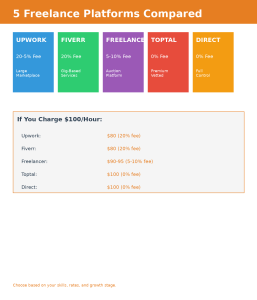
| Platform | Hourly Rate Needed | Hours/Month (160 billable) | Comments |
|---|---|---|---|
| Upwork | $62.50 | 160 | High rate needed to overcome fees. Must be repeat client for 10% rate |
| Fiverr | $62.50 | 160 | Harder to charge this much on Fiverr. Might need multiple lower-priced gigs |
| Toptal | $31.25 | 160 | Lower rate needed because 0 fees. Easier to achieve |
| Direct | $31.25 | 160 | Same rate as Toptal but you control everything. More sustainable |
The Direct Clients Strategy: How to Find and Keep Them
Direct clients are the most profitable. But how do you find them when you’re starting out?
Also Read: How to Build a Personal Brand That Attracts Premium Freelance Clients
5 Ways to Find Direct Clients:
Method 1: Referrals From Existing Clients
How it works: Do excellent work for platform clients. Ask them to refer you to other companies. Offer a referral bonus (5-10% of first project) if that motivates them.
Timeline: Slow start (weeks 1-12), then accelerates. Most sustainable method long-term.
“I’ve loved working with you. If you know anyone else who needs [your service], I’d love to help them. I offer a 10% discount on first projects for referrals.”
Method 2: Personal & Professional Network
How it works: Reach out to people you know. Friends, former colleagues, acquaintances. Let them know you’re freelancing. Ask for introductions to companies that might need your work.
Timeline: Immediate (first 2 weeks). Initial contacts should come within 30 days.
Method 3: LinkedIn Outreach
How it works: Identify your ideal client (company type, decision-maker role). Connect with relevant people. Engage with their content. Message them with a low-pressure introduction focused on helping them.
Timeline: Weeks 2-8 for initial conversations. 3-6 months to close first clients.
“Hi [Name], I notice you’re leading marketing at [Company]. I’ve been helping similar SaaS companies with [your specialty]. Thought you might find this resource useful: [link]. Happy to chat if you ever need support.”
Method 4: Content & Thought Leadership
How it works: Write articles (like you’re reading now), share insights, demonstrate expertise. People find you and reach out because they see you’re knowledgeable.
Timeline: Slow (3-6 months to see results), but generates consistent, high-quality leads.
Method 5: Warm Cold Outreach
How it works: Research companies in your niche. Find the decision-maker. Send personalized email explaining how you help companies like them. Focus on value, not your services.
Timeline: Medium (expect responses within 2-4 weeks). 10-20% response rate typical for well-executed campaigns.
Building Your Hybrid Model: Platforms + Direct Clients
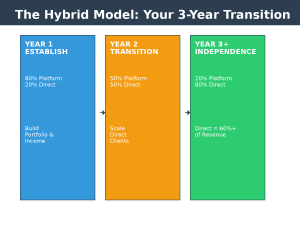
The smartest freelancers don’t choose one. They use a hybrid approach:
Year 1: Upwork/Fiverr to build portfolio, testimonials, and initial income. Simultaneously build direct client relationships and personal brand.
Year 2: Continue platform work but dedicate 30-50% energy to direct client acquisition. Scale direct clients while reducing platform dependency.
Year 3+: Direct clients become primary (60-80%). Platforms provide supplementary income and keep you sharp.
The Strategic Platform-to-Direct Transition:
Phase 1: Establish (Months 1-6)
Focus: Build portfolio and testimonials
Platform effort: 80%
Direct client effort: 20% (networking, content)
Expected: 3-5 direct client leads
Phase 2: Transition (Months 6-12)
Focus: Deepen direct client relationships, maintain platform revenue
Platform effort: 60%
Direct client effort: 40% (actively pursuing leads)
Expected: 2-3 direct clients start, replacing platform income
Phase 3: Independence (Month 12+)
Focus: Direct clients become primary revenue source
Platform effort: 20-30% (steady base income)
Direct client effort: 70-80% (growth and maintenance)
Expected: 60-70% of income from direct clients
Platform Selection Matrix: Which Platform For You?
| Your Situation | Best Platform Choice | Why |
|---|---|---|
| Complete beginner, no portfolio | Fiverr or Upwork | Build portfolio quickly. Fiverr for packaged services, Upwork for varied work |
| Experienced, strong credentials | Toptal | Get premium clients, no fees, higher rates. Worth the vetting effort |
| Want repeatable, passive income | Fiverr | Gigs work 24/7. Scale through multiple packages |
| Specialized skill (designer, dev, PM) | Toptal + Upwork | Toptal for premium clients, Upwork as secondary for volume |
| Building personal brand | Direct clients + LinkedIn | Platforms undermine brand positioning. Build directly |
| Need consistent monthly income | Mix Upwork + Fiverr | Diversify platform risk. Different client patterns |
| Hourly work preference | Upwork or Toptal | Both support hourly rates well. Toptal preferred if qualified |
| Project-based work | Upwork or Freelancer | Better for fixed-price projects. Upwork has more clients |
Also Read: 8 Red Flags That Reveal Bad Freelance Clients (Before They Waste Your Time
30-Day Platform Strategy Action Plan
Week 1: Audit Your Current Situation
- Day 1: List all platforms you’re currently on (or considering)
- Day 2: Calculate your actual net earnings on each platform (gross minus fees)
- Day 3: Identify which platform has given you best clients (easiest to work with, fewest revisions)
- Day 4: Count how many repeat clients you have on each platform
- Day 5: Assess your personal brand strength (do people know you exist outside platforms?)
- Day 6-7: Define your ideal income goal for next 12 months
Week 2: Optimize Your Platform Presence
- Day 8: Update your Upwork/Fiverr profile with stronger positioning
- Day 9: Add new portfolio pieces showing your best work
- Day 10: Request testimonials from your top 3 clients
- Day 11: Optimize your profiles for search (better titles, descriptions)
- Day 12: Apply to Toptal (if your skills qualify)
- Day 13-14: Create a portfolio website outside platforms
Week 3: Start Direct Client Pursuit
- Day 15: List 20 people you know who might refer work or hire you directly
- Day 16-17: Reach out to 10 people with warm message (no hard sell)
- Day 18: Set up LinkedIn and optimize for your niche
- Day 19: Identify 20 companies that are ideal clients
- Day 20: Research decision-makers at 5 target companies
- Day 21: Send first batch of warm cold outreach (personalized messages)
Week 4: Build Sustainable Systems
- Day 22: Create a referral template and system for asking clients for introductions
- Day 23: Plan your next 3 content pieces (articles, insights, thought leadership)
- Day 24: Draft email/phone script for direct client conversations
- Day 25: Create a simple proposal template for direct work
- Day 26: Set up basic contract template for direct clients
- Day 27-28: Commit to one direct outreach activity weekly
- Day 29-30: Reassess: Which platform performed best? Which direct leads show promise?
30-Day Results to Expect: Clearer picture of which platform serves you best. At least 2-3 direct client conversations started. Foundational systems in place for sustainable growth. Reduced dependency on any single platform.
The Long Game: Platform Strategy Over 12 Months
Months 1-3: Build, optimize, test. Establish presence on 1-2 platforms. Start direct outreach.
Months 4-6: Scale what works. Double down on best platform. Pursue 3-5 direct clients actively.
Months 7-9: Direct clients should start generating income. Reduce reliance on platforms.
Months 10-12: Platforms become supplementary. Direct clients are 50%+ of income.
Final Thoughts
Platforms Are Tools, Not Your Business
Platforms are useful tools. They provide consistent income, client access, and payment protection. But they’re not your business—they’re someone else’s business that you’re working within.
The freelancers earning six figures aren’t relying on Upwork’s algorithm or Fiverr’s recommendation system. They’ve built direct client relationships where they set the terms, keep all the money, and maintain control.
Use platforms to start. Use them as supplementary income. But never use them as your only strategy. Your long-term success depends on transitioning from “freelancer on a platform” to “freelancer with direct clients.”
About The Author
