
8 Red Flags That Reveal Bad Freelance Clients (Before They Waste Your Time
The Real Cost of Bad Clients
You know the type. The inquiry looks great. Budget seems decent. Then they become your worst nightmare.
They change requirements mid-project. They demand revisions without end. They negotiate payment. They expect you to be available 24/7. They disappear when it’s time to pay.
One bad client doesn’t just cost you money. They cost you mental health, sleep, and the opportunity cost of turning down good clients.
Here’s what most freelancers don’t realize: bad clients announce themselves in the first conversation. You just need to know what to listen for.
This guide breaks down the 8 red flags that appear early, the 7 green flags that mean “yes,” the screening questions that reveal everything, and the scripts to handle difficult conversations.
The freelancers earning the most money aren’t the ones taking every project. They’re the ones saying no to bad clients fast. Your selection criteria matters more than your skills.
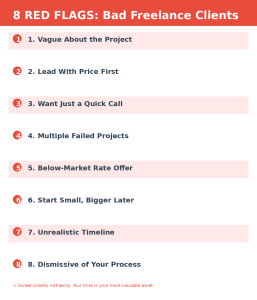
8 Red Flags That Reveal Bad Freelance Clients
These warning signs typically appear in the first email or call. If you see one, be cautious. If you see multiple, pass.
1 They’re Vague About the Project
What it sounds like: “We need a website” or “Can you do some marketing?” with no details provided.
Why it’s a red flag:
- They haven’t thought through what they actually need
- They’ll keep changing requirements as you go
- Scope creep is inevitable
- You can’t quote accurately (sets up price conflict)
- They’re likely doing this with multiple freelancers
How to respond: “I’d love to help. To give you an accurate quote, I need more details: What’s your specific goal? Who’s your target audience? What’s your budget range? What’s your timeline?”
2 They Lead With “How Much?” Before Explaining the Project
What it sounds like: First message: “What’s your rate?” with no context about the project.
Why it’s a red flag:
- Price-shopping is their only criterion
- They’ll work with whoever’s cheapest
- They don’t value quality, only cost
- Payment disputes are common
- You’ll constantly be undercut by cheaper competitors
Pro tip: Good clients never ask price first. They ask about capability, process, and timeline. If price is the lead question, they’re a budget hunter.
3 They Want “Just a Quick Conversation” to Explain Via Call/Video
What it sounds like: “Can we hop on a call?” for the initial inquiry instead of sending written details.
Why it’s a red flag:
- They’re not organized (can’t write a brief)
- They want to dominate the conversation
- Hard to reference agreements later (“We never discussed that”)
- Eats your time with rambling explanations
- They’re used to getting free consulting via calls
How to respond: “I appreciate that! I usually work more efficiently through email first—can you send me a brief overview of the project, timeline, and budget? Once I understand the scope, we can jump on a call if needed to clarify details.”
4 They Mention Other Freelancers or Agencies They’ve Worked With “Didn’t Work Out”
What it sounds like: “We’ve tried 3 designers before, but they just didn’t understand our vision.”
Why it’s a red flag:
- The pattern suggests the problem is them, not the freelancer
- They likely change requirements constantly
- They blame contractors instead of taking responsibility
- You’ll probably be “fired” too, then blamed publicly
- High likelihood of payment disputes
Reality check: One bad experience? Unlucky. Two? Coincidence. Three or more? That’s a pattern. You’re looking at a difficult client.
5 They Offer Below-Market Rate Without Knowing Your Rates
What it sounds like: “Our budget is $500 for a website” (for a professional site) or “$200 for logo design.”
Why it’s a red flag:
- They don’t value professional work
- They expect unlimited revisions at that price
- They’ll negotiate harder mid-project (“Can you do this extra thing for free?”)
- Payment delays are common at this price point
- You’ll be frustrated the entire engagement
How to respond: “I appreciate the budget transparency. My typical rate for this scope is $X-$Y. I understand that might be higher than expected. Happy to discuss options—would you like to scope this smaller, or would you prefer to discuss budget?”
6 They Want to “Start With Something Small” But Hint at Bigger Projects Later
What it sounds like: “Let’s start with a small $500 project, and if it goes well, we have bigger budget for ongoing work.”
Why it’s a red flag:
- They’re testing you at a low price point
- The “bigger budget” often never materializes
- They’ve already decided your rate based on this small project
- You’ll negotiate harder on the next project but they remember the low rate
- Classic bait-and-switch tactic
What to do: Charge your regular rate for the small project. If they want to prove trust first, that’s fair—but at your standard rate, not a discount. If they balk, they weren’t serious about ongoing work anyway.
7 They Have Unrealistic Timelines or Expectations
What it sounds like: “We need this website done in 3 days” or “Can you create 50 designs and we’ll pick the best ones?”
Why it’s a red flag:
- They don’t respect the craft or the process
- They’re setting you up to fail from the start
- Quality will suffer, they’ll blame you
- You’ll work nights/weekends and still disappoint them
- Payment disputes likely (since they’re already unhappy)
How to respond: “I understand the urgency. For quality work, here’s my realistic timeline: [timeline]. I can potentially rush it to [shorter timeline], but that would require a 50% rush fee and limits the quality I can deliver. Which works better for you?”
8 They’re Dismissive About Your Process or Expertise
What it sounds like: “You overthink this—just do it quickly” or “Design is simple, why does it take so long?”
Why it’s a red flag:
- They don’t respect your expertise
- They’ll second-guess every decision
- Unlimited revisions are incoming
- They don’t understand why quality takes work
- The entire engagement will be frustrating
The bottom line: If they don’t respect your profession before hiring you, they won’t respect you during or after. Walk away.
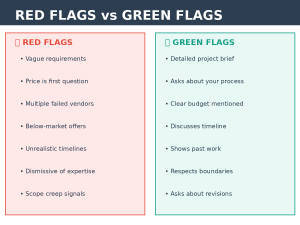
7 Green Flags of Good Clients
Now, here’s what good clients look like. When you see these, jump on it.
1 They Provide Detailed Project Context Upfront
What it sounds like: “We’re a SaaS company, we need [specific deliverable], our target audience is [detail], our budget is [range], and we need it by [date].”
Why it’s good: They’re organized, they’ve thought it through, and they respect your time. Easy to quote accurately. Easy to deliver. Easy to satisfy.
2 They Ask About Your Process and Experience
What it sounds like: “Walk me through how you approach this type of project” or “Have you worked with SaaS companies before?”
Why it’s good: They care about fit, not just price. They understand that the right freelancer matters. These clients tend to trust your judgment and don’t micromanage.
3 They Have a Clear Budget and Mention It Early
What it sounds like: “Our budget for this is $8,000-$10,000” without you asking.
Why it’s good: Budget transparency means they’re serious, they’ve allocated funds, and they’re not looking for a deal. Clear budget = easier project.
4 They Ask About Your Availability, Not Your Rock-Bottom Price
What it sounds like: “What’s your turnaround time?” instead of “What’s your cheapest option?”
Why it’s good: They’re thinking about timing and fit, not just undercutting you. Quality-focused clients ask different questions than budget-focused ones.
5 They Provide References or Case Studies They’ve Done
What it sounds like: “Here’s our website” or “Here’s a project similar to what we’re thinking.”
Why it’s good: They give you context, they’re transparent, and they’re not trying to hide who they are. Easy to understand what they actually need.
6 They Respect Your Time and Communication Boundaries
What it sounds like: “What’s the best way to stay in touch?” and respecting your stated availability.
Why it’s good: Boundary respect = healthy engagement. These clients won’t expect 24/7 responses. They understand you have other clients.
7 They Ask About Revisions, Changes, and Next Steps Upfront
What it sounds like: “How many revision rounds are included?” or “What happens if we need to make changes?”
Why it’s good: They’re thinking about process and protecting themselves too. This shows they’ve worked with freelancers before and they’re professional about it.
Also Read: How to Build a Freelance Portfolio That Attracts Premium Clients
The Screening Questions That Reveal Everything
Ask these questions in your initial conversation. The answers tell you everything you need to know.
| Question | What a Good Answer Looks Like | Red Flag Answer |
|---|---|---|
| “Tell me about your project in detail.” | Specific description, context, goals, timeline, budget | Vague, rambling, or evasive |
| “What’s your timeline?” | Realistic, clear deadline with some buffer | “ASAP” or “As fast as possible” |
| “What’s your budget for this project?” | Clear range that’s realistic for scope | Below-market, vague, or “we’ll negotiate” |
| “How did you hear about me?” | Referral, portfolio, specific recommendation | Random cold outreach, platforms like Fiverr |
| “Have you worked with freelancers before?” | “Yes, and it went well” with specific example | “We’ve tried a few but it never works out” |
| “Who will be my main point of contact?” | One clear person with decision-making power | Multiple people, unclear authority, CEO for questions |
| “What happens if requirements change?” | Clear conversation about scope changes and process | Vague or “we’ll figure it out as we go” |
The Client Screening Process
Use this framework for every new inquiry:
Step 1: Initial Email (Before Any Call)
- Request written project brief
- Ask 3-4 screening questions above
- Gauge communication quality in their response
- Decision point: Do you want to proceed?
Step 2: Initial Conversation (If They Pass Step 1)
- Clarify project details
- Walk them through your process
- Discuss timeline and expectations
- Introduce your terms: revisions, payment schedule, scope boundaries
- Decision point: Gut check—do you want this client?
Step 3: Quote & Agreement
- Send detailed quote with scope clearly defined
- Include: what’s included, what’s not, timeline, payment terms, revision policy
- Request written agreement before starting
- Decision point: Final chance to back out if they push too hard on terms
Step 4: Start (Only If All Steps Passed)
- Confirm timeline and deliverables
- Establish communication norms
- First payment received before work begins
Pro tip: The screening process is also them evaluating you. Good clients will appreciate your professionalism and clear process. Bad clients will balk at your questions and terms—and that’s the sign you should have passed.
Word-for-Word Scripts for Difficult Conversations
Script 1: When They Want to “Start Small”
“I appreciate you thinking of me for this. I charge [rate/price] for all projects regardless of size—it covers the same work, process, and revisions. I understand if that doesn’t fit your budget right now. If you’d like to scope this down so it’s smaller in deliverables (and therefore cost), I’m happy to discuss that. What would be most important to include?”
Script 2: When They Want to Negotiate Price Down
“I understand budget is important. My rate is [rate] because [reason: experience, specialization, results]. That said, I’m open to discussing how we can work together within your budget. We could: (1) reduce scope, (2) extend timeline, or (3) adjust deliverables. Which would work best for you?”
Script 3: When They Want “Unlimited Revisions”
“I include [number] rounds of revisions in my standard rate. This usually covers major direction changes. Beyond that, revisions are billed at [rate]. This keeps things sustainable for both of us. Does that work for your project?”
Script 4: When They’re Unclear About the Project
“I want to make sure I deliver exactly what you need. Let me ask some clarifying questions: (1) What’s the main goal? (2) Who’s your audience? (3) What does success look like? (4) What’s your budget? Once I understand these, I can give you an accurate quote and timeline.”
Script 5: When It’s Time to Decline
“Thank you for thinking of me for this project. After reviewing the details, I don’t think I’m the right fit for what you need. I’d recommend [type of freelancer/agency] for this scope. I appreciate the opportunity, and I hope you find the perfect match.”
How to Fire or Decline Clients (The Right Way)
When to Fire a Client During a Project:
- Repeated scope creep without acknowledgment
- Ongoing disrespect or dismissiveness
- Non-payment or payment delays
- Unreasonable communication demands (e.g., requiring 24/7 availability)
- Unethical requests
How to Fire a Client (Professional Script):
“I want to be honest: I don’t think this is working out the way either of us hoped. I care about delivering quality work, and I don’t think I can do that under the current circumstances. I recommend [transition plan]. I wish you the best with finding a freelancer who’s a better fit.”
How to Decline a Client Upfront:
“Thanks for reaching out. After reviewing your project, I don’t think I’m the right match. It’s not a reflection on you or the project—just different expertise. I’d recommend someone who specializes in [area]. Best of luck!”
Key principle: Firing a client mid-project costs you more than declining upfront. Screen ruthlessly at the beginning.
30-Day Client Filtering Plan
Week 1: Audit Your Past Clients
- List your last 10 clients
- Rate each: easy/okay/difficult
- Identify patterns (which red flags appeared?)
- Note which clients paid on time, communicated well, didn’t demand revisions
Week 2: Create Your Client Screening Process
- Write your 3-4 must-ask screening questions
- Create an email template for new inquiries
- Set a minimum project value (below which you don’t take work)
- Define your revision policy clearly
Week 3: Test Your New Process
- Use new screening questions with next 3 inquiries
- Notice how you feel about each client
- Say no to at least one client this week
- Adjust your process based on what works
Week 4: Commit to Higher Standards
- Only accept clients who pass all screening criteria
- Decline clients who show red flags (even if money is tight)
- Track which inquiries you decline—notice the savings in time and stress
- Assess: better clients = happier? higher-paying? easier projects?
Expected result: After 30 days, you should notice fewer difficult clients, higher conversion rates with ideal clients, and less stress overall. The money from 2 good clients beats the money from 5 difficult ones.
Also Read: Building Sustainable Freelance Income: The Diversification Trap & What Actually Works
The Real Cost of Bad Client Selection
One bad client:
- Eats 30-50% more time than a good one
- Causes stress that bleeds into other areas of your life
- Makes you dread opening your email
- Creates negative emotions toward your work
- Can damage your reputation if project fails
- Often doesn’t pay on time
- Prevents you from taking better clients (you’re booked)
One good client:
- Runs smoothly with clear communication
- Pays on time without question
- Respects your process
- Leads to referrals to other good clients
- Makes you want to do good work
- Often becomes a repeat client
- You can charge at or above your rates without negotiation
Final Thoughts: Your Time is Your Most Valuable Asset
You can’t buy back time. Every hour spent with a difficult client is an hour you can’t spend with a good one, working on your business, or resting.
The freelancers making the most money aren’t the ones working the most hours. They’re the ones being selective about who they work with.
This week, start screening. Ask the questions. Notice the red flags. Say no to clients who don’t fit.
In 30 days, you’ll wonder why you didn’t do this sooner.
Dealing with a difficult current client? Email us at Sologikz@gmail.com with specifics—we help freelancers navigate tough client situations and know when to hold firm or walk away.
About The Author
