
How to Build a Personal Brand That Attracts Premium Freelance Clients
Why Your Personal Brand Is Your Biggest Business Asset
There are thousands of freelancers in your field. They have similar skills, similar portfolios, similar rates. So why do some command premium prices while others compete on cost?
The difference isn’t talent. It’s brand.
A strong personal brand means clients recognize your name. They trust you before the first conversation. They remember your unique value. They refer you to others. They don’t negotiate your rates because they see you as the solution, not a commodity.
Without a brand, you’re invisible in a sea of competitors. With a brand, you’re the person everyone thinks of for your specific expertise.
This guide covers the exact framework to build a memorable personal brand, the positioning statement that attracts your ideal clients, the content strategy that establishes authority, and the scripts to introduce yourself with confidence.
Real statistic: Freelancers with a recognizable personal brand earn 35-50% higher rates than those competing on price alone. Your brand is directly tied to your income.
5 Steps to Build Your Brand Foundation
Before you create anything, you need a solid foundation. These five steps define who you are as a professional.
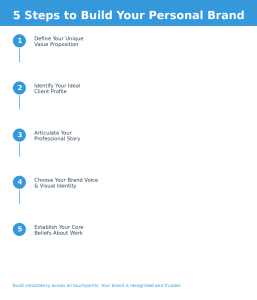
1 Define Your Unique Value Proposition
What makes you different from other freelancers doing your work?
This isn’t about being the cheapest or the fastest. This is about your unique combination of skills, experience, perspective, or results.
- What problems do you solve that others don’t emphasize?
- What’s your perspective based on past experience?
- What results do you consistently deliver?
- What do clients say you’re exceptional at?
- What do you actually enjoy doing (versus what you tolerate)?
Example: Instead of “I’m a content writer,” try “I write conversion-focused content for SaaS founders who want to scale revenue without burning out.” That specificity attracts the right clients.
2 Identify Your Ideal Client Profile
Your brand isn’t for everyone. The more specific you are, the stronger your brand becomes.
Define your ideal client across these dimensions:
- Industry or Business Type: B2B SaaS? Agencies? Solopreneurs? E-commerce?
- Company Size: Startups, small businesses, established companies?
- Revenue/Budget Level: Who can afford your premium rates?
- Pain Point You Solve: What’s their biggest challenge?
- Outcome They Want: What do they hope to achieve?
- Decision-Maker Type: Founder? Marketing Director? Operations Manager?
The clarity principle: The more you niche down, the easier it is to build authority. “I help early-stage B2B SaaS companies write their positioning documents” beats “I help anyone with writing.”
3 Articulate Your Professional Story
People connect with stories, not credentials. Your story is why you do this work and what shaped your perspective.
Your professional story should cover:
- The Origin: How did you get into this field? What sparked your interest?
- The Turning Point: What changed how you approach your work?
- The Lesson: What did you learn that now helps your clients?
- The Mission: What do you want to help people accomplish?
This isn’t a rambling autobiography. It’s a 2-3 minute story that explains why you’re credible, relatable, and worth hiring.
Pro tip: The best professional stories include a moment of struggle or failure that led to breakthrough insight. That’s what makes you human and trustworthy.
4 Choose Your Brand Voice and Visual Identity
How do you communicate? How do you want to be perceived?
Brand voice choices:
- Professional/Formal: “I specialize in enterprise-level solutions…”
- Approachable/Friendly: “I love helping small businesses finally nail their messaging…”
- Authoritative/Expert: “Here’s what most people get wrong about this…”
- Inspiring/Motivational: “Your potential is bigger than you think…”
Visual identity elements:
- Color palette (2-3 main colors)
- Typography (font choices for headings and body text)
- Photography style (professional, candid, lifestyle, minimal)
- Design aesthetic (modern, vintage, minimalist, bold)
- Logo or personal symbol
Important: Consistency across these elements makes you instantly recognizable. When someone sees your colors or your writing style, they should think “that’s them.”
5 Establish Your Core Beliefs About Your Work
What do you stand for professionally? What are your non-negotiables?
Examples of core beliefs:
- “Quality always comes before speed.”
- “The client’s success is my success.”
- “Transparent communication builds trust.”
- “Creative solutions beat cookie-cutter templates.”
- “I only work with clients I can genuinely help.”
These beliefs shape your decisions, your client selection, your work approach, and your reputation. They’re what clients respect about you beyond the deliverables.
Also Read: 8 Red Flags That Reveal Bad Freelance Clients (Before They Waste Your Time
Personal Brand Audit Checklist
Before building your brand forward, assess where you are now. This audit reveals gaps and opportunities.
| Brand Element | Current Status | What’s Working | What Needs Work |
|---|---|---|---|
| Online Presence | Website? LinkedIn? Twitter? Portfolio? | Which platforms show your best work? | Which platforms are outdated or missing? |
| Professional Bio | Is it current and compelling? | Does it communicate your value? | Is it generic or outdated? |
| Messaging | How do you describe your work? | Are you clearly differentiating yourself? | Do you use industry jargon? Is it confusing? |
| Visual Consistency | Do your platforms look coordinated? | Consistent colors, fonts, photography style? | Mismatched or inconsistent visuals? |
| Content/Thought Leadership | Do you publish articles, insights, or advice? | What content gets engagement and results? | Are you invisible in your expertise area? |
| Client Testimonials | Do you showcase client results? | Which testimonials are most powerful? | Missing or outdated social proof? |
| Email Signature/Links | Where do you direct people? | Do all links go to your best work? | Are links broken or outdated? |
| Client Feedback | What do clients say about working with you? | What are your strongest differentiators? | Are there gaps between your brand and reality? |
Your Brand Positioning Statement
This is the foundational sentence that guides all your branding decisions. It clarifies who you are and who you serve.
The Positioning Statement Formula:
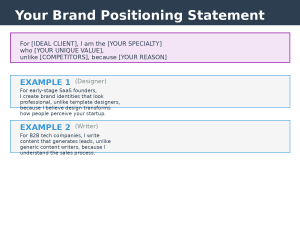
“For [ideal client], I am the [your role/specialty] who [your unique value], unlike [competitors], because [your reason/belief].”
Three Real Examples:
Example 1 (Designer):
“For early-stage SaaS founders, I am the brand designer who transforms confused positioning into compelling visual identity, unlike generic template designers, because I believe cohesive branding is what separates startups from looking like startups.”
Example 2 (Content Creator):
“For B2B tech companies, I am the content strategist who creates buyer-focused content that actually generates leads, unlike vanity content writers, because I’ve been in sales and I know what moves deals forward.”
Example 3 (Project Manager):
“For creative agencies, I am the operations strategist who streamlines chaotic workflows into scalable systems, unlike traditional PMs, because I’ve worked in multiple agencies and seen exactly where chaos happens.”
How to write yours:
- Identify your ideal client (from Step 2 above)
- State your role or specialty clearly
- Articulate your unique value (not just “good at X”—what’s the outcome?)
- Name the competition or alternative your client might choose
- Explain why you’re credible or different (experience, belief, methodology)
Once you have this statement, test it. Does it feel authentic? Does it differentiate you? Does it attract the clients you want? If not, refine it.
Content Pillars Strategy: What You’re Known For
Your brand isn’t built in one conversation. It’s built through consistent content and messaging around 3-5 core topics.
Content pillars are the themes you talk about repeatedly. They establish expertise, build trust, and give clients a clear understanding of your perspective.
How to Identify Your Content Pillars:
- What do clients ask you about most often? These are your natural teaching opportunities.
- What problems do you solve repeatedly? You have deep expertise here.
- What do you have strong opinions about? This shows conviction and attracts like-minded clients.
- What do you want to be known for? Aspirational pillars shape your brand future.
Example Content Pillars by Specialty:
For a Freelance Designer:
Pillar 1: Brand Strategy (positioning, audience, differentiation)
Pillar 2: Design Systems (consistency, scalability, efficiency)
Pillar 3: Client Collaboration (the design process, feedback loops, revisions)
Pillar 4: Business Growth (pricing, portfolio, client management)
Pillar 5: Design Trends (what’s current, what’s timeless, what to ignore)
For a Freelance Writer/Content Creator:
Pillar 1: Content Strategy (planning, research, audience insights)
Pillar 2: Copywriting Fundamentals (persuasion, storytelling, psychology)
Pillar 3: SEO & Discoverability (keywords, optimization, ranking)
Pillar 4: Content Formats (blogs, emails, sales pages, social media)
Pillar 5: Measuring Results (metrics, ROI, client success stories)
For a Freelance Strategist/Consultant:
Pillar 1: Problem Diagnosis (identifying real issues vs symptoms)
Pillar 2: Strategy Development (frameworks, planning, implementation)
Pillar 3: Team Execution (delegation, accountability, tracking)
Pillar 4: Business Scaling (systems, processes, growth)
Pillar 5: Decision-Making (data, intuition, risk assessment)
Rule of thumb: Content around these pillars should be 80% of your published material. This consistency is what makes you an authority.
Optimizing Your Online Presence for Your Brand
Your brand lives in multiple places. Each needs to reinforce the same message.
The Essential Platforms (In Priority Order):
Priority 1: Your Website or Portfolio
This is your owned property. No algorithm can take it away. It should communicate your positioning statement clearly within 5 seconds.
Must-have website elements:
- Clear headline that answers “What do you do?” in 10 words or less
- Subheading that explains who this is for
- Professional photo (you should be visible—this is personal branding)
- Your professional story (2-3 paragraphs, not your resume)
- Case studies or portfolio showing results, not just deliverables
- Testimonials from clients you loved working with
- Clear call-to-action (schedule call, send email, download guide)
- Email signup for newsletter or updates (builds your audience)
Priority 2: LinkedIn Profile
This is where clients and referral partners research you before hiring.
Optimize your LinkedIn for brand:
- Professional headshot (not generic, actually you)
- Headline that includes your positioning (not just “Freelancer at [company]”)
- Compelling “About” section that tells your story
- Highlighted projects and case studies in “Featured” section
- Regular content sharing (articles, insights, industry observations)
- Complete and detailed experience section showing progression
- Skills endorsed that reinforce your positioning
- Recommendations from past clients
Priority 3: Social Media (Choose 1-2 Platforms)
Don’t try to be everywhere. Choose the platforms where your ideal clients spend time.
- B2B or services? LinkedIn + Twitter
- Design/visual work? Instagram + Portfolio site
- Content/education? Twitter + YouTube/Blog
- Building a community? LinkedIn + Substack/Newsletter
Key principle: It’s better to be excellent on two platforms than mediocre on five.
Also Read: Building Sustainable Freelance Income: The Diversification Trap & What Actually Works
Scripts for Introducing Your Brand
Script 1: The 30-Second Elevator Pitch
“I help [ideal client] achieve [specific outcome] through [your method/approach]. What makes me different is [your unique angle]. I’ve worked with [type of companies], and typically they see [specific result] within [timeframe].”
Real example: “I help SaaS founders clarify their positioning so they can attract better clients and charge premium rates. What makes me different is I’ve been on the founder side, so I understand the pressure. I’ve worked with 20+ early-stage companies, and typically they see their conversion rates improve by 25-30% once we nail their messaging.”
Script 2: The “Tell Me About Your Work” Response
“I work with [ideal client] who are struggling with [specific pain point]. My approach is [your methodology in 1-2 sentences]. The outcome my clients typically see is [results + timeframe]. Right now I’m focusing on [current specialty or area], which is where I find I can create the most impact.”
Script 3: The Story-Based Introduction
“[Brief personal origin story that shows credibility]. Through that experience, I realized [key insight]. Now I work with [ideal client] to help them avoid that same mistake. My specialty is [your positioning].”
Real example: “I spent three years as a freelancer competing on price, constantly stressed about money, taking any client that came along. The turning point was realizing I was spending all my energy on the wrong things. Once I built an actual brand and niche, my income tripled and my stress dropped by half. Now I help freelancers do the same—build a recognized brand so they’re not constantly hustling for the next client.”
Script 4: Introducing Yourself on Social Media or Email
“I’m [Name], and I work with [ideal client] to [your unique value]. I share insights about [content pillar 1], [content pillar 2], and [content pillar 3] to help professionals like you [outcome they want].”
Real example: “I’m Saheed, and I work with freelancers and solopreneurs to build sustainable careers without the constant hustle. I share insights about client management, pricing strategy, and personal branding to help you focus on work you love and get paid what you’re worth.”
The Brand Consistency System
A powerful brand isn’t built in a day—it’s built through consistent messaging, visual identity, and presence over time.
The Three Consistency Pillars:
Pillar 1: Message Consistency
- Use the same positioning statement across all platforms
- Refer to your ideal client the same way everywhere
- Highlight your unique value consistently
- Keep your tone and voice recognizable
- Share content around your 3-5 pillars repeatedly
Pillar 2: Visual Consistency
- Same color palette across website, social, presentations
- Consistent typography and design style
- Similar photography style (professional, personal, minimalist)
- Logo and visual signature used the same way
- Profile photos that look intentionally chosen, not random
Pillar 3: Behavioral Consistency
- Show up consistently (publish weekly, share regularly, respond promptly)
- Keep the same standards for quality and professionalism
- Follow through on commitments and promises
- Interact with others’ content in ways that reflect your brand
- Stay true to your core beliefs even when it’s inconvenient
The consistency trap: Many freelancers get this backwards. They think consistency means being boring. Actually, consistency is what makes your unique personality shine. When you’re clear and consistent about who you are, your authenticity becomes your brand.
30-Day Brand Building Action Plan
Week 1: Foundation & Clarity
- Day 1-2: Complete the 5 foundation steps (UVP, ideal client, story, voice, beliefs)
- Day 3: Conduct your personal brand audit
- Day 4: Write your positioning statement and test it
- Day 5: Identify your 3-5 content pillars
- Day 6-7: Document your brand voice and visual identity choices
Week 2: Online Presence Audit & Optimization
- Day 8: Audit your website or portfolio homepage
- Day 9-10: Rewrite your website headline, subheading, and “About” section to match your positioning
- Day 11: Audit your LinkedIn profile
- Day 12-13: Update LinkedIn headline and “About” section
- Day 14: Upload professional headshot to all platforms
Week 3: Messaging & Content Planning
- Day 15: Write your 30-second elevator pitch and practice it
- Day 16: Write your story-based introduction
- Day 17: Create a content calendar for the next 4 weeks (based on your pillars)
- Day 18-19: Write 3 content pieces aligned with your pillars
- Day 20: Schedule social media posts or publish blog content
- Day 21: Update your email signature with your positioning
Week 4: Refinement & Commitment
- Day 22: Get feedback on your positioning from 2-3 people (mentor, friend, colleague)
- Day 23: Refine based on feedback
- Day 24: Create a brand style guide document (fonts, colors, tone, messaging)
- Day 25: Identify one new content creation habit (weekly article, daily social post, monthly video)
- Day 26-27: Commit to your new content habit with first pieces published
- Day 28-30: Reach out to past clients and ask for testimonials (social proof step)
30-Day Results to Expect: Clearer positioning that attracts better clients. Updated online presence that communicates your value. Initial content establishing expertise. Testimonials showing social proof. A system for consistent brand building going forward.
Also Read: How to Build a Freelance Portfolio That Attracts Premium Clients
The Long-Term Brand Building Strategy
30 days is the launch. Here’s what sustains a powerful brand:
Ongoing Brand Activities (Monthly):
- Publish 4 pieces of content aligned with your pillars
- Engage with others’ content in your niche (commenting, sharing, discussing)
- Send newsletter or email update to your audience
- Share case study or client result demonstrating your value
- Attend or participate in one industry event or conversation
- Collect one new testimonial or client success story
Quarterly Brand Review:
- Assess what content resonates most
- Check if you’re attracting your ideal clients
- Notice any shifts in your positioning or focus
- Update portfolio with recent work
- Refresh testimonials and case studies
Final Thoughts: Your Brand Is Your Business Moat
In a world of infinite freelancers, a strong brand is your competitive advantage. It’s what separates you from the crowd. It’s why premium clients choose you.
The freelancers earning the most aren’t always the most talented. They’re the ones with the clearest brand. The ones clients recognize. The ones people refer.
Your brand isn’t arrogance. It’s clarity. It’s showing up as your best professional self, consistently, with a clear message about who you help and why.
Start this week. Complete one foundation element. Update one platform. Write one piece of content. Small, consistent actions build powerful brands.
Building your brand but not sure if you’re on track? Email us at Sologikz@gmail.com with your current positioning statement or brand challenge—we help freelancers clarify their positioning and build memorable brands.
About The Author
