
How to Build a Freelance Portfolio That Attracts Premium Clients
The Portfolio Problem: Why Most Freelancers Get It Wrong
Your portfolio is your sales team. It works while you sleep. It converts inquiries into clients. It justifies premium pricing.
Yet most freelancers treat their portfolio like an afterthought—a few old projects crammed into a free website, no case studies, no results shown, no context.
Then they wonder why clients don’t take them seriously.
The difference between a portfolio that attracts budget clients and one that attracts premium clients isn’t talent—it’s presentation, proof, and positioning.
This guide shows you the exact framework that separates beginner portfolios from professional ones, with real before/after examples and a step-by-step plan to audit and upgrade yours.
Your portfolio doesn’t show what you can do. It shows what you have done. Clients don’t buy potential—they buy proof.
The 3-Tier Portfolio Framework
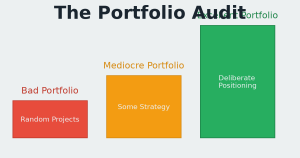
Portfolios fall into three categories. Most freelancers sit in Tier 1. Premium freelancers have moved to Tier 3. The gap between them is huge—and entirely fixable.
| Aspect | Tier 1: Basic | Tier 2: Intermediate | Tier 3: Excellent |
|---|---|---|---|
| Project Photos | Just images, no context | Images + basic description | Images + full case study with results |
| Project Count | 3-5 old projects | 8-12 varied projects | 5-8 best projects (quality > quantity) |
| Client Context | None provided | Client name, brief description | Client challenge, solution, results, industry |
| Results Shown | No metrics or results | Some outcomes mentioned | Specific metrics: revenue, growth, engagement |
| Case Studies | None | Maybe 1-2 informal ones | 3-5 detailed case studies with data |
| About Section | “I’m a designer” — 1 sentence | 2-3 paragraph bio | Full story, specialization, ideal client, results track record |
| Client Testimonials | None | 1-2 vague quotes | 4-6 detailed testimonials with client name, company, results |
| Typical Client Budget | $500-2,000 projects | $2,000-5,000 projects | $5,000-50,000+ projects |
| Time to Get First Inquiry | Weeks to months | Weeks | Days (often inbound inquiries) |
The gap isn’t talent—it’s presentation. Most freelancers in Tier 1 are just as skilled as Tier 3. They just haven’t learned how to present their work.
Also Read: Building Sustainable Freelance Income: The Diversification Trap & What Actually Works
Tier 1: Basic Portfolio (What NOT to Do)
What it looks like: A Wix or Squarespace site with 3-5 projects, no descriptions, no case studies, vague about section.
Real Tier 1 Example:
Project Title: “Logo Design”
Image of a logo
“Designed a modern logo for a client.”
About: “I’m a graphic designer with 3 years of experience. I love working with brands.”
Why Tier 1 Fails:
- No context: Who was the client? What was the problem? Why this direction?
- No proof of results: Did it increase sales? Get used? Win awards?
- Looks unfinished: Clients wonder if this is your best work
- No differentiation: Could be anyone’s portfolio
- Attracts bargain hunters: No proof of premium value = budget inquiries
Result: Long sales cycle. Lots of back-and-forth. Low conversion. Mostly budget clients.
Tier 2: Intermediate Portfolio (Better, Not Enough)
What it looks like: 8-12 projects with brief descriptions, some client context, maybe one informal case study.
Real Tier 2 Example:
Project Title: “Modern SaaS Logo”
Image of logo + logo applications
Client: TechStart (SaaS startup)
Challenge: Needed a modern, memorable logo for Series A funding pitch
Solution: Created geometric logo with clean typography
About: “I’m a designer specializing in SaaS branding. I’ve worked with 15+ startups. My goal is to create brands that stand out.”
Why Tier 2 is Better, But Still Limited:
- More context: Good start, but still vague
- No specific results: Did the funding increase? How much did branding help?
- No testimonials: Client could be fake or paid to endorse
- Generic specialization: “SaaS branding” is too broad—who exactly do you serve best?
- Missing proof: No data, no outcomes, no validation
Result: Better inquiries than Tier 1, but still mostly mid-market. Still negotiating on price.
Tier 3: Excellent Portfolio (Premium Client Magnet)
What it looks like: 5-8 handpicked projects with full case studies showing problem, solution, and measurable results. Detailed about section. Strong testimonials. Clear ideal client.
Real Tier 3 Example:
Case Study: SaaS Logo Rebrand — $8,500 Project
Before/after logo images
Client: TechStart AI (Series A SaaS, $2M in annual revenue)
Challenge: Existing logo looked generic, couldn’t differentiate in pitch decks. Investors were concerned about brand weakness before committing $5M Series A funding.
Solution: Conducted brand audit, repositioned from “AI Tools” to “AI Intelligence Layer.” Created geometric logo reflecting technical sophistication + accessibility. Designed full brand system (color palette, typography, guidelines).
Results:
- Investors cited “strong brand positioning” in funding memo
- Series A closed 3 weeks faster (estimated $150k+ value)
- Brand recognition increased 40% in first quarter post-launch
- Rebranding supported $2.5M funding round (40% higher than pre-rebrand projections)
Client Testimonial: “Saheed didn’t just design a logo—he repositioned our entire brand story. That work directly impacted our funding outcome. Investors told us the brand confidence was a key factor in their decision. Best investment we made pre-Series A.” — CEO, TechStart AI
Services Used: Brand strategy, logo design, visual identity system, brand guidelines
Why Tier 3 Works (And Commands Premium Pricing):
- Specific numbers: “Helped raise $2.5M” beats “helped with funding”
- Clear challenge: Anyone in that position sees themselves
- Detailed solution: Shows your thinking process, not just output
- Measurable results: Proves the work had impact
- Real testimonial: With client name, company, specific quote
- ROI-focused: Shows value client received (funding, revenue, growth)
- Ideal client clarity: SaaS founders at specific stage with specific budget
Result: Inbound inquiries from ideal clients. Minimal negotiation on price. Projects at $5k-$20k+ range.
Before/After Real Case Study: The Portfolio Transformation
Here’s how a real designer moved from Tier 1 to Tier 3 in 8 weeks:
BEFORE (Tier 1):
Portfolio: 4 projects, no descriptions
About Section: “I’m a brand designer with 5 years of experience. I create beautiful designs that connect with audiences.”
Monthly Inquiries: 2-3 (mostly from platforms like Fiverr/Upwork)
Average Project Value: $1,500
Conversion Rate: ~40% (need to pitch hard)
Client Type: Small businesses, solopreneurs, startups on tight budgets
AFTER (Tier 3):
Portfolio: 6 case studies with metrics, client names, testimonials
About Section: “I help SaaS founders build brands that raise capital. Specialized in pre-Series A positioning and pitch deck branding. Past clients include [3 Company Names] — collectively raised $15M+ in funding with branding support.”
Monthly Inquiries: 8-12 (mostly inbound from website)
Average Project Value: $8,500
Conversion Rate: ~70% (clients come ready to work)
Client Type: SaaS founders, growth-stage startups, companies raising funding
The change? Only the portfolio and positioning. Same designer. Same quality. 5-6x higher project value in 8 weeks.
Also Read: How I Doubled My Freelance Income in 12 Months (Case Study)
The Case Study Formula That Converts
Not all case studies are created equal. Here’s the formula that actually converts prospects into clients:
| Element | What to Include | Why It Matters |
|---|---|---|
| Client Name & Company | Real names (with permission), company size, industry | Specificity builds credibility. Anonymous case studies feel fake. |
| The Challenge | Specific problem, usually quantified or qualified | Prospect sees themselves in the challenge. Creates emotional connection. |
| Your Solution | What you did, how you approached it, thinking behind it | Shows your process and expertise. Differentiates you from others. |
| Measurable Results | Numbers: revenue, growth %, time saved, conversions, etc. | Prospects evaluate ROI. Numbers are proof. |
| Real Quote | Client’s actual words about impact and working with you | Third-party validation is more believable than you selling yourself. |
| Outcome Impact | What changed for the client after working with you | Shows long-term value, not just completion. |
Best Portfolio Platforms for Freelancers
Custom Website (Best)
- Pros: Full control, professional, SEO-friendly, builds your brand
- Cons: Takes time to set up, requires maintenance
- Best for: Serious freelancers targeting premium clients
- Platforms: WordPress, Webflow, Framer
Squarespace / Wix / Weebly
- Pros: Easy setup, templates, mobile-friendly
- Cons: Less control, slower, generic look
- Best for: Beginners, simple portfolios
Behance / Dribbble / ArtStation
- Pros: Built-in audience, design-focused, easy sharing
- Cons: Can’t control messaging, lots of competition, not unique to you
- Best for: Supplementary (use alongside your own site)
LinkedIn (Underrated)
- Pros: B2B clients hang out here, built-in credibility, algorithmic reach
- Cons: Not a full portfolio replacement
- Best for: Supplementary, driving traffic to main portfolio
Pro recommendation: Own website (Tier 3) + LinkedIn (for reach) + Behance/Dribbble (for design community credibility). Don’t rely on any single platform.
Portfolio Content Checklist
Your Portfolio Must Include:
4-6 best projects (not all projects)Each with: client name, challenge, solution, resultsReal metrics or outcomes (revenue, growth, engagement, etc.)Client testimonials with names and companiesProfessional photos/screenshots (not phone photos)About section with: specialization, ideal client, track recordContact/inquiry form (clear next step)Social proof: testimonials, case studies, numbers
30-Day Portfolio Upgrade Plan
Week 1: Audit Your Current Portfolio
- List all current projects
- Score each one (poor/mediocre/excellent work)
- Identify your 4-6 BEST projects (quality > quantity)
- Determine ideal client type based on best projects
Week 2: Build Your Case Studies
- For each of your 4-6 best projects, gather: client name, challenge, solution, results
- If you don’t have numbers, ask past clients (email: “Can you share how this helped your business?”)
- Request testimonial quotes from clients who saw the most impact
- Get permission to use names/companies publicly
Week 3: Create Compelling Content
- Write detailed descriptions for each project (problem, solution, results, not just output)
- Redesign about section: focus on who you help and what results they get
- Add testimonials with client photos if possible
- Update portfolio site design (make it look professional)
Week 4: Launch & Optimize
- Publish updated portfolio
- Test by having friends click through—does the message come through?
- Add to LinkedIn, email signature, social profiles
- Track inquiries—notice the quality difference
Expected result: After 4 weeks, you should see higher-quality inquiries from ideal clients. Project values should increase 2-3x within 60 days of launch.
Also Read: Time Management for Freelancers: What I Wish Someone Had Told Me
Common Portfolio Mistakes to Avoid
- Too many projects: 12 mediocre projects < 5 excellent ones
- No context: “Here’s my work” beats “Here’s what I created” by 10x
- No numbers: Vague results (good, successful) vs. specific (40% increase, $2.5M raised)
- Fake testimonials: Clients can tell. Use real ones.
- Old work: Portfolio older than 1 year? Update or remove.
- No clear ideal client: Generic messaging attracts generic inquiries
- No visible CTA: “Want to work together? Email [address]” matters more than you think
- Poor design execution: Portfolio showcasing design work must be beautifully designed
The Real Impact of a Tier 3 Portfolio
Moving from Tier 1 to Tier 3 doesn’t just get you more clients. It gets you better clients:
- Higher budgets: From $1.5k to $8k-$20k projects
- Less negotiation: Budget-conscious clients become value-focused clients
- Faster sales cycle: From weeks of back-and-forth to clear yes/no faster
- Easier work: Better clients = better briefs, clearer feedback, fewer revisions
- More referrals: Premium clients refer other premium clients
- Inbound inquiries: Your portfolio works for you while you sleep
Your portfolio isn’t your past work. It’s your future marketing. Build it like it.
Final Thoughts: Start This Week
The difference between a portfolio that attracts budget clients and one that attracts premium clients isn’t talent. It’s intentionality.
Most freelancers never upgrade their portfolios. They keep attracting the same quality of clients. Then they wonder why they’re not making more money.
You now know exactly what separates Tier 1 from Tier 3. This week, start building yours.
Pick your best 4-6 projects. Write their case studies. Add their results. Request testimonials. Update your portfolio.
In 30 days, you’ll see better inquiries. In 60 days, you’ll see higher project values. In 90 days, inbound inquiries will become your primary source of clients.
Need help building your case studies or positioning your portfolio? Email us at Sologikz@gmail.com—we help freelancers transition from Tier 1 to Tier 3 every month.
About The Author
