
Time Management for Freelancers: What I Wish Someone Had Told Me
Time Management for Freelancers: What I Wish Someone Had Told Me

The Year I Almost Quit
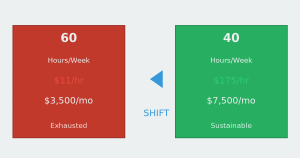
2019 was the year I worked 60 hours a week, made $3,500 a month, and wanted to throw my laptop out the window.
I wasn’t lazy. I wasn’t unskilled. I was just completely broken about how to spend my time.
I believed everything I’d read about freelance success: hustle harder, work more hours, be available 24/7, juggle multiple clients, never say no. So I did all of that. And I was miserable. Worse, I was still poor.
The problem wasn’t effort. The problem was that I’d accepted a series of myths about freelance time that made me less productive, not more.
“I didn’t need better time management. I needed to stop believing in the wrong myths about time.”
In the next few sections, I’m going to tell you what those myths were, why they’re wrong, and what actually worked to cut my hours from 60 to 40 while tripling my income.

Myth 1: More Hours = More Money
The Myth:
If I work 60 hours a week, I’ll make more money than someone working 40. So to increase income, I just need to work longer days.
This is the most seductive lie about freelance work. It feels true. Work more = earn more. Simple math.
Except it’s backwards.
When I was working 60 hours a week at $11/hour effective rate, I made $3,500/month. When I restructured my time (working smarter, not longer), I cut to 45 hours and made $6,200/month. Eventually, I hit 40 hours and $7,500/month.
Here’s why more hours trap you in poverty:
You work longer on low-paying projects. When you’re desperate, you take everything. You spend hours on $400 logo jobs because you need the money NOW. Those hours could have been spent on higher-value work—like raising prices, finding better clients, or creating retainers. But you don’t have time for that because you’re drowning in low-paying work.
You get tired. And tired brains are bad at pricing, negotiation, and strategic decisions. I made my worst business decisions when exhausted—accepting rushed timelines, dropping prices, saying yes to nightmare clients. All because I was running on fumes.
You can’t do high-leverage work. Strategic work takes mental energy. Raising prices takes courage. Finding direct clients takes focus. Content creation takes creativity. You can’t do any of that when you’re crushed by your workload.
The Truth: Your hourly rate only goes up if you intentionally do different work—not more work. The math changes when you stop competing on hours and start competing on value.
Also Read: How I Doubled My Freelance Income in 12 Months (Case Study)
Myth 2: You Need to Be Available 24/7
The Myth:
Clients expect instant responses. If you’re not replying at night and weekends, you’ll lose opportunities. Successful freelancers are always “on.”
I believed this. So I checked email at midnight. I responded to messages on Sundays. I was reachable constantly.
You know what happened? Clients learned I was always available. They took longer to reply knowing I’d respond immediately anyway. Projects dragged on because there was no urgency. And I was exhausted.
One Tuesday at 11 PM, a client emailed asking for a complete revision of their logo. I responded immediately (because I was checking email). They thought I was available. They asked me to jump on a call at midnight their time. I did it because I didn’t want to seem “unresponsive.”
That’s not dedication. That’s desperation.
The breakthrough came when I set boundaries. I created an auto-responder: “I check email Monday-Friday, 10 AM – 5 PM. I’ll respond within 24 hours.” I disabled email notifications on my phone. I stopped checking Slack at night.
Guess what? Clients didn’t leave. Better clients actually appreciated the professionalism. The desperate clients who needed 24/7 responses? I didn’t want them anyway.
The irony is this: being LESS available made me MORE productive. Because now I had actual working hours. I knew exactly when to work, when to stop, and when to rest. My output improved because I wasn’t depleted.
The Truth: Boundaries save time. A clear schedule (even if it’s not traditional 9-5) is faster than being perpetually available. The best clients respect working hours; the worst clients disrespect them anyway.
Myth 3: Planning Takes Too Much Time
The Myth:
I don’t have time for planning. I need to get straight to work. Every minute spent planning is a minute I could be billing.
This was my excuse in 2019. No time for systems. No time for tracking. No time for planning. Just raw, constant grinding.
I was also losing money constantly. I’d forget to invoice. I’d lose track of which projects were profitable. I’d repeat the same mistakes. I had no idea which clients were profitable and which were eating my time.
The turning point was painful but necessary: I spent a full week—a billable week—building a simple tracking system. I documented:
- How much time each project type takes (logo design, brand identity, revisions)
- Which clients were easy to work with vs. nightmare clients
- How often clients requested revisions and “quick tweaks”
- Which project types were profitable vs. which burned time
That week of “lost” billable time saved me hundreds of hours over the next year.
Because now I could say: “I see logo design takes me 15 hours on average with 4 rounds of revisions. For $500, that’s $33/hour. That’s not working.” So I stopped doing cheap logo work. Or I said: “Brand identity projects take 25 hours but clients are happy and rarely ask for revisions. At $2,000, that’s $80/hour. This is worth protecting.”
Planning isn’t overhead. Planning is profit.
The Truth: 5% of time spent planning saves 20% of time spent grinding. You won’t know what to cut until you measure it.
Myth 4: Say Yes to Everything
The Myth:
Rejection means lost money. I can’t afford to say no. Every opportunity matters. Successful freelancers are busy with everything.
This myth almost destroyed me.
I had 7 active clients in 2019. Seven. Different industries, different work styles, different communication preferences, different timelines. Every day was chaos. I’d finish a rush project for Client A, then jump to Client B’s emergency, then respond to Client C’s revision request, then scope work for Client D.
My brain was context-switching every hour. I was terrible at everything. Quality sucked. Efficiency sucked. I was always behind. Always scrambling.
Then I made a deliberate choice: I was only going to work with 3 active clients maximum.
This was terrifying. What if they all left? What if I couldn’t find new clients?
So what happened? I got more selective. I said no to the difficult clients. I said no to low-paying projects. I raised my prices. I focused completely on my 3 good clients. Quality went up. Efficiency went up. They loved the attention. They gave me more work. My hourly rate jumped from $33 to $60 almost immediately.
Saying no to bad opportunities is saying yes to good ones. Every hour I spent on Client F (nightmare client, $25/hour) was an hour I couldn’t spend on Client B (dream client, $100/hour).
The Truth: Fewer, better clients beat more, worse clients every single time. Deep focus beats context-switching. Stop saying yes to everything.
Myth 5: Slow Periods Mean You’re Failing
The Myth:
If you’re not constantly booked, you’re not succeeding. Slow periods mean I need to hustle harder, take more projects, be more available.
This myth had me in a vicious cycle: Work hard → Burn out → Lose efficiency → Work even harder to catch up.
I saw slow periods as failures instead of opportunities.
In 2020, I had a slow month. Panicked, I frantically looked for new projects. I lowered prices. I sent desperate pitches. It was embarrassing and ineffective.
Then I had an idea: What if I used that slow period intentionally?
I spent 3 weeks on strategic work instead of billable work:
- Revamped my portfolio to attract better clients
- Wrote case studies of my best work
- Reached out to past clients for referrals (no pitch, just genuine check-ins)
- Updated my rates and service packages
Guess what? The month after that slow period, I booked 40% more work at higher rates. It wasn’t a coincidence.
Slow periods are maintenance windows. Use them to improve your positioning, update your portfolio, reconnect with clients, and think strategically. The hustle never stops—but sometimes it looks different.
The Truth: Slow periods aren’t failures. They’re opportunities for strategic work that busy periods won’t allow. Use them to build, not panic.
Alao Read: Upwork vs Fiverr vs Other Platforms: Which is Best for Your Niche?
What Actually Changed Everything
I stopped optimizing for hours and started optimizing for rate.
The goal wasn’t to work more. The goal was to increase my effective hourly rate and actually have time to live.
That meant:
- Saying no to $500 logo jobs (even when desperate)
- Investing in portfolio and positioning
- Setting clear working hours
- Working with fewer, better clients
- Using slow periods strategically
- Measuring everything
The result: 60 hours at $33/hour ($3,500/month) became 40 hours at $175/hour ($7,500/month).
It wasn’t magic. It was just different priorities.
30-Day Action Plan: Time Management Reset
Week 1: Measure
- Track your time for 5 working days. Every hour. Which projects? Which clients? How long did each task take?
- Calculate your real hourly rate. Take each project’s fee and divide by actual hours spent (including revisions, emails, meetings).
- Identify your “bad” work. Which projects pay less than $50/hour? Which clients are energy drains?
Week 2: Set Boundaries
- Define your working hours. When do you start? When do you stop? When are you not available?
- Create an email auto-responder. “I check email Monday-Friday, 9 AM – 5 PM. I’ll respond within 24 hours.”
- Disable notifications outside working hours. Slack, email, messages—turn them all off after 5 PM.
Week 3: Stop Low-Value Work
- Identify your bottom 3 projects. The ones that pay lowest or take longest.
- Plan how to end them. Finish current projects, don’t take new ones, refer clients elsewhere if possible.
- List what to say no to. Projects under X dollars? Clients who email after hours? Revision-heavy work? Write it down.
Week 4: Invest in Strategy
- Spend 5 hours on your portfolio. If you have slow time, invest it. If you don’t, schedule it anyway.
- Write one case study. Pick your favorite client project and document the process, results, and outcome.
- Reach out to 5 past clients. Not to pitch. Just genuine check-ins: “I was thinking of the work we did together. How are things going?”
The Real Lesson
Time management isn’t about fitting more work into your day. It’s about protecting the work that matters and cutting everything else.
The myths I believed—work longer, be always available, say yes to everything—were keeping me trapped in low-value work. The shift happened when I stopped listening to those myths and started optimizing for what actually matters: earning more money while working fewer hours.
That’s the actual definition of success as a freelancer.
Everything else is just hustle culture dressed up as advice.
About The Author
