
Client Communication: Red Flags and How to Handle Difficult Clients
You can have the best skills in the world, but one difficult client can drain your energy, kill your profit margin, and make you question why you went freelance. The good news? Most nightmare clients announce themselves before you take the job. You just need to know what to listen for.
Why Client Selection Matters More Than Skills
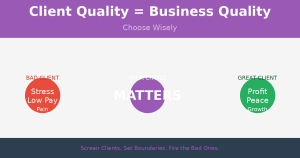
Here’s a harsh truth: the quality of your freelance life depends almost entirely on your client quality, not your technical abilities. A mediocre designer with amazing clients will earn more and feel happier than a phenomenal designer with terrible clients.
Difficult clients create a compounding problem. They consume disproportionate time, demand unpaid revisions, delay payments, stress you out, and often pay the least. Meanwhile, dream clients are low-maintenance, pay on time, respect your expertise, and provide repeat work.
The solution isn’t better skills. It’s better screening. This guide teaches you how to spot red flags early and how to manage difficult situations when they arise.
The Red Flags: What to Listen For During Initial Contact
Before you even send a proposal, pay attention to how prospects communicate. These early signals predict exactly how difficult they’ll be.
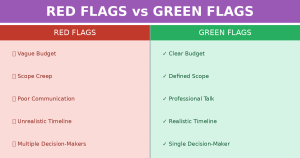
Red Flag 1: Vague About Budget
What you hear: “What’s your lowest price?” or “Just quote me and I’ll see if I can afford it” or complete silence about budget
What it means: They’re not serious. They’re comparing you to ten other freelancers and picking the cheapest.
What happens: You’ll lose the project or win it at an unsustainable price.
Red Flag 2: Asking You to “Prove Yourself” With Free Work
What you hear: “Can you do a small sample first?” or “Let’s start with a trial project at a discount” or “Prove your skills with a test”
What it means: They don’t respect your time or existing portfolio. They’ll likely do this again mid-project.
What happens: Unpaid work, taken work they never compensate for, or endless “tests.”
Red Flag 3: Scope Creep Signals
What you hear: “I’m still figuring out what I want” or “Can you just include everything and we’ll trim later?” or changing requirements mid-conversation
What it means: Project scope will shift constantly. You’ll work triple the hours you quoted.
What happens: You’ll make $15/hour on work you quoted at $75/hour.
Red Flag 4: Communication Disrespect
What you hear: Demanding immediate responses, contacting you on weekends, unclear communication, lots of “urgent” requests
What it means: They don’t respect boundaries. This will be constant stress.
What happens: You’re always “on call.” Your other work suffers. Your personal life suffers.
Red Flag 5: Multiple Decision-Makers With No Clear Authority
What you hear: “I’ll need to check with my team,” “My boss has to approve everything,” or you’re in a group chat with 8 decision-makers
What it means: Approval delays. Conflicting feedback. Endless revisions.
What happens: A 2-week project becomes a 2-month nightmare.
Red Flag 6: Pushy or Dismissive Tone
What you hear: Talking down to you, dismissing your professional recommendations, being demanding without being polite
What it means: They don’t value your expertise. They’ll second-guess every decision.
What happens: Constant conflict. Your work gets diluted by their “suggestions.” You feel undervalued.
Red Flag 7: Unrealistic Timelines
What you hear: “Can you finish this by tomorrow?” or asking for a month’s worth of work in one week
What it means: They either don’t understand the work involved or don’t respect your capacity.
What happens: You’re working nights and weekends for normal pay.
Red Flag 8: Bad-Mouthing Previous Freelancers
What you hear: “The last three freelancers I hired were terrible” or complaints about every vendor
What it means: Pattern behavior. Soon, you’ll be the “terrible” freelancer they’re complaining about.
What happens: You become the scapegoat.
Pro tip: If you see 3+ of these flags, walk away. Your peace of mind is worth more than the project fee.
Also Read: Freelance Pricing Strategies: How to Charge What You’re Worth
Green Flags: What Good Clients Look Like
For every red flag, there’s a green flag that signals a dream client relationship.
Green Flag 1: Clear budget and timeline from the start
A client who says “I have $3,000 and need this by October 15” is organized and serious.
Green Flag 2: Trusts your expertise
They ask for your recommendations instead of telling you how to do your job.
Green Flag 3: Respects your boundaries
They understand you have other clients and won’t demand 24/7 availability.
Green Flag 4: Clear decision-maker
One person with authority makes decisions. No design-by-committee.
Green Flag 5: Professional communication
They’re polite, organized, and communicative without being demanding.
Green Flag 6: Realistic expectations
They understand quality work takes time. They’re not asking for miracles overnight.
Green Flag 7: Speaks positively about previous vendors
“Our last designer was great, but we’re expanding and need help” = good sign.
How to Screen Clients Before Accepting the Project
Step 1: Ask Qualifying Questions
Before sending a proposal, have a consultation call. This filters out bad fits immediately and shows the client’s communication style.
Questions to ask:
- “What budget range are we working with?” (Listen for clarity or vagueness)
- “When do you need this completed?” (Realistic or urgent?)
- “Who will be approving this work?” (One person or a committee?)
- “How will you measure success?” (They’ve thought about goals or just guessing?)
- “Have you worked with freelancers before?” (Learn what they expect)
Step 2: Check Their References
Don’t skip this. Message previous freelancers on their Upwork profile (if available). Ask one simple question: “Would you work with this client again and why?”
Their answer reveals everything.
Step 3: Watch How They Negotiate
A reasonable client negotiates once. A difficult client constantly re-negotiates, nickel-and-dimes your quote, and tries to add scope without budget increase.
Step 4: Trust Your Gut
If something feels off during initial conversation, it’s off. You don’t need a logical reason to decline. “I don’t think I’m the right fit for your project” is a complete sentence.
Setting Boundaries: The Prevention Strategy
Most difficult client situations stem from unclear boundaries. Prevent 80% of problems with crystal-clear contracts and communication norms.
Boundary 1: Response Time
State explicitly: “I respond to messages within 24 business hours. Emergency issues (site down, deadline today) can be handled same-day for a rush fee.”
This prevents the “why didn’t you respond in 2 hours?” complaint.
Boundary 2: Revision Limits
Your contract should say: “Includes 2 rounds of revisions. Additional revisions are $[X] per round.”
This stops unlimited free revisions that eat your profit.
Boundary 3: Scope Definition
Write exactly what’s included and what’s not. Example:
- Included: 3 logo concepts, brand colors, fonts
- Not included: Printing costs, merchandise design, website mockups
Boundary 4: Payment Terms
50% upfront, 50% on delivery. Or 100% upfront for smaller projects. Non-negotiable.
Boundary 5: Project Timeline
If they request urgent work, state: “Rush projects (under 1 week) carry a 30% rush fee.”
This compensates you for dropping other work and makes them think twice about unrealistic deadlines.
Managing Difficult Situations: Scripts That Work
Situation 1: Scope Creep Mid-Project
Client adds extra work without extra budget.
What you say:
“I’m happy to add [new request]. That goes beyond our original scope, so I can add it as a separate project for $[X], or I can prioritize it and push back the other deliverables. Which works better for you?”
Why it works: You’re not saying no. You’re giving them options and making consequences clear.
Situation 2: Client Demands Instant Changes
They want revisions done immediately without respect for your schedule.
What you say:
“I can get that to you by [specific time]. If you need it sooner, I have a rush fee of $[X] to reprioritize. Let me know what works best.”
Why it works: You’re accommodating but making them pay for urgency.
Situation 3: Client Questions Your Expertise
They dismiss your professional recommendations and want something they’re sure won’t work.
What you say:
“I understand. Based on my experience, this approach might not achieve your goal of [their goal]. However, if you want to proceed with this version, I’m happy to. Let’s document this in writing so we’re both clear it was your preferred direction.”
Why it works: You’re not forcing them. You’re protecting yourself by documenting their choice.
Situation 4: Client Delays Payment
They received the work but keep delaying payment.
What you say (first message):
“Hi [Client], I noticed the payment for [project] is now [X days] overdue. Can you let me know when I can expect it?”
What you say (second message, 1 week later):
“The invoice is now [X days] overdue. Per our contract, late payments accrue 1.5% monthly interest. Payment should be received by [date] to avoid this. Let me know if there’s an issue on your end.”
Why it works: You’re being professional but firm. Late fees incentivize payment.
Situation 5: Client Becomes Hostile or Abusive
Personal attacks, dismissive language, or threatening behavior.
What you say:
“I value professional relationships and want to deliver quality work for you. However, I’m not comfortable continuing under these conditions. I can either pause the project for 48 hours while we reset, or refer you to another freelancer. Which would you prefer?”
Why it works: You’re not taking abuse. You’re offering a reset or exit. Most abusive clients back off immediately.
When to Walk Away: If a client is abusive, threatens legal action without cause, or asks you to do something unethical—stop. Refund what you must and end the relationship. Your mental health is not worth any project fee.
When to Fire a Client (And How to Do It)
Yes, you can and should fire clients. It’s the most underrated power of freelancing.
Fire When:
- They’re abusive or disrespectful
- They consistently don’t pay on time
- Scope creep has made the project unprofitable
- They demand unethical work
- The stress isn’t worth the money
How to Fire Professionally:
Email template:
“Hi [Client],
After reflection, I don’t think I’m the right fit for this project. I want to make sure you’re working with someone who can give you their best work and full attention. I’d like to formally end our engagement as of [date].
[Refund details if applicable]
I’m happy to refer you to other freelancers who might be a better match for your needs. Best of luck with the project.”
Why it works: You’re being professional, not bitter. You’re not explaining yourself excessively.
Firing a client is often the best business decision you’ll make. The time and emotional energy you reclaim is worth far more than the lost revenue.
Also Read: How to Set Up a Productive Remote Workspace on Any Budget
Building a Portfolio of Dream Clients
After dealing with difficult clients, you might think all clients are problems. They’re not. Dream clients exist. Here’s how to attract them.
Strategy 1: Be Selective
Reject 50% of opportunities. Picky freelancers attract better clients. Desperate freelancers attract the worst ones.
Strategy 2: Show Client Testimonials
Highlight your best client relationships. Good clients attract more good clients.
Strategy 3: Specialize
Generalists get all types of clients. Specialists (logo design for e-commerce, content for SaaS, etc.) attract premium clients with higher budgets.
Strategy 4: Raise Your Rates
Higher-priced services attract more serious, professional clients. Bargain hunters go elsewhere.
Strategy 5: Ask For Referrals
Your best clients know other good clients. Ask: “If you know other business owners who might benefit from my services, I’d appreciate a referral.”
Your Communication Action Plan
- This week: Review past difficult clients. Identify which red flags you missed
- This week: Create a standard contract that includes revision limits, scope definition, and payment terms
- Next project: Screen the client thoroughly before accepting. Ask qualifying questions
- Next project: Check references from previous freelancers
- Ongoing: When you feel unsure, decline. Your gut is right
- Ongoing: Document everything in writing—especially scope changes and client requests
- Monthly: Review which clients are draining you. Plan transitions to exit the bad ones
Final Thoughts
Your client relationships determine your freelance success more than your technical skills. A great freelancer with terrible clients is miserable and underpaid. An average freelancer with dream clients is happy and profitable.
The shift happens when you start saying no. No to vague budgets, no to scope creep, no to disrespect, no to unrealistic timelines. With each “no,” you attract better clients and build a sustainable business.
Screen relentlessly. Set boundaries clearly. Fire the bad ones. The freelancers making six figures aren’t necessarily more skilled—they’re just more selective.
About the author: Based on years of freelance experience across multiple platforms and working with clients ranging from startups to established businesses. This guide reflects lessons learned from both amazing client relationships and painful ones that taught valuable boundary-setting skills.
About The Author
