
Six Articles of Faith (Iman)
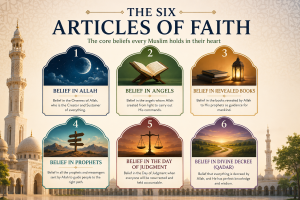
The Pillars of Internal Conviction. The Six Articles of Faith in Islam
Six Articles of Faith. While the Five Pillars of Islam represent the outward, physical acts of worship, the Articles of Faith (Arkan al-Iman) constitute the internal, intellectual, and spiritual foundation of a believer.
Faith, in the Islamic context, is not a passive feeling but a structured set of convictions that dictate how one perceives reality, existence, and the afterlife. To have Iman (faith) is to have a firm belief in the heart, an acknowledgment with the tongue, and a manifestation through the limbs.
These articles provide the “internal compass” for the Muslim. They offer answers to the existential questions regarding our origin, our purpose, and our ultimate destination. By internalizing these six points, a person develops a worldview that is centered on the Divine, grounded in moral responsibility, and hopeful for eternal peace.
Also Read: 5 Pillars of Islam
1. Belief in Allah (Tawhid)
The first and most essential article of faith is the belief in Allah as the one and only God. This is the concept of Tawhid, which is the absolute oneness and uniqueness of the Creator. It is the rejection of any partners, equals, or intermediaries in worship.
Belief in Allah involves acknowledging His Lordship (Rububiyyah)—that He alone is the Creator, Sustainer, and Master of the universe. It also involves acknowledging His sole right to be worshipped (Uluhiyyah), meaning that all acts of devotion, prayer, and sacrifice must be directed to Him alone.
Furthermore, it includes belief in His Names and Attributes (al-Asma’ was-Sifat), understanding that He possesses the most perfect qualities—such as being the All-Knowing, the All-Merciful, and the All-Powerful—without any resemblance to His creation. This belief fosters a direct, personal connection between the individual and God, free from the complications of created idols or human hierarchies.
2. Belief in the Angels (Mala’ikah)
The second article of faith is the belief in the existence of angels. In Islam, angels are beings created from light who possess no free will; they exist solely to obey God’s commands and carry out specific duties in the universe.
Believing in angels is an acknowledgment of the “unseen” world (al-Ghayb). It reminds the believer that the physical world we perceive is only a small part of a much larger, divinely managed reality. Prominent angels include Jibril (Gabriel), who was responsible for delivering revelation to the Prophets; Mika’il (Michael), who is tasked with providing sustenance and managing the natural world; and Israfil, who will blow the trumpet to signal the Day of Resurrection.
Additionally, every person is believed to be accompanied by “Noble Scribes”—angels who record every word and deed, fostering a sense of accountability and mindfulness in the believer’s daily life.
Also Read: Philosophy of Speech in Islamic Ethics
3. Belief in the Divine Books (Kutub)
The third article is the belief in the books revealed by God to His messengers as a source of guidance for humanity. Muslims believe that throughout history, God sent scriptures to provide a moral and legal framework for different civilizations.
These books include the Suhuf (Scrolls) revealed to Ibrahim, the Tawrat (Torah) revealed to Musa, the Zabur (Psalms) revealed to Dawud, and the Injil (Gospel) revealed to ‘Isa. However, the final and complete revelation is the Quran, sent to the Prophet Muhammad. Unlike previous scriptures, which Muslims believe were specific to certain times and people or were subject to human alteration over time, the Quran is viewed as the final, protected word of God for all of humanity until the end of time. It serves as the ultimate criterion (al-Furqan) to distinguish truth from falsehood.
4. Belief in the Prophets and Messengers (Rusul)
The fourth article is the belief in the men chosen by God to convey His message to mankind. From the first human, Adam, to the final messenger, Muhammad, a long chain of prophets was sent to every nation to call people to the worship of one God and to establish justice.
Belief in the prophets requires acknowledging them all without distinction in their status as divinely inspired guides. This includes well-known figures like Nuh (Noah), Ibrahim (Abraham), Isma’il (Ishmael), Ishaq (Isaac), Ya’qub (Jacob), Yusuf (Joseph), Musa (Moses), and ‘Isa (Jesus). Each prophet was granted miracles and wisdom suited to their people’s needs.
Following the Prophet Muhammad is seen as the culmination of this belief, as he brought the final, perfected code of conduct that encompasses and validates the core messages of all preceding prophets.
5. Belief in the Day of Judgment (Yawm al-Qiyamah)
The fifth article is the belief in the afterlife and the Day of Reckoning. Islam teaches that this worldly life is a temporary test and that physical death is not the end of existence, but a transition to an eternal state.
Belief in the Day of Judgment involves the conviction that every individual will be resurrected and held accountable for their intentions and actions. On this day, the records kept by the angels will be presented, and justice will be served with absolute precision.
Those who lived with faith and performed good deeds will be rewarded with Jannah (Paradise), a place of eternal peace and joy. Those who rejected the truth and committed oppression will face Jahannam (Hellfire). This belief provides a profound sense of moral purpose; it ensures that even when justice is not achieved in this world, it is guaranteed in the next, encouraging believers to remain steadfast in virtue regardless of their circumstances.
6. Belief in Divine Decree (Al-Qadr)
The final article of faith is the belief in Al-Qadr, often translated as predestination or divine decree. This is the understanding that God has full knowledge of all things—past, present, and future—and that nothing happens in the universe except by His will and permission.
Al-Qadr rests on four pillars: God’s knowledge of everything, His recording of all events in the “Preserved Tablet” (al-Lawh al-Mahfuz), His creative will, and His creation of all things. This belief is not meant to negate human free will; rather, it teaches that while humans have the agency to choose their actions, those choices occur within the encompassing knowledge and power of the Creator.
For a believer, this article is a source of immense psychological strength. It teaches that whatever reaches you was never meant to miss you, and whatever misses you was never meant to reach you. It fosters patience (Sabr) during hardship and humility (Shukr) during success, leading to a state of profound contentment with the soul’s journey.
Also Read: The Signs of a Hypocrite (Munafiq)
Conclusion
The Six Articles of Faith create a comprehensive intellectual framework that balances the seen and the unseen, the individual and the universe, and this life and the next. While the Five Pillars provide the visible structure of a Muslim’s life, the Articles of Faith provide the vital spirit that makes those actions meaningful. Together, they form a complete way of life that seeks to align the human heart with the will of its Creator, producing an individual who is at peace with themselves, their purpose, and their destiny.
About The Author
