
10 Good Habits in Islam
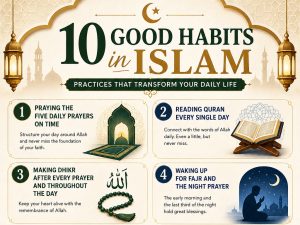
10 Good Habits in Islam: Practices That Transform Your Daily Life
Why Habits Matter in Islam
10 good habits in islam. Islam is not a religion that confines itself to grand moments of worship. It does not ask you to be religious only on Fridays, only in Ramadan, or only when something difficult happens. The entire architecture of Islamic practice is built around daily repetition, small consistent actions, and the transformation of ordinary moments into acts of worship. The Prophet, peace be upon him, made this explicit when he said that the most beloved deeds to Allah are those done consistently, even if they are small. That single teaching reframes everything. It means that a person who prays two voluntary rak’ahs every day without fail is doing something more beloved to Allah than someone who occasionally performs enormous acts of worship with long gaps in between.
This is the logic of Islamic habits. They are not about perfection. They are about consistency, about building a life in which the remembrance of Allah is woven into the fabric of every day, not reserved for special occasions. The ten habits below are drawn directly from the Sunnah of the Prophet and the teachings of the Quran. Each one is something a Muslim can begin today, build gradually, and sustain for a lifetime.
Also Read: What Is Islam? Everything you need to know.
Habit One: Praying the Five Daily Prayers on Time
Of all the habits a Muslim can build, this one is the foundation. The five daily prayers, Fajr, Dhuhr, Asr, Maghrib, and Isha, are not suggestions. They are the second pillar of Islam and an obligation on every adult Muslim. But beyond the obligation, there is a transformative power in praying on time that goes beyond simply fulfilling a religious duty.
Praying on time means structuring your entire day around the remembrance of Allah. It means that no matter what you are doing, every few hours you stop, turn toward the qiblah, and stand before your Creator. Work stops. Business pauses. Arguments cool. The concerns of the world recede, at least for a few minutes, and the person praying is reminded of what actually matters. This daily interruption of worldly life is not an inconvenience. It is the point.
The Prophet described salah as the coolness of his eyes, meaning it was the thing he turned to for comfort and rest. He also said that between a man and shirk and kufr is the abandonment of salah. The scholars have written extensively on the severity of this statement, but the practical implication is clear: the prayer is not something you fit into your schedule when convenient. Your schedule is built around the prayer.
Building this habit practically means knowing your prayer times and setting reminders if needed, keeping wudu as often as possible so that when the time comes you are ready, and gradually working on ensuring all five prayers are performed at or near their earliest time rather than rushed at the last minute or combined out of negligence. Start with whatever state you are in and build from there.
Habit Two: Reading Quran Every Single Day
The Quran is the word of Allah. That statement is easy to say and much harder to sit with fully. If a person genuinely believed that they were holding in their hands the actual words of the Creator of the universe, sent specifically as guidance for them personally, they would not leave it on a shelf for weeks at a time. The habit of daily Quran recitation is one of the most consistently emphasized practices in the Sunnah.
The Prophet said that the best of you is the one who learns the Quran and teaches it. He described the person who recites the Quran as like a citrus fruit, good in smell and good in taste. He described the heart that does not contain any Quran as a ruined house. The imagery is deliberately striking. A heart without Quran is described as derelict, uninhabited, falling apart.
The amount is secondary to the consistency. If you can only read half a page after Fajr, read half a page after Fajr every day without missing. If you can manage a full page, manage a full page. The scholars recommend dividing the Quran into thirty portions, one juz per day, which allows a complete reading every month. But that is an advanced habit. The beginner’s habit is simply: open the Quran every day. Read something. Reflect on what you read. Close it knowing that you maintained the connection for one more day.
Add to the recitation the habit of reading a brief tafsir or explanation of what you are reading. The Quran was not revealed to be chanted without comprehension. It was revealed to be understood, acted upon, and internalized. Even ten minutes of reading the meaning of what you recited moves your relationship with the Quran from ritual to genuine engagement.
Habit Three: Making Dhikr After Every Prayer and Throughout the Day
Dhikr is the Arabic word for remembrance, and in Islamic practice it refers to the specific formulas of praise, glorification, and acknowledgment of Allah that a Muslim repeats throughout the day. The Quran says: “Verily, in the remembrance of Allah do hearts find rest.” That is not a metaphor. It is a description of how the human heart actually functions when it is connected to its Creator.
After every obligatory prayer, the Prophet had a consistent routine of dhikr. He would say SubhanAllah thirty-three times, Alhamdulillah thirty-three times, and Allahu Akbar thirty-three times, completing one hundred with La ilaha illallah wahdahu la sharika lah, lahul mulku wa lahul hamdu wa huwa ala kulli shay’in qadeer. This dhikr takes approximately two minutes. Performed after all five prayers, it takes ten minutes of the day. The reward described in the hadith for this practice is the forgiveness of sins even if they are as abundant as the foam of the sea.
Beyond the post-prayer dhikr, Islam prescribes remembrance for virtually every moment of the day. There are adhkar for waking up, for entering and leaving the bathroom, for putting on clothes, for leaving the house, for entering and leaving the mosque, for eating, for drinking, for traveling, for entering a new place, for hearing thunder, for seeing something pleasing, for sneezing, for lying down to sleep, and for everything in between. The comprehensive collection of these daily remembrances is found in the book Hisnul Muslim, known in English as Fortress of the Muslim, which every Muslim household should own and use.
Building the dhikr habit means starting small. Pick the post-Fajr dhikr and the before-sleep adhkar and do those consistently for a month before adding more. Consistency with two adhkar is worth more than attempting all of them for three days and abandoning them.
Habit Four: Waking Up for Fajr and the Night Prayer
Fajr is the most difficult prayer for most Muslims in practical terms because it requires waking up before sunrise, often in the dark, when the body resists. The Prophet described Fajr as the prayer that the hypocrites find most difficult to attend. That description is meant not to shame but to motivate. The difficulty is real, and overcoming it regularly is itself a form of worship.
Beyond Fajr, the night prayer, known as Tahajjud or Qiyamul Layl, is described in the Quran and Sunnah as one of the highest voluntary acts of worship available to a Muslim. Allah praises those who spend portions of the night in prayer. The Prophet said that the best prayer after the obligatory prayers is the night prayer. He also said that Allah descends to the nearest heaven in the last third of every night and asks: is there anyone calling on Me so I may answer? Is there anyone asking so I may give? Is there anyone seeking forgiveness so I may forgive?
The last third of the night, the hour or so before Fajr, is described as a time of extraordinary spiritual receptivity. Duas made at this time, tears shed at this time, and prayers offered at this time carry a weight that the same acts at other times do not. Building the habit of waking even twenty minutes before Fajr to make dua and pray two extra rak’ahs is one of the most powerful spiritual investments a Muslim can make.
Start with protecting Fajr first. Ensure you never miss it, even if it means setting multiple alarms, sleeping earlier, or asking someone to wake you. Once Fajr is secured as an unbreakable habit, begin experimenting with waking earlier for Tahajjud, even just occasionally at first, until it becomes regular.
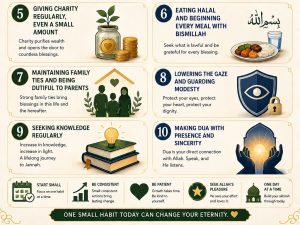
Habit Five: Giving Charity Regularly, Even a Small Amount
The Prophet said that charity extinguishes sin the way water extinguishes fire. He also said that every day the sun rises, there is a duty on every joint of the human body to give charity, and that among the things that fulfill this duty is every act of kindness, every good word, and every helping hand. Voluntary charity, known as sadaqah, is one of the habits most consistently encouraged across the Quran and the Sunnah.
What makes the Islamic approach to charity as a habit particularly accessible is that the Prophet explicitly removed the barrier of wealth. He was asked what a person should do if they have nothing to give, and he said that even removing a harmful thing from the road is sadaqah. Smiling at your brother is sadaqah. Saying a good word is sadaqah. Guiding someone who is lost is sadaqah.
That said, the habit of giving money regularly, even a small fixed amount, is a specific practice with its own rewards. Some scholars recommend setting aside a small portion of income every week, even as little as whatever equivalent to a few coins, and giving it consistently. The Prophet described the person who gives even a date in charity as having that charity grown by Allah into something the size of a mountain by the Day of Judgment.
The deeper purpose of the charity habit is what it does to the heart of the giver. Regular giving loosens the grip of attachment to wealth. It trains the nafs, the self, to release rather than hoard. It builds a orientation toward generosity that begins to affect every relationship and every transaction in a person’s life. The person who gives regularly becomes, over time, a more open-hearted person in ways that extend far beyond the act of giving money.
Habit Six: Eating Halal and Beginning Every Meal With Bismillah
The Prophet said: “Every action of consequence begins with Bismillah, and if it does not begin with Bismillah, it is cut off from blessing.” Beginning meals with Bismillah is a Sunnah that takes a single second but transforms the act of eating from a biological function into a conscious acknowledgment of the One who provided the food.
The Quran is direct about the importance of halal consumption. It tells believers to eat from what is good and lawful. The scholars have discussed extensively the relationship between what a person consumes and the state of their heart. Ibn Al-Qayyim wrote in detail about how the food a person eats affects their capacity for worship, their emotional states, and their spiritual receptivity. A body nourished by haram, whether in the nature of the food itself or in how it was earned, is a body whose spiritual faculties are dulled.
Building the halal eating habit is not only about avoiding pork and ensuring meat is properly slaughtered, though those are the obvious starting points. It extends to ensuring that the money used to buy food is itself halal, earned through honest means. It extends to not wasting food, because the Prophet prohibited israf, excess and wastefulness, particularly in eating. It extends to the etiquette of eating: using the right hand, eating from what is nearest to you, not criticizing food, and not eating in a reclining position as the Prophet discouraged that posture.
Add to Bismillah the habit of saying Alhamdulillah after finishing eating, as the Prophet taught. The meal becomes bracketed by the remembrance of Allah, a small but consistent act that reminds the person eating that sustenance is a gift, not an entitlement.
Habit Seven: Maintaining Family Ties and Being Dutiful to Parents
Silatur rahim, maintaining the ties of kinship, is described in Islam as one of the actions most directly connected to blessings in this world and the next. The Prophet said that whoever wishes to have their provision expanded and their life lengthened should maintain their family ties. He also said that the person who severs family ties will not enter Paradise.
The duty to parents is given even greater emphasis. The Quran places the duty to parents immediately after the duty to Allah in multiple verses. It commands not only obedience to parents but kindness, specifically prohibiting even the word “uff,” a mild expression of irritation, toward them. The scholars explain that this prohibition of the lightest expression of annoyance establishes by implication that anything harsher is more severely prohibited.
Building this as a daily or weekly habit means making a phone call to a parent or sibling not because something is needed but simply to check in. It means visiting relatives regularly. It means not letting grudges fester within families to the point of cutting off contact. The Prophet gave special attention to maintaining ties with relatives who are difficult, saying that true silatur rahim is not returning the kindness of those who are already kind to you but maintaining connection with those who have cut you off or treated you badly.
This habit has an almost guaranteed worldly return. Strong family ties produce networks of support, goodwill, and love that carry a person through difficulties that would otherwise be faced alone. What Islam frames as religious duty, human experience confirms as practical wisdom.
Habit Eight: Lowering the Gaze and Guarding Modesty
The Quran commands both men and women to lower their gaze and guard their modesty. This is addressed in Surah An-Nur directly, and the command is given to men first before women, which the scholars note as significant. Lowering the gaze is not a passive or occasional act. It is an active daily discipline that requires conscious effort, particularly in an era of smartphones, social media, and a culture saturated with visual content designed to capture and hold attention.
The Prophet described the gaze as a poisoned arrow of Shaytan. He also said that the zina of the eye is looking, and that Allah has written for every son of Adam his share of zina, and the eye’s share is the forbidden look. This connects the seemingly small act of what you choose to look at to the broader question of who is in control of your desires and attention, you or whatever happens to appear in front of you.
Building this habit is one of the most counter-cultural things a Muslim can do in contemporary life. It requires a deliberate decision about what you allow into your eyes, which means being intentional about social media consumption, about what content you watch, about where your eyes go in public spaces, and about the overall relationship between your gaze and your inner state. The scholars note that every unlawful look dims the light of the heart incrementally, in ways that may not be immediately obvious but accumulate over time.
The positive dimension of this habit is what it cultivates: a sense of inner dignity, a freedom from the restlessness that comes from an undisciplined eye, and a clarity of heart that makes worship feel more natural and less effortful.
Also Read: What Is Dhul Hijjah in Islam?
Habit Nine: Seeking Knowledge Regularly
The first word revealed in the Quran was Iqra. Read. Recite. The first revelation did not begin with a law, a prohibition, or a ritual. It began with a command to engage the mind. The Prophet said that seeking knowledge is an obligation upon every Muslim. He said that whoever travels a path seeking knowledge, Allah makes easy for them a path to Paradise. He said that scholars are the inheritors of the prophets.
The knowledge referred to here is primarily Islamic knowledge: understanding the Quran, the Sunnah, the basics of fiqh that govern daily worship and transactions, the lives of the prophets, the biographies of the companions, the history of Islam, and the sciences of the heart. This does not require enrolling in a formal institution, though that is excellent. It requires committing regular time to learning.
Building this habit practically looks like this: pick one Islamic book and read it consistently until it is finished. Attend a weekly halaqah, study circle, at your local mosque. Listen to one Islamic lecture a week on a topic you genuinely need to understand better. Learn the meaning of the surahs you recite most frequently in prayer so that your prayer becomes a conversation you understand rather than words you repeat. Over years, this consistent investment in knowledge produces a Muslim who is grounded, who can answer questions about their religion, who is not easily misled by either extremism or modernist dilution, and who has a relationship with their religion that is intellectual as well as emotional.
Habit Ten: Making Dua With Presence and Sincerity
Dua is described in Islam as the weapon of the believer and the essence of worship. The Prophet said that dua is worship, and he recited the verse in which Allah says: “Call upon Me, I will respond to you.” The connection is direct and personal. You speak to Allah. He hears you. He responds in ways that may be immediate, delayed, or redirected to a greater benefit you do not yet see, but He does not ignore.
The tragedy of many Muslims is that dua has become a formality, words repeated by habit without presence, without the conviction that Allah is actually listening, without any real expectation of response. The scholars describe this as one of the main reasons duas are not answered: the heart is absent from the tongue.
Building the dua habit means carving out dedicated time for sincere conversation with Allah. After every obligatory prayer is an excellent time. The last third of the night before Fajr is even more powerful. The moment of breaking fast during Ramadan is described as a time when dua is not rejected. Dua while prostrating in sujud is also specifically encouraged, as the Prophet said the servant is closest to their Lord while in prostration.
What to ask for is everything. No request is too small or too large for Allah. Ask for the guidance of a family member. Ask for ease in your work. Ask for protection from specific sins you struggle with. Ask for the wellbeing of Muslims who are suffering. Ask for Jannatul Firdaus, the highest level of Paradise, without feeling that it is presumptuous, because the Prophet himself instructed the believers to ask for Al-Firdaus specifically.
The habit of dua ultimately builds a relationship. A Muslim who speaks to Allah daily, not just in formal prayer but in the direct, unscripted conversation of personal supplication, is a Muslim who knows they are not alone in anything they face. That knowledge, carried consistently through years of the dua habit, is one of the most stabilizing and strengthening forces a human being can have.
Building These Habits: A Realistic Approach
Do not attempt all ten at once. That is the fastest path to attempting nothing. Pick the one that feels most important or most neglected in your life right now and work on it exclusively for thirty days. Add the next one once the first feels natural. This is how the Prophet built his community: gradually, consistently, with mercy for human limitation and with the understanding that small actions done steadily outweigh grand gestures done occasionally.
The goal is not a flawless religious performance. The goal is a life in which Allah is genuinely present: in what you eat, in what you see, in how you treat your family, in how you spend your money, in the first thing you say when you wake up and the last thing you say before you sleep. That life is built one small habit at a time, and it is available to any Muslim willing to begin.
About The Author
