
Five Pillars of Islam
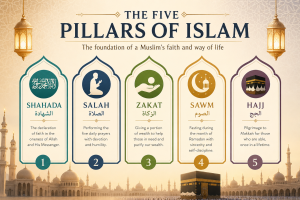
Foundation of Faith: An Exploration of the Five Pillars of Islam
Five Pillars of Islam. Before you Worship Allah, you must know that there is None like him. And the next thing to know is The Five pillars of Islam. Believe in one God and Prophet Muhammad is the Messenger of God, Pray five times Daily, Alms Giving to the poor, Fasting During the month of Ramadan 29 or 30 days, Go to Mecca and Medina to perform Hajj. The spiritual architecture of Islam is built upon five fundamental practices that serve as the core framework for a believer’s life. These are commonly referred to as the Five Pillars of Islam.
Just as a physical structure relies on its pillars to remain upright and resilient against external pressures, the spiritual life of a Muslim is sustained and defined by these five essential acts. They are not merely rituals performed in isolation; rather, they are deeply interconnected commitments that shape an individual’s relationship with the Creator, their own soul, and the broader human community.
In an increasingly complex and fast-paced world, these pillars provide a sense of stability, purpose, and rhythm. They represent a comprehensive system of self-discipline, social justice, and spiritual mindfulness. To understand the Five Pillars is to understand the heartbeat of Islamic practice and the ethical compass that guides millions of people across diverse cultures and geographies.
Also Read: Philosophy of Speech in Islamic Ethics
Shahada: The Declaration of Faith
Believe in One God and Prophet Muhammad is his Messenger. The first and most foundational pillar is the Shahada, the testimony of faith. It is the gateway through which one enters the fold of Islam and the constant refrain that echoes throughout a Muslim’s life. The declaration consists of two profound parts: “There is no god but Allah, and Muhammad is the messenger of Allah.”
This statement is more than just a verbal utterance; it is a radical affirmation of monotheism (Tawhid). By declaring that there is no deity worthy of worship except the One Creator, a believer rejects all forms of idolatry, whether physical objects or internal obsessions like wealth, power, or ego. It is an act of spiritual liberation, placing the ultimate authority and source of meaning outside the realm of the created and into the hands of the Eternal.
The second part of the Shahada recognizes the role of the Prophet Muhammad as the final recipient of divine revelation. This acknowledges that while God is the source of guidance, that guidance is mediated through human experience and historical reality. Following the messenger implies an commitment to the values of mercy, integrity, and justice that he embodied. The Shahada is the intellectual and emotional anchor of the faith, providing the “why” behind every other action a believer takes.
Salah: The Ritual Prayer
Pray Five times Daily. If the Shahada is the anchor, Salah is the rhythm of the soul. Muslims are required to perform five daily prayers at specific intervals: dawn (Fajr), noon (Dhuhr), afternoon (Asr), sunset (Maghrib), and night (Isha). This cycle ensures that a believer never goes too long without reconnecting with their spiritual source.
Salah is a unique form of communication that involves the mind, the tongue, and the body. The physical postures—standing, bowing, and prostrating—symbolize different states of the human soul in relation to the Divine: standing in attention, bowing in respect, and prostrating in total humility. This physical engagement prevents the prayer from becoming a purely abstract or intellectual exercise; it grounds the spiritual experience in the physical reality of the body.
Furthermore, Salah serves as a powerful tool for time management and psychological well-being. In a world of constant distractions, the call to prayer (Adhan) acts as a mandatory pause. It forces the individual to step away from their worldly concerns—work, stress, social media—and refocus on what is ultimate. This regular “reset” helps maintain a sense of perspective and inner peace. When performed in congregation, Salah also reinforces social equality, as people from all walks of life stand shoulder-to-shoulder, emphasizing that in the eyes of the Creator, all are equal.
Also Read: The Signs of a Hypocrite (Munafiq)
Zakat: The Almsgiving
Alms Giving to the Poor. The third pillar, Zakat, transforms the spiritual impulse into a social reality. It is the mandatory giving of a specific portion of one’s surplus wealth (typically 2.5%) to those in need. In Islamic ethics, wealth is not seen as an absolute personal possession but as a trust (Amanah) from God. Zakat is the mechanism through which the “rights” of the poor in the wealth of the rich are fulfilled.
The word “Zakat” itself means purification and growth. By giving away a portion of their earnings, the believer purifies their wealth from greed and selfishness. It is an acknowledgment that one’s success is not solely the result of personal effort but is facilitated by a wider social and divine context. Psychologically, Zakat helps detach the heart from the love of material accumulation, fostering a spirit of generosity and empathy.
On a societal level, Zakat acts as a primitive but effective form of social security. It aims to redistribute wealth to ensure that the basic needs of the most vulnerable—the orphans, the widows, the destitute, and the travelers—are met. It is not an act of “charity” in the sense of a voluntary favor, but an act of “justice” that maintains the equilibrium of the community. It fosters a sense of mutual responsibility, where the prosperity of one is linked to the well-being of all.
Sawm: Fasting During Ramadan
Fasting During the month of Ramadan. The fourth pillar is Sawm, the act of fasting from dawn until sunset during the ninth month of the Islamic calendar, Ramadan. During these daylight hours, Muslims abstain from food, drink, and intimate relations. However, the physical fast is only the outer shell of a much deeper spiritual exercise.
Sawm is a school of self-discipline and willpower. By voluntarily denying the most basic human needs, the believer proves to themselves that they are not a slave to their desires. It is a period of intense self-reflection, where the individual seeks to “starve the ego and feed the soul.” The increased focus on prayer, the recitation of the Quran, and acts of kindness during this month heightens one’s spiritual sensitivity.
Fasting also serves as a profound lesson in empathy. When a person experiences the pangs of hunger and the parchedness of thirst, their understanding of the plight of the hungry becomes experiential rather than just intellectual. This heightened awareness naturally leads to increased generosity. Ramadan is often the time when communal bonds are strongest, as families and friends gather for the Iftar (breaking of the fast), sharing food and gratitude. It is a month of communal healing and spiritual rejuvenation.
Hajj: The Pilgrimage to Mecca
Go to Mecca and Medina to perform Hajj. The final pillar is the Hajj, the pilgrimage to the holy city of Mecca, which every Muslim who is physically and financially able is expected to perform at least once in their lifetime. Hajj is the ultimate spiritual journey, representing a return to the origins of the faith and a rehearsal for the Day of Judgment.
The rituals of Hajj are deeply symbolic. Pilgrims wear the Ihram—two simple white unstitched cloths—which removes all markers of wealth, status, and nationality. In the vast crowds at the Kaaba or on the plains of Arafat, a king is indistinguishable from a laborer. This radical equality is one of the most powerful aspects of the Hajj, reminding the believer of their essential humanity and their shared destination.
Hajj is also a journey of endurance and sacrifice. It requires leaving behind the comforts of home and navigating a challenging environment alongside millions of others.
This physical struggle is meant to mirror the internal struggle of the soul toward purification. The culmination of the Hajj is a sense of rebirth; many pilgrims return home with a renewed commitment to their faith and a broader, more inclusive perspective on the global human family. It is a profound demonstration of unity in diversity.
Interconnectedness of the Pillars
While each pillar has its own specific requirements and benefits, they are best understood as a unified system. The Shahada provides the intention; Salah provides the daily discipline; Zakat provides the social conscience; Sawm provides the internal strength; and Hajj provides the ultimate perspective. Together, they create a balanced life that addresses the needs of the individual and the needs of society.
A person who practices Salah but ignores Zakat has a disconnected spirituality that fails to manifest as social compassion. Conversely, a person who gives to charity but neglects prayer may find their actions lacking a consistent spiritual anchor. The Five Pillars demand a holistic approach to life, where the vertical relationship with God is always balanced by the horizontal relationship with fellow human beings.
Also Read: The Concept of Lowering the Gaze in Islamic Ethics
Conclusion
The Five Pillars of Islam are not ancient relics but living practices that continue to shape the lives of nearly two billion people. They offer a path toward meaning in an era that often feels fragmented and chaotic. By grounding the believer in regular acts of devotion, generosity, and self-restraint, these pillars help cultivate a character defined by peace, integrity, and service.
In the end, the pillars are a means to an end: the attainment of a “sound heart” (Qalbun Salim). They are the tools given to the believer to navigate the complexities of existence while remaining true to their highest ideals. Whether through the quiet whisper of the Shahada, the focused movements of Salah, the hidden act of Zakat, the patient hunger of Sawm, or the epic journey of Hajj, the Five Pillars represent the enduring human quest for connection with the Divine and harmony with the world.
About The Author
