
How to Perform Ghusl Janabah
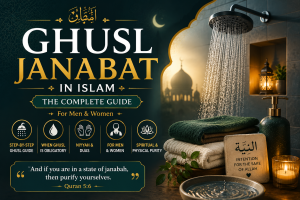
How to Perform Ghusl Janabah
What Is Janabah and Why Ghusl Becomes Obligatory
How to Perform Ghusl Janabah. Janabah is a state of major ritual impurity in Islam that arises from two specific causes: sexual intercourse, whether or not ejaculation occurs, and the discharge of semen, whether through a wet dream, masturbation, or any other means. When either of these occurs, a person enters the state of janabah and is required to perform ghusl before they can pray, fast, recite the Quran, touch the Mushaf, perform tawaf, or enter a mosque.
This is not a matter of cultural custom or personal hygiene preference. It is a religious obligation clearly established in the Quran and the Sunnah of the Prophet, peace be upon him. Allah says in Surah Al-Maidah: “If you are in a state of janabah, then purify yourselves.” The scholars of all four major schools of Islamic law are in complete agreement on this ruling. There is no room for ambiguity about whether it is required.
What is worth understanding before going through the steps is the distinction between what makes ghusl valid and what makes it complete in the full Sunnah sense. A ghusl that covers the obligatory minimums is valid and lifts the state of janabah. A ghusl performed the way the Prophet performed it is both valid and rewarded in its own right. This guide covers both so you know exactly what you are doing and why.
Also Read: How to Perform Ghusl Nifas in Islam
What Causes Janabah?
Before getting into the how, it is worth being precise about what actually puts a person in the state of janabah, because there are common misconceptions.
Sexual intercourse between spouses makes both partners junub (in the state of janabah) regardless of whether either person ejaculates. The ruling is tied to penetration itself. This comes from the hadith of the Prophet: “When a man sits between the four parts of a woman and the two circumcised parts meet, ghusl becomes obligatory.” Ejaculation does not need to happen. This is the position of the majority of scholars.
Ejaculation of semen outside of intercourse also makes a person junub. This includes wet dreams, which scholars refer to as ihtilam. If a person wakes up and finds traces of semen on their clothing or body, ghusl is obligatory. If they remember dreaming but find nothing, most scholars say ghusl is not required. If they find traces but do not remember dreaming, ghusl is still obligatory because the evidence is there on the body.
One thing that does not cause janabah is pre-seminal fluid, which is the clear fluid that sometimes exits before ejaculation. The majority position, including the Shafi’i and Maliki schools, is that pre-seminal fluid does not require ghusl, only wudu. The Hanafi school holds that it requires the washing of the affected area and wudu. In all schools, it does not trigger the obligation of ghusl.
The Obligatory Acts of Ghusl Janabah
This is the most important section to understand before reading the step-by-step. If you know what is obligatory, you know what cannot be left out under any circumstance. If you know what is recommended, you know what earns extra reward but whose omission does not invalidate the ghusl.
The obligatory acts of ghusl, on which there is broad scholarly agreement, are three. The first is the intention in the heart. The second is ensuring that water reaches the entire outer surface of the body, including all skin and hair. The third is removing any visible physical impurity from the body before or during the wash.
The Hanafi and Hanbali schools add two more obligatory acts: rinsing the mouth by gargling water inside it, and rinsing the nose by sniffing water in and expelling it. In the Shafi’i and Maliki schools, these are strongly recommended but not obligatory.
Performing wudu before the main wash, washing in a specific order of right then left, and beginning with the head are all part of the Sunnah method. They are not obligatory in the strict sense, but they are the way the Prophet performed ghusl and are the complete and proper way to do it.
Step One: Make the Intention
As with all acts of worship in Islam, ghusl begins with the niyyah, the intention. You make it in your heart that you are performing this ghusl to lift the state of janabah. Nothing is said out loud. No specific Arabic phrase is required. No verbal formula needs to be recited. Simply being internally aware and resolute that this is what you are doing, and doing it for the sake of purification, is the intention.
If you get under the shower without any awareness that you are performing ghusl, just washing your body out of routine habit, it does not count as the ritual bath. The intention is what distinguishes the act of worship from ordinary hygiene. This is a principle that applies across Islamic worship and it applies here too.
Also Read: How to Bath After Menstruation in Islam
Step Two: Say Bismillah
Before you begin, say Bismillah. In the Hanafi and Hanbali schools this is obligatory if you remember it. In the Shafi’i and Maliki schools it is strongly recommended. Either way, it takes a moment and marks the beginning of a deliberate act of worship. Do not skip it out of habit or forgetfulness. Make it part of your routine each time you perform ghusl.
Step Three: Wash Both Hands Three Times
Before touching anything else, wash both hands thoroughly up to the wrists three times. This step comes directly from multiple authentic narrations describing the ghusl of the Prophet. Aisha and Maymunah, both wives of the Prophet, described his ghusl in detail in Sahih Bukhari and Sahih Muslim, and both mention that he began by washing his hands. The reason is practical as well as ritual: you want clean hands before you begin cleaning the rest of your body and handling water.
Step Four: Clean the Private Area and Remove Any Impurity
Use your left hand to wash the private area and remove any traces of semen, discharge, or other impurity. This must be done thoroughly. The private parts, the area around them, and any skin on the body that has visible impurity on it must be cleaned with water at this stage. Rubbing with the left hand while pouring water over the area is the method described in the narrations.
This step is obligatory. Ghusl water running over a surface that still has visible impurity on it does not count as purification for that area. You must remove the impurity first and then the water of ghusl follows. Do not rush through this part.
After washing the private area, wash the left hand again thoroughly with soap or by rubbing it against the ground or a clean surface, as described in some narrations.
Step Five: Perform Wudu
At this point, perform a full wudu. This means washing the face including rinsing the mouth by gargling water and rinsing the nose by sniffing water in and blowing it out, washing both arms up to and including the elbows, wiping over the head, and washing the feet. This is part of the established Sunnah method of ghusl janabah and is described in the narrations of both Aisha and Maymunah.
The practical wisdom here is that wudu performed as part of ghusl is counted by the majority of scholars as covering the minor purification entirely. This means that after completing a valid ghusl, you do not need to perform a separate wudu before praying, unless something happens to break your wudu between finishing the ghusl and praying.
If you are standing in a basin or drain area where water pools at your feet, you may delay washing the feet until the very end of the ghusl so that you wash them last on clean ground.
Step Six: Pour Water Over the Head Three Times and Wet the Scalp and Hair Roots
This is where the main ghusl wash begins. Pour water over the entire head three times. With each pour, use your fingers to rub and massage the scalp so that water genuinely reaches the roots of the hair. The obligation here is that water must reach the actual skin of the scalp, not just the surface of the hair.
For men with short hair this is straightforward. For men with longer hair, and for women performing ghusl janabah rather than ghusl hayd, the same principle applies: the roots must be reached. Unlike ghusl hayd where Umm Salamah was specifically told she did not need to undo her plaited hair, no such exemption is narrated for ghusl janabah. However, the majority of scholars extend that ruling to ghusl janabah as well, meaning that a woman with tightly braided hair does not need to undo it provided she can genuinely saturate the roots. If the braids are so dense or sealed that water cannot penetrate to the scalp, undoing them is necessary.
Three pours over the head is the Sunnah. One thorough drenching that reaches the scalp is the obligatory minimum.
Step Seven: Wash the Right Side of the Body, Then the Left
After the head, pour water over the right side of the body first, then the left. Use your hands to rub the water across every part of the skin as you go. This is not passive. You are not simply standing under a shower and letting water run over you. You are actively guiding water to every surface of the body and rubbing it in to ensure contact.
Every part of the outer body surface must have water reach it. The list of areas that are commonly missed includes: the inside of the navel, the area behind the ears, the underarms, the skin behind the knees, between the toes, beneath the chin, the back of the neck, skin folds in the stomach or thighs if present, and the back between the shoulder blades. Run your hands over every part of your body deliberately as you wash.
If you are using a shower, do not assume the falling water is doing the work. Move your hands across every surface. If you are using a basin or bucket, pour water over each section and rub immediately after.
Step Eight: Wash the Feet (If Delayed)
If you delayed washing your feet during wudu because you were standing in pooling water, wash them now after stepping onto clean ground. This completes the ghusl.
The Dua After Ghusl
After completing ghusl, you may recite the same supplication that is said after wudu: “Ashhadu an la ilaha illallah wahdahu la sharika lah, wa ashhadu anna Muhammadan abduhu wa rasuluh. Allahumma-j’alni min at-tawwabin waj’alni min al-mutatahhirin.” This translates roughly as: “I bear witness that there is no god but Allah alone with no partner, and I bear witness that Muhammad is His servant and messenger. O Allah, make me of those who repent and make me of those who purify themselves.” This is based on the hadith narrated by Tirmidhi and Ibn Majah regarding the supplication after wudu, and scholars extend it to ghusl.
Common Questions About Ghusl Janabah
Does a wet dream require ghusl for both men and women?
Yes. Scholars agree that if a woman has a wet dream and wakes to find fluid discharge, ghusl is obligatory on her just as it is on a man. The Prophet confirmed this explicitly when Umm Sulaym asked him about it, and he said yes, if she sees water, meaning the fluid. The confusion arises because women often do not notice discharge as clearly as men notice semen, but the ruling is the same.
What if a person is unsure whether they ejaculated?
If a person feels a strong sensation that usually accompanies ejaculation and then finds traces of fluid, ghusl is obligatory. If there is genuine doubt and no trace is found, the majority scholarly position is that ghusl is not required in cases of pure doubt without evidence. Wudu would be performed and the person moves on.
Can ghusl be performed with any water?
The water used must be tahir and mutlaq, meaning it is pure and has not been used previously for purification and has not changed significantly in smell, color, or taste due to a foreign substance. Tap water, rain water, well water, river water, and sea water all qualify. Scented water, flavored water, or water that has changed significantly in nature does not.
What about nail polish?
Conventional nail polish creates a waterproof seal over the nail surface. Since water reaching the entire outer body surface is obligatory, ghusl performed with nail polish intact is not valid according to the majority of scholars. Remove it before performing ghusl. Some water-permeable brands have been approved by certain scholars after testing, but this remains disputed, and the safe position is to remove all nail polish before any obligatory ghusl.
Does ghusl janabah cover wudu?
Yes, according to the majority of scholars. A valid ghusl janabah that includes rinsing the mouth and nose also lifts the state of minor impurity and makes a separate wudu unnecessary before prayer, provided nothing breaks the wudu after the ghusl is completed.
What if water is genuinely unavailable?
If a person is in a situation where water is completely unavailable or using it would cause genuine physical harm, tayammum is performed instead as a temporary substitute. Tayammum lifts the state of janabah temporarily and permits prayer, but as soon as water becomes available and its use is safe, ghusl must be performed.
For Males Specifically: Circumcision and Beneath the Foreskin
For uncircumcised men, it is obligatory to ensure that water reaches beneath the foreskin during ghusl janabah. This area does not cleanse itself simply by water running over the outside. The foreskin must be retracted and the skin beneath it washed directly. Scholars across all major schools are clear on this point. Neglecting this area would mean part of the obligatory wash was missed and the ghusl would be incomplete.
Also Read: When is Islam Makhachev Next Fight
A Practical Note on Showers vs. Basins
Many Muslims perform ghusl under a running shower, which is perfectly valid, but it comes with a practical risk: the assumption that the shower spray is doing all the work. It is not. A shower delivers water passively. The obligation requires that water make contact with the entire body surface, and actively rubbing the skin with your hands is the only reliable way to ensure this happens. Use your hands throughout. Check the overlooked areas deliberately. Do not treat ghusl like a routine shower where you wash selectively and stand under the stream for a while. Treat it as an intentional, thorough act of worship that covers every inch of skin.
In Conclusiond
Ghusl janabah is one of the most frequently performed ritual acts in the life of a married Muslim, and yet it is one that many people perform without fully understanding what makes it valid, what makes it complete, and what the common errors are. The steps are genuinely simple once understood, but simplicity is not the same as carelessness.
Performing ghusl with proper intention, in the order the Prophet demonstrated, ensuring every part of the body is reached, and knowing the difference between what is obligatory and what is recommended — this is what gives the act of purification its completeness. It is not just about being physically clean. It is an act of returning to a state that permits the highest acts of worship. That transition deserves to be done properly.
About The Author
