
Ten Companions Promised Paradise: Al-Ashara Al-Mubashara
The Most Honoured Group in Islamic History
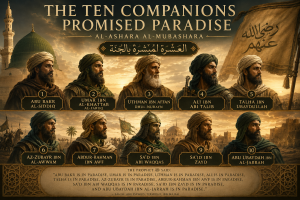
Ten Companions Promised Paradise: Al-Ashara Al-Mubashara. Among the 124,000 companions who walked with the Prophet Muhammad, peace be upon him, there is a group of ten men whose status stands entirely apart from the rest. These are the Ashara Mubashara, an Arabic phrase that translates directly as the ten who were given glad tidings, or more commonly in English, the ten companions promised Paradise. What makes their position unique is not simply that they were great Muslims, though they were, and not simply that they served Islam faithfully, though they did. What makes their position singular in all of Islamic history is that the Prophet himself, while they were still alive and walking the earth, named each one of them individually and declared that they would be in Paradise.
This declaration is narrated in a hadith collected by Abu Dawud, Tirmidhi, and Ibn Majah, and it is graded as sahih, authentic. The Prophet, peace be upon him, said: “Abu Bakr is in Paradise, Umar is in Paradise, Uthman is in Paradise, Ali is in Paradise, Talha is in Paradise, Az-Zubayr is in Paradise, Abdur-Rahman ibn Awf is in Paradise, Sa’d ibn Abi Waqqas is in Paradise, Sa’id ibn Zayd is in Paradise, and Abu Ubaydah ibn Al-Jarrah is in Paradise.”
Ten names. Ten guarantees. Given not after their deaths but while they lived, breathed, and continued to be tested by this world. Understanding who each of these men was, what they did for Islam, and why they earned this distinction is one of the most enriching studies a Muslim can undertake.
One: Abu Bakr Al-Siddiq
Abu Bakr’s full name was Abdullah ibn Abi Quhafah, and he was given the title Al-Siddiq, meaning the one who affirms truth with great conviction. He was born approximately two years after the Prophet and was the closest friend the Prophet had among men throughout his adult life. When the Prophet received the first revelation and came home shaking, it was his wife Khadijah who comforted him first. But when the Prophet began to share the message publicly, it was Abu Bakr who was the first adult free man to accept Islam without a moment of hesitation.
Abu Bakr spent his considerable personal wealth in the service of Islam. He purchased and freed enslaved Muslims who were being tortured for their faith, including Bilal ibn Rabah, the man who would become the first muadhdhin in Islamic history. He accompanied the Prophet on the Hijrah migration to Madinah, hiding with him in the cave of Thawr when the Quraysh search party was at the cave entrance. The Quran references this moment directly in Surah At-Tawbah, where Allah says: “He was the second of two when they were in the cave.” That is one of only two explicit references to a companion by situation in the entire Quran.
After the Prophet’s death in 632 CE, Abu Bakr became the first Caliph of Islam. He ruled for only two years and three months, but in that short time he preserved the unity of the Muslim community, which was fracturing under the weight of grief and the actions of those who refused to pay zakat after the Prophet’s death, and he initiated the compilation of the Quran into a single written document. He died in 634 CE at approximately 63 years old, the same age as the Prophet. He was buried beside the Prophet in what is now the Prophet’s Mosque in Madinah.
Also Read: 10 Good Habits in Islam
Two: Umar ibn Al-Khattab Al-Faruq
Umar ibn Al-Khattab is one of the most towering figures in Islamic history. He was given the title Al-Faruq by the Prophet, meaning the one who distinguishes between truth and falsehood. Before his conversion to Islam, Umar was one of the most feared opponents of the Muslims. He was physically powerful, strong-willed, and deeply tribal in his loyalties. His conversion to Islam is one of the most dramatic stories in the early Muslim community and happened after he set out with the intention of killing the Prophet.
The details of his conversion vary in narration, but what is agreed is that hearing some verses of the Quran recited broke something open inside him that his anger could not hold shut. He went directly to the Prophet and declared his Islam. The Prophet reportedly made dua asking that Islam be strengthened by either Umar ibn Al-Khattab or Amr ibn Hisham, known as Abu Jahl. It was Umar who answered that dua.
Umar served as the second Caliph from 634 to 644 CE. Under his leadership, the Islamic state expanded at a pace that shocked the world. Persia, Egypt, Syria, and Palestine all came under Islamic governance during his caliphate. He was famous for the simplicity of his personal life despite governing the largest empire of his era. He wore patched clothing, slept on a simple mat, and walked through the streets of Madinah at night to check on the welfare of his people personally. He was assassinated while leading Fajr prayer in 644 CE by a Persian man named Abu Lu’lu’ah. He died asking that his funeral be simple and his debts paid, and he was buried beside the Prophet and Abu Bakr.
Also Read: What Is Islam? Everything you need to know.
Three: Uthman ibn Affan Dhul-Nurayn
Uthman was given the title Dhul-Nurayn, meaning the one with two lights, because he married two daughters of the Prophet in succession. He first married Ruqayyah, and when she died, he married Umm Kulthum. No other man in history married two daughters of a prophet, which is why this distinction became his defining title.
Uthman was a wealthy merchant from the noble Umayyad clan of Quraysh and one of the earliest converts to Islam. He was known above all for his extraordinary generosity. When the Muslim army was preparing for the campaign of Tabuk and was desperately short of supplies and funds, Uthman equipped a third of the entire army from his personal wealth. The Prophet asked who would purchase the well of Rumah, a private well that the Muslims had to buy water from, and make it free for all Muslims. Uthman bought it and dedicated it as a public good.
He became the third Caliph in 644 CE following Umar’s assassination. His caliphate, which lasted twelve years, produced perhaps the most consequential act in Islamic textual history: the standardization of the Quran into a single authoritative written form with copies sent to all major Muslim cities. This is the Quran that Muslims read today, and it is known as the Uthmanic mushaf. In his later years he faced internal political opposition and revolt. He was assassinated in his home in Madinah in 656 CE while reading the Quran. His blood fell on the page.
Four: Ali ibn Abi Talib
Ali ibn Abi Talib was the cousin of the Prophet and later his son-in-law through his marriage to Fatimah, the Prophet’s daughter and most beloved child. He was one of the very first people to accept Islam, possibly the first male child to do so, having accepted at approximately ten years of age while living in the Prophet’s household.
Ali was known for three things above all others: his courage in battle, his profound knowledge of Islam, and his deep spiritual connection to the Prophet. He was the standard bearer of the Muslim army in numerous battles and fought with extraordinary valor at Badr, Uhud, Khaybar, and others. The Prophet gave him his own sword, Dhul Fiqar, a double-pointed blade that became one of the most iconic symbols of early Islamic history.
After the assassination of Uthman, Ali became the fourth Caliph in 656 CE. His caliphate was marked by internal civil conflict, including the Battle of the Camel and the Battle of Siffin, divisions that still shape Islamic sectarian history today. He was assassinated in 661 CE while praying Fajr in the mosque of Kufa by a man named Ibn Muljam. He died two days later from his wounds. His station in Islam is described in an authentic hadith where the Prophet said: “I am the city of knowledge and Ali is its gate.”
Five: Talha ibn Ubaydullah
Talha ibn Ubaydullah was from the Taym clan of Quraysh and one of the earliest converts to Islam. His defining moment came at the Battle of Uhud, one of the most difficult days in early Islamic history, when the Muslim army was in disarray and the Prophet was in danger. Talha stood over the Prophet, shielding him with his own body, and sustained so many arrow wounds to his hand that it became permanently disabled. The Prophet reportedly said on that day: “Talha has made the dealing obligatory,” meaning he had secured for himself something great from Allah.
He was known for extraordinary generosity with wealth. On more than one occasion he distributed his entire available cash holdings to those in need in a single day. He participated in the Battle of the Camel alongside Aisha, may Allah be pleased with her, which placed him in a complicated political position in the later period of the civil conflict. He was killed at the Battle of the Camel in 656 CE. He is remembered as one of the most personally courageous and generous of all the companions.
Six: Az-Zubayr ibn Al-Awwam
Az-Zubayr ibn Al-Awwam was the cousin of the Prophet through his mother Safiyyah, who was the Prophet’s paternal aunt, and he was also the son-in-law of Abu Bakr through his marriage to Asma bint Abi Bakr. He accepted Islam at approximately fifteen years of age and was one of the first five or six people to enter the religion.
He is remembered as the first person to draw a sword in the defence of Islam, having done so during the early Makkan period when he heard a false rumour that the Prophet had been attacked. He participated in virtually every major military campaign of early Islam and was known as the hawari, the disciple or devoted helper, of the Prophet. He also died at the Battle of the Camel in 656 CE.
Seven: Abdur-Rahman ibn Awf
Abdur-Rahman ibn Awf is one of the most remarkable economic stories in Islamic history. He was a wealthy merchant before Islam, gave up much of his wealth in the path of Allah during the early persecutions in Makkah, migrated to Madinah with essentially nothing, and then within a short time rebuilt his fortune from scratch through honest trade. When the Prophet paired him with Sa’d ibn Al-Rabi’ Al-Ansari as brothers upon arrival in Madinah, Sa’d offered to share half of everything he owned. Abdur-Rahman famously declined and asked only to be shown where the marketplace was.
He became extraordinarily wealthy again and is remembered for his extraordinary charitable giving. He once donated an entire caravan of 700 camels loaded with goods to the Muslim cause. He reportedly freed over 30,000 enslaved people during his lifetime. Despite his wealth, he was known for deep personal humility and simplicity in his habits. He died in approximately 652 CE, leaving behind a legacy of generosity that scholars still cite as one of the finest examples of how wealth can be used in the service of Allah.
Eight: Sa’d ibn Abi Waqqas
Sa’d ibn Abi Waqqas has the distinction of being the first person to shed blood in the defence of Islam, having struck an idolater who was harassing the early Muslims in Makkah. He was also one of the youngest of the ten promised Paradise, having accepted Islam at approximately seventeen years of age.
His defining contribution to Islamic history came as the military commander who defeated the Persian Sassanid Empire at the Battle of Al-Qadisiyyah in 636 CE and subsequently conquered the Persian capital Ctesiphon, bringing the entire Persian Empire under Islamic governance. He later became the governor and founder of the city of Kufa in Iraq. He is also known for the authenticated narration that his dua was never rejected, something the Prophet testified to during his lifetime. He lived the longest of all the ten promised Paradise, dying in approximately 674 CE at over 80 years of age.
Nine: Sa’id ibn Zayd
Sa’id ibn Zayd is perhaps the least widely known of the ten among general Muslim audiences, but his story is no less extraordinary. He was the son of Zayd ibn Amr, one of the hanifs, the pre-Islamic monotheists who had rejected idolatry and were searching for the religion of Ibrahim before the Prophet’s mission began. Sa’id accepted Islam very early, before the Muslims began praying in the Kaaba openly, which places him among the most senior of converts.
He was married to Fatimah bint Al-Khattab, who was the sister of Umar ibn Al-Khattab. It was partly through visiting his home that Umar encountered the Quran on the day he intended to harm the Muslims, which contributed to the circumstances of Umar’s own conversion. Sa’id participated in numerous military campaigns and lived a life of sincere, committed service to the religion. He died in approximately 671 CE.
Also Read: What Is Dhul Hijjah in Islam?
Ten: Abu Ubaydah ibn Al-Jarrah
Abu Ubaydah ibn Al-Jarrah was given the title Amin Al-Ummah, the trustee of this nation, by the Prophet himself. He was known above all for his qualities of trustworthiness, humility, and selflessness. At the Battle of Badr, he found himself facing his own father, who was fighting on the side of the Quraysh, and he did not turn away from the duty before him. That moment illustrated in the starkest possible terms the depth of his conviction.
He was sent by Abu Bakr to Syria as a military commander and proved to be one of the most effective and beloved commanders in Islamic military history. He conquered Damascus and much of the Levant. He was famously modest about his achievements and deeply beloved by those who served under him. He died in 639 CE during the plague of Amwas in Syria. When the plague began spreading through his army, Umar sent orders for him to leave the area. Abu Ubaydah refused, saying he would not abandon his soldiers. He died of the plague alongside them. Umar wept openly when he received the news.
What Their Lives Teach Us
The ten promised Paradise were not promised that status because they were born special or because they had perfect personalities. Umar had a famous temper. Uthman faced political difficulties in his later reign. Ali’s caliphate was marked by civil war. These were human beings with full human complexity. What they had in common was total sincerity of faith, willingness to sacrifice everything they had for Allah and His messenger, and a consistency of worship and character that was recognised and attested to by the Prophet himself.
Their lives are a detailed and concrete answer to the question of what it looks like to live Islam fully. Not perfectly, but fully. With everything. Reading their biographies in depth, in books like Ibn Katheer’s Al-Bidayah wan Nihayah or the Siyar Alam An-Nubala of Imam Al-Dhahabi, is one of the most motivating and grounding things a Muslim can do. These were real people. Their stories are documented. And the Prophet promised them what every Muslim spends their entire life hoping and working toward.
About The Author
