
The Retainer Advantage: Building Recurring Revenue with Long-Term Clients
The Most Underrated Business Model for Freelancers
The Retainer Advantage: Building Recurring Revenue with Long-Term Clients. Most freelancers think project-by-project.
They finish a project, invoice the client, and move on to finding the next client. Rinse and repeat.
This model has a critical flaw: No predictability. No stability. No peace of mind.
The retainer model fixes this.
A retainer is simple: A client pays you a fixed amount each month (or week) for a set number of hours or a defined scope of work. They get dedicated access. You get recurring revenue.
Here’s why this changes everything:
- Predictable income: You know exactly how much you’ll earn next month
- Reduced sales burden: You spend less time hunting for new clients
- Deeper work: You understand the client so well you can do strategic work, not just reactive
- Better projects: Retainer clients trust you more, so they give you better work
- Higher rates: Retainer rates are typically 20-30% higher than project rates
- Lifetime value: A $5K/month retainer for 2 years = $120K with ONE client
The Retainer Reality: Freelancers with 3-4 retainer clients earning $5-10K/month each have ZERO income stress. They know their baseline. Everything else is bonus. This is the difference between a freelance business and a freelance career.
Also Read: Getting Testimonials and Case Studies: Build Powerful Social Proof That Wins Clients
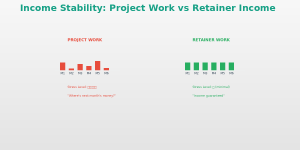
Retainer vs Project Work: The Comparison
Project Work
How it works: Client has a specific project. You quote it. You execute it. Done.
Income: Unpredictable. Month 1: $8K. Month 2: $2K. Month 3: $12K.
Effort: High. Constant sales cycle. New client discovery. Pitching. Negotiating.
Depth: Limited. You’re fixing immediate problems, not building strategy.
Rates: Standard for your market.
Retainer Work
How it works: Client pays you monthly for ongoing availability and work.
Income: Predictable. $5K every month, guaranteed.
Effort: Low. You have a set scope. You manage expectations weekly. No sales cycle.
Depth: Deep. You know their business inside out. You’re a strategic partner.
Rates: 20-30% premium over project work.
The Income Stability Comparison
| Model | Monthly Income | Predictability | Sales Effort | Stress Level |
|---|---|---|---|---|
| Project-Based (churning) | $3-15K (varies) | 10% | High (constant hunting) | Very High |
| 3-4 Retainers | $15-20K (stable) | 90% | Low (set schedule) | Low |
| Mixed (retainers + projects) | $15-25K (stable base) | 80% | Medium (fewer needed) | Medium |
Notice the difference in stress level. Retainers don’t just change your income—they change your mindset.
The Ideal Retainer Client
Not every client is a good retainer fit. The ideal retainer client:
- Has recurring work: They need ongoing help, not a one-time project
- Values your expertise: They trust your judgment and don’t micromanage
- Has budget: They can afford $3-10K/month (or whatever your minimum is)
- Communicates well: They’re responsive and clear about needs
- Treats you professionally: Respectful, pays on time, reasonable expectations
- Is growing: They’re ambitious and want to invest in growth (more work = more value)
Red Flags for Retainer Clients
- They want to “try it out for a month” (no commitment = no priority from you)
- They’re constantly negotiating price after you agree (cheap mindset)
- They expect unlimited work for a fixed price (scope creep waiting to happen)
- They don’t communicate (you’ll be chasing them constantly)
- They mention “we’ll need to reduce costs soon” (income unpredictability)
Transitioning From Project to Retainer Work
Most of your retainer clients will come from existing clients who loved you.
How to Transition an Existing Client
Step 1: Prove value first
Complete a great project. Deliver results. Make them happy.
Step 2: Identify ongoing needs
“I noticed you need help with X regularly. What if we set up a retainer instead of project-by-project?”
Step 3: Present the retainer option
“Instead of billing you per project, I offer a monthly retainer of $X. You get 20 hours/month, and I prioritize your work. This is usually 25% cheaper than our current project rate.”
Step 4: Make it easy to say yes
“Let’s try it for 3 months and see if it works. If you’re not happy, no hard feelings.”
Example Transition
Client just finished a $8K website redesign. They’re thrilled.
You notice they need ongoing content updates, minor design tweaks, and technical maintenance.
You suggest: “You’re spending about $2K/month on these small projects. What if we do a retainer instead? $3,500/month gets you 20 hours of work + priority support. That’s about 30% cheaper, and I’m always available when you need me.”
They love the predictability. You get $3,500 × 12 = $42,000/year from one client.
Types of Retainer Models
Model 1: Hours-Based Retainer
How it works: Client pays for X hours per month. Whatever work they need, up to X hours.
Pro: Simple. Clear. Flexible for the client.
Con: You need to track time. Client might expect more than contracted hours.
Example: “$4,000/month for 20 hours. Overage is billed at $250/hour.”
Model 2: Scope-Based Retainer
How it works: Client pays for a defined scope (e.g., “2 new pages per month, 10 revisions, X hours of strategy”).
Pro: No time tracking. Clear deliverables. Prevents scope creep.
Con: You must define scope precisely. Can’t change scope mid-month.
Example: “$3,000/month includes: 1 blog post, 15 revisions, weekly strategy call, priority support.”
Model 3: Hybrid Retainer
How it works: Defined scope + hours (e.g., “2 pages/month plus 10 hours for anything else”).
Pro: Flexibility with structure. Best of both worlds.
Con: Slightly complex to communicate.
Example: “$5,000/month: 2 pages + 2 strategy calls + 10 hours of ad-hoc work.”
Pricing Your Retainer (What You’re Really Selling)
Retainer pricing is different from project pricing.
You’re not selling X hours of work. You’re selling availability, priority, and peace of mind.
The Pricing Formula
Step 1: Calculate your hourly rate
What do you charge per hour? ($100? $150? $200?)
Step 2: Multiply by expected hours
For a “$4,000/month” retainer at $100/hr, that’s 40 hours.
Step 3: Apply the retainer premium
Reduce hours by 20-30% (because you’re offering recurring, predictable work).
So 40 hours becomes 30 hours (effectively $133/hour).
Step 4: Round to a nice number
$4,000/month feels better than $3,987/month.
Example Calculation
Your hourly rate: $150
Desired monthly revenue: $4,500
That’s 30 hours at $150
With retainer premium (25% less hours needed):
You reduce to 22-23 hours (effectively $195-205/hour)
Retainer price: $4,500/month
What client gets: 25 hours/month (rounded up for goodwill)
The Retainer Agreement: What to Include
RETAINER AGREEMENT
CLIENT: [Company Name]
SERVICE PROVIDER: [Your Name]
EFFECTIVE DATE: [Date]
MONTHLY RETAINER: $[AMOUNT]
INCLUDED:
✓ [Hours/scope item 1]
✓ [Hours/scope item 2]
✓ [Hours/scope item 3]
✓ Priority email response (24 hours)
✓ [Weekly/monthly] strategy call
NOT INCLUDED:
✗ Work outside defined scope
✗ [Specific services you’re excluding]
✗ Overage hours (billed at $X/hour)
PAYMENT TERMS: Due on the 1st of each month. Payment via [method].
COMMITMENT: 3-month minimum. Either party can end with 30 days’ notice after initial 3 months.
COMMUNICATION: Weekly [call/email] updates. Emergency response within 24 hours for critical issues.
SCOPE CHANGES: Additions to scope will be quoted separately. We’ll discuss quarterly if scope should change.
LATE PAYMENTS: After 10 days, work pauses until payment received.
By signing below, you agree to these terms.
Building the Monthly Rhythm
Retainers work best when there’s a predictable rhythm.
Weekly Cadence
- Monday morning: Email with what you accomplished last week + what’s coming this week
- Wednesday: Strategy call (15-30 min) to discuss priorities, blockers, wins
- Friday: Quick status on what’s done + what’s queued for next week
Monthly Cadence
- First day: Invoice sent + retainer work begins
- Mid-month: Longer strategy call to discuss bigger picture, growth opportunities
- End of month: Summary report + metrics (if applicable)
Why This Matters
Consistency builds trust. When your client knows exactly when they’ll hear from you, they stop worrying about whether you’ll get things done. This reduces friction and makes the retainer feel valuable.
Pro Tip: Use the same day/time for your weekly call. Make it easy for them to calendar. Consistency is underrated.
Communication and Boundaries
The biggest retainer failure point is unclear boundaries.
Set Clear Expectations
In your retainer agreement, define:
- Response time: “I respond to emails within 24 hours” (not “immediately”)
- Call schedule: “We have a weekly Wednesday 10 AM call” (not “available anytime”)
- Working hours: “I work 9-5 Eastern” (not “always on”)
- Scope limits: “20 hours/month” (not “unlimited”)
- Communication channel: “Email for non-urgent, Slack for urgent” (be specific)
The Weekly Email Template
Subject: [Client Name] – Week of [Date] Update
Hi [Client],
COMPLETED THIS WEEK:
✓ [Item 1]
✓ [Item 2]
✓ [Item 3]
IN PROGRESS:
→ [Item 1] – Expected completion: [Date]
→ [Item 2] – Waiting on feedback
NEXT WEEK:
• [Priority 1]
• [Priority 2]
BLOCKERS/DECISIONS NEEDED:
[If applicable]
Looking forward to our call Wednesday at 10 AM!
[Your Name]
Growing Retainer Revenue (Upsells)
Once you have a retainer client, they’re your best source for revenue growth.
Types of Upsells
1. Hours increase
“You’ve hit your 20 hours consistently. Want to increase to 30 hours for better availability?”
2. Additional services
“You’re asking about social media a lot. Want me to add 5 hours/month for that?”
3. Strategy work
“Let’s do a quarterly strategy session ($2K) to plan the next quarter.”
4. Team expansion
“You’re growing fast. Want me to bring in a contractor to handle [service]?”
The Right Time to Upsell
After they’ve hit their hours limit 2-3 months in a row. Then you say:
“Hey, I noticed you’ve been maxing out your hours almost every month. Sounds like you need more capacity. Want to increase to [X hours] for [Y price]? It would give me more breathing room to do strategic work instead of reactive work.”
This frames it as benefiting them, not as a sales pitch.
Also Read: The Art of Writing Winning Proposals: Land More Clients with Compelling Pitches
When Retainer Doesn’t Work (and What to Do)
Not every retainer works out. Here’s what to watch for:
Warning Sign 1: Scope Creep
Client keeps asking for things outside scope. Response: “That’s outside our retainer scope. I can add it for [$X] or we can increase your retainer to $[Y] to include it.”
Warning Sign 2: Inconsistent Work
Some weeks you’re slammed, some weeks you have nothing. Response: “This month you only used 8 hours. Do you still need 20 hours/month? Let’s adjust.”
Warning Sign 3: Poor Communication
Client is hard to reach, doesn’t respond to emails, misses calls. Response: “For this to work, we need better communication. Can we schedule a call to reset expectations?”
Warning Sign 4: Late Payments
Invoice goes unpaid past 10 days. Response: Put work on pause. “Work resumes once payment is received.”
When to End It
If you’re unhappy, end it. Give 30 days’ notice (as per your agreement). The right retainer client will make you happy. If they don’t, find one who will.
Critical Point: A bad retainer is worse than no retainer. One difficult client at $5K/month will stress you more than five easy project clients at $2K each. Don’t keep a retainer out of fear of losing income.
The Long-Term Retainer Strategy
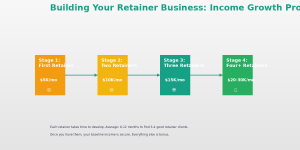
Here’s the ultimate goal:
3-4 retainer clients at $5-8K/month each = $15-30K/month baseline income.
Everything else (projects, upsells, new services) is profit on top of that.
This is the difference between a freelancer living month-to-month and a freelancer building a real business.
The Retainer Truth: The freelancers who are happiest and most successful aren’t necessarily the best at their craft. They’re the ones who figured out how to transition from chasing projects to being chosen by clients who want ongoing relationships. You stop selling. You start partnering.
Your next move: Look at your current clients. Which one would be a good retainer fit? Reach out this week and propose it.
About The Author
