
The Art of Writing Winning Proposals: Land More Clients with Compelling Pitches
Why Your Proposals Matter More Than Your Skills
The Art of Writing Winning Proposals: You could be the best freelancer in your field. But if your proposals are weak, you won’t get hired.
Here’s the reality: Your proposal is your first sales conversation with a potential client.
It’s not about showing off your skills. It’s about proving you understand their problem and can solve it better than anyone else.
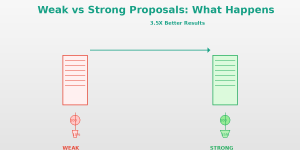
Most freelancer proposals fail because they:
- Focus on themselves: “I have 10 years of experience…” instead of “Your project needs…”
- Are generic: Look like they could be sent to anyone, because they could be
- Bury the price: At the bottom, no clear value proposition above it
- Use jargon: Talk in industry terms the client doesn’t care about
- Are too long: Rambling explanations instead of clear, concise points
- Don’t address objections: Leave questions unanswered
A winning proposal does the opposite.
The Proposal Truth: Your proposal close rate is a reflection of your sales skill, not your freelance skill. You can be mediocre at your craft but still win projects. Conversely, you can be exceptional but lose projects due to poor proposals.
The Psychology of Winning Proposals
Before you write a single word, understand what the client is actually thinking.
What Clients Are Really Asking
When a client reads your proposal, their internal dialogue is:
- “Do you understand my problem?” (If not, I’m hiring someone else)
- “Can you actually solve it?” (Prove it, don’t just tell me)
- “Why you and not someone cheaper?” (Value justification)
- “What exactly do I get?” (No surprises, no scope creep)
- “How long will this take?” (Timeline certainty)
- “Can I trust you?” (Credibility signals)
A winning proposal answers all six questions. In order.
The Three Types of Proposal Rejection
Type 1: You don’t understand their problem
They reject because your proposal shows you didn’t read their request carefully. You sound like you could be talking to anyone.
Type 2: Your price is too high
They can’t see the value. They think your price doesn’t match the scope. You didn’t justify the cost.
Type 3: You didn’t build trust
Your proposal lacks social proof. No testimonials. No case studies. No credibility signals. They don’t feel confident enough to hire you.
Good news: All three are fixable. With the right proposal structure, you eliminate all three rejection reasons.
Also Read: Building a Freelance Business Plan: Strategy for Success
The Winning Proposal Structure
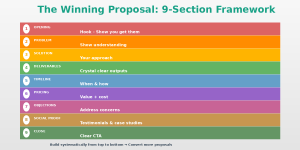
Here’s the skeleton of a winning proposal:
- Opening (Hook): Show you understand their project
- Problem Understanding: Demonstrate deep comprehension of their challenge
- Solution: Your approach (not just your services)
- Deliverables: Exact outputs, no ambiguity
- Timeline & Process: When and how you’ll deliver
- Pricing: Presented with value, not as a cost
- Objection Handling: Address the “but what if?” questions
- Social Proof: Testimonials, case studies, credentials
- Clear Close: Next steps, call to action
This is the framework. Let’s build each section.
Section 1: The Opening (Hook)
Your opening has 3 sentences to prove you’re not sending a generic proposal.
The Opening Formula
Sentence 1: Acknowledge what they asked for
Sentence 2: Show you understand their goal/challenge
Sentence 3: State your excitement to help
Example Opening
WEAK: “Thanks for reaching out. I’m a freelance writer with 5 years of experience in content creation…”
STRONG: “Thanks for reaching out about blog content for your SaaS product. I noticed you’re targeting CTOs and technical leaders—this requires writing that bridges business value with technical credibility. I’ve done this for 12+ similar companies and I’m excited to help you build authority in this space.”
The strong version proves you read the brief, understand their niche, and know the specific challenge.
Section 2: Show You Understand Their Problem
This is where most proposals fail. They skip this section entirely.
Dedicate 2-3 sentences to proving you understand their specific challenge.
What to Include
- Acknowledge their exact situation (not generic)
- Mention a challenge or opportunity you identified from their brief
- Show you’ve thought about why this matters to them
Example
Your Challenge: “You’re rebuilding your website to better convert visitors into leads. Your current site is outdated, doesn’t showcase your portfolio clearly, and isn’t optimized for the buyer’s journey. You need a site that builds trust immediately and guides prospects toward consultation requests.”
This shows you read their brief and understand their real challenge.
Section 3: Present Your Solution
This is where you explain your approach, not just your services.
Don’t Say This
“I offer website design, UX consulting, and copywriting services.”
Say This Instead
“I’ll take a 3-phase approach: (1) Strategy session to understand your buyer and positioning, (2) Design your site around the customer journey with trust-building elements, (3) Copywriting that speaks to each stage. This ensures your site doesn’t just look good—it converts.”
The second version explains your thinking. The client understands the methodology.
Solution Section Structure
- Your overall approach (3-4 sentences)
- 3-5 key steps or phases
- Why this approach works for their specific situation
Section 4: Crystal Clear Deliverables
This is where you prevent scope creep and confusion.
Example: Weak vs. Strong
WEAK: “I’ll design your website and provide copywriting.”
STRONG:
- Homepage (with hero section, value proposition, trust signals, CTA)
- Services page (overview + 3 individual service pages)
- Portfolio section (6-8 case studies with before/after metrics)
- Pricing page (with FAQ section)
- Contact/CTA page
- Mobile responsive design (tested on iOS and Android)
- Copywriting for all pages
- 2 rounds of revisions included
The strong version eliminates ambiguity. The client knows exactly what they’re getting.
Section 5: Timeline & Process
Clients want to know WHEN and HOW you’ll work.
Timeline Should Include
- Kickoff: When do we start? (Day 1)
- Milestones: Key checkpoints (Week 1-2: Strategy and wireframes, Week 3-4: Design, etc.)
- Deliverable dates: When specific items are ready for review
- Revision rounds: How many and when
- Launch date: Go-live (final date)
Example
| Phase | Deliverable | Timeline |
|---|---|---|
| Discovery | Strategy document + wireframes | Week 1-2 |
| Design | High-fidelity mockups (desktop + mobile) | Week 3-4 |
| Development | Working site (staging) | Week 5-6 |
| Testing & Revisions | QA + 2 rounds of revisions | Week 7 |
| Launch | Live site | Week 8 |
A clear timeline shows you’re organized and professional.
Section 6: Pricing (Psychology Matters)
How you present price matters as much as the number itself.
Pricing Presentation Rules
- Never lead with price. Price comes after value justification.
- Explain the price. Why does it cost this amount? (time, expertise, deliverables)
- Show the breakdown. If it’s $5K, show what comprises it (design, development, copywriting, revisions)
- Offer options. Basic, Standard, Premium packages. Clients like choices.
- Emphasize value, not cost. “Investment of $5K for a site that converts 15% of visitors” not “It’s expensive.”
Pricing Presentation Example
Investment: $8,500
This investment includes:
• Strategy and discovery ($1,200)
• Design (homepage + 5 inner pages): $3,000
• Development & mobile optimization: $2,500
• Copywriting: $1,500
• 2 rounds of revisions: Included
• Training (30 min): Included
Why this price? A custom website that converts requires design expertise, technical implementation, persuasive copywriting, and ongoing optimization. This investment typically pays for itself through increased leads within 3-6 months.
Section 7: Addressing Objections
Anticipate the objections clients will have. Address them proactively.
Common Objections & How to Handle Them
| Objection | Proactive Response |
|---|---|
| “What if we need changes after launch?” | “I include 2 rounds of revisions before launch. After launch, we can discuss a support/retainer plan.” |
| “How much revisions are included?” | “Detailed in deliverables section above. 2 rounds before launch, unlimited minor fixes.” |
| “Can you guarantee results?” | “No one can guarantee conversions. What I do guarantee is a well-designed, optimized site. Results depend on marketing.” |
| “What if we need to pause or adjust timeline?” | “Flexible. We can pause and resume. If timeline shifts significantly, we’ll adjust the scope.” |
| “Your price seems high. Competitor is cheaper.” | “Happy to discuss. I focus on custom solutions and long-term relationships. Price reflects expertise and deliverables.” |
Section 8: Social Proof & Credibility
Don’t just tell clients you’re good. Show them.
Social Proof Elements
- Testimonial: From a previous client (include name, company, result)
- Case study: Brief example (challenge → solution → result with metrics)
- Credentials: Relevant certifications, publications, speaking
- Portfolio: Link to similar work or past projects
- Metrics: “10+ years experience,” “Helped 50+ SaaS companies”
Example Social Proof Section
Why You Can Trust This Approach
“I’ve redesigned 25+ SaaS websites using this exact framework. Here’s what my clients achieved:”
Example: B2B SaaS company → 40% increase in qualified leads after website redesign
Testimonial: “Saheed understood our market and designed a site that speaks to technical decision-makers. Best investment we made this year.” — CEO, TechCorp
Portfolio: www.example.com/case-studies
Section 9: The Close (Clear CTA)
End with a clear next step. Don’t be ambiguous.
Good Close
“Ready to move forward? I’m available to start on [DATE]. To confirm, please reply with your approval and we’ll schedule the kickoff call.”
Bad Close
“Let me know if you have any questions or if there’s anything else I can clarify.”
The good close is action-oriented. The bad close is passive.
Close Should Include
- Confirmation mechanism (approval, signature, payment)
- Next step (kickoff call, deposit, contract)
- Timeline (when can you start if approved?)
- How to respond (email, phone, link to sign)
Common Proposal Mistakes to Avoid
Mistake 1: Generic Proposals
Problem: Your proposal could be sent to anyone.
Fix: Reference specific details from their brief in every section.
Mistake 2: Too Long
Problem: 10+ pages. Nobody reads it all.
Fix: Keep it to 2-3 pages max. One page is even better.
Mistake 3: Technical Jargon
Problem: You sound smart but they don’t understand you.
Fix: Explain in terms your client cares about. Use their language.
Mistake 4: No Clear Scope
Problem: Deliverables are vague. Sets you up for scope creep.
Fix: Crystal clear list. Every item defined.
Mistake 5: Price Without Justification
Problem: “$5,000” with no context. Feels expensive.
Fix: Explain what comprises the price. Show value.
Mistake 6: No Social Proof
Problem: No testimonials, no case studies. They don’t know if you’re trustworthy.
Fix: Include at least one testimonial and/or case study link.
Critical Mistake: Sending the same proposal to different clients. Customize every proposal. If you’re using templates, customize them. Reference their project. Show you care.
Also Read: Building a Freelance Business Plan: Strategy for Success
Complete Proposal Template
PROPOSAL FOR: [CLIENT NAME] – [PROJECT]
Prepared by: [YOUR NAME]
Date: [DATE]
OPENING
Thanks for reaching out about [specific project from their brief]. I understand you’re looking to [their goal]. I’ve worked with [similar clients] on this exact challenge, and I’m excited to help you [desired outcome].
YOUR CHALLENGE
[2-3 sentences about their specific situation, challenge, and opportunity you identified]
MY APPROACH
I’ll take a [X]-phase approach:
1. [Phase 1 with goal]
2. [Phase 2 with goal]
3. [Phase 3 with goal]
This ensures [why this works for them].
DELIVERABLES
✓ [Specific deliverable 1]
✓ [Specific deliverable 2]
✓ [Specific deliverable 3]
✓ [X rounds of revisions included]
TIMELINE
Week 1: [Milestone]
Week 2: [Milestone]
Week 3: [Milestone]
[Final delivery date]
INVESTMENT
$[PRICE]
This includes: [breakdown of what comprises price]
This investment typically [ROI/value explanation]
SOCIAL PROOF
Similar project result: [Specific metric or testimonial]
Portfolio: [Link to case studies or portfolio]
NEXT STEPS
Ready to move forward? I can start on [DATE]. To confirm, please reply with your approval. Looking forward to working with you!
[Your contact info]
The Real Secret to Winning Proposals
All of this comes down to one thing: Your proposal should make the client feel like you get them.
Not like you’re pitching a service. Like you’re the person who understands their specific problem better than anyone else.
The Proposal Paradox: The more specific your proposal is to THEM, the more appealing you become to OTHERS. Because if you took that much time to understand one client’s problem, you’ll do the same for any client.
Start implementing this structure on your next proposal. Track your response rate. You’ll notice a difference immediately.
Better proposals = more clients = better business.
About The Author
