
Building a Financial Safety Net: Emergency Fund for Freelancers
Why Freelancers Need Emergency Funds (More Than Anyone Else)
Building a Financial Safety Net. Most employed people have a safety net: a steady paycheck every two weeks, unemployment benefits, and job security (relatively speaking).
Freelancers have none of this.
Your income isn’t guaranteed. Your projects can end. Your clients can disappear. Your market can shift. And suddenly, you have zero income.
This is why an emergency fund isn’t optional for freelancers. It’s essential.
An emergency fund is:
- Your insurance policy: When income dries up, you can survive
- Your negotiating power: You can say no to bad clients because you’re not desperate
- Your freedom: You can take time off without panic
- Your growth opportunity: You can invest in tools, learning, and business development
- Your peace of mind: You sleep better knowing you’re covered
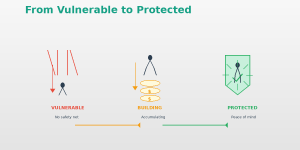
The Freelance Vulnerability: Most freelancers operate on the edge of financial disaster. One lost client. One dry month. One unexpected expense. And suddenly they’re in crisis mode. An emergency fund eliminates this vulnerability.
Also Read: Building a Freelance Business Plan: Strategy for Success
How Much Should You Save? (The Real Answer)
You’ll hear this a lot: “Save 3-6 months of expenses.”
For employees, this works. For freelancers? It’s not enough.
Here’s why: Employees have job security. Freelancers don’t.
An employee losing their job is temporary. They can find another job in 1-3 months. For a freelancer, losing major clients is a business crisis. Finding replacement income takes longer.
The Freelancer Emergency Fund Formula
Save 6-12 months of business expenses (not just personal living expenses).
Why the full range?
- 6 months: If you’re established with multiple consistent clients and diverse income streams
- 9 months: If you’re mid-level with some clients but still building stability
- 12 months: If you’re newer, specialized, or have limited client diversity
This sounds like a lot. It is. But here’s the reality: your business needs to survive an extended income drought.
Why This Matters
Scenario: You have 3 major clients. One client cuts their budget (cost downsizing). Another pauses their project (market conditions). The third goes quiet (you haven’t heard from them in a week).
Suddenly, you’ve lost 60% of your income. How long can you survive on the remaining 40%? Can you pivot and find new clients fast enough?
With a 12-month emergency fund, you can. You’re not desperate. You can be selective about which clients you pursue. You can say no to lowball offers. You have runway.
Calculate Your Target (Step-by-Step)
Step 1: Calculate Monthly Business Expenses
Don’t calculate just your personal living expenses. Calculate your full business costs.
Include:
- Living expenses (rent, food, utilities)
- Business software subscriptions (project management, invoicing, design tools)
- Equipment maintenance and replacement
- Professional development
- Taxes (quarterly estimated taxes)
- Insurance (health, business liability)
- Marketing and networking costs
Step 2: Choose Your Safety Net Period
6 months? 9 months? 12 months? Choose based on your situation:
| Your Situation | Target | Reasoning |
|---|---|---|
| Established (3+ years), multiple clients | 6 months | You have track record, network, can pivot quickly |
| Mid-level (1-3 years), growing client base | 9 months | You have some stability but still building |
| Newer (under 1 year) or highly specialized | 12 months | Income variability is high, replacement time is long |
| 1-2 major clients (over 50% income) | 12 months | Losing one client is catastrophic |
Step 3: Calculate Your Target
Formula:
Monthly Expenses × Safety Net Months = Target Emergency Fund
Example:
Monthly Expenses: $4,000
Safety Net Period: 9 months
Target: $4,000 × 9 = $36,000
This means you need $36,000 in your emergency fund.
Where to Keep Your Emergency Fund
Not in your checking account. Not invested in stocks. In a safe, accessible, interest-bearing account.
Best Options for Freelancers
- High-Yield Savings Account: 4-5% APY, FDIC insured, instant access. Best option for most freelancers.
- Money Market Account: Similar to savings but may offer slightly higher rates. Check fees.
- Short-term CD (Certificate of Deposit): If you won’t need the money for 6+ months, CDs offer slightly higher rates but lock your money.
- Separate Bank: Consider using a different bank than your checking/operating account. This creates psychological separation and reduces temptation to raid the fund.
Pro Tip: Open your emergency fund at a different bank than your business checking. It’s easier to justify using money that’s in front of you than money you have to transfer from another institution.
NOT Recommended
- Stock market/investments: Too volatile. You need certainty when emergencies happen.
- Crypto: Same issue. Volatility + tax complexity.
- Your business checking account: Too tempting to spend.
Strategy: How to Build It Fast
Your target might be $30K-$50K. That feels overwhelming. How do you get there?
You don’t do it all at once. You build it systematically.
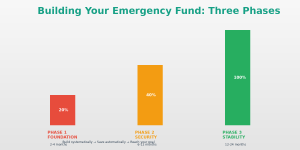
Phase 1: Foundation (First $5,000)
Goal: Build a 1-month emergency fund quickly.
Timeline: 2-4 months
How: Save aggressively from every project. Aim for 20-30% of earnings.
This gives you immediate protection against small crises (equipment failure, unexpected expense).
Phase 2: Security (Next $10,000)
Goal: Build a 3-month emergency fund.
Timeline: 6-12 months
How: Continue saving 15-20% of earnings + implement percentage method (see below).
Now you can survive a dry month or two without stress.
Phase 3: Stability (Remaining balance)
Goal: Reach your full target (6-12 months).
Timeline: 12-24 months
How: Lock in percentage savings + bonus allocation + income growth.
Once you reach your target, shift focus to growth and wealth building.
The Percentage Method (Automatic Savings)
The fastest way to build an emergency fund is to make it automatic.
How It Works
Every time you get paid, automatically transfer a percentage to your emergency fund.
Recommended percentages:
- Building phase (0-6 months emergency fund): 20-30% of income
- Accumulating phase (6-12 months): 15-20% of income
- Maintenance phase (12+ months): 5-10% of income
Example: 20% of Every Project
You invoice a client for $5,000.
You receive payment: $5,000
Immediately transfer: $1,000 to emergency fund
Your operating account: $4,000 (for expenses, reinvestment, profit)
This happens automatically. You don’t have to think about it. And it adds up fast.
Math Check: If you earn $5,000/month and save 20%, that’s $1,000/month. To build a $36,000 emergency fund? 36 months. But most freelancers increase earnings over time, so actual timeline is faster.
From Zero to Fully Funded (3 Realistic Timelines)
Timeline A: Aggressive (12-18 months)
Monthly income: $4,000
Target emergency fund: $36,000 (9 months)
Savings rate: 25% of income ($1,000/month)
After 12 months: $12,000 saved
After 18 months: $18,000 saved (income growth helps)
After 24 months: $36,000 (GOAL REACHED)
Timeline B: Moderate (24-30 months)
Monthly income: $4,000
Target emergency fund: $36,000 (9 months)
Savings rate: 15% of income ($600/month)
After 12 months: $7,200 saved
After 24 months: $14,400 saved (with growth)
After 30 months: $36,000 (GOAL REACHED)
Timeline C: Hybrid (18-24 months)
Start with 25% savings rate, then drop to 15% after 12 months
After 12 months at 25%: $12,000
After 24 months at 15%: $24,000 + $12,000 = $36,000 (GOAL REACHED)
When (and How) to Use Your Emergency Fund
Emergency fund rules:
- Use it for TRUE emergencies: Job loss, major equipment failure, medical costs, family crisis
- Don’t use it for: Splurges, vacations, new laptop upgrades, or because you had a bad month
- Use it instead of debt: Rather than taking a personal loan or credit card debt, use your emergency fund
What Counts as an Emergency?
| Emergency ✅ | Not an Emergency ❌ |
|---|---|
| Loss of major client(s) | Wanting a vacation |
| Extended illness (can’t work) | Wanting new equipment |
| Critical equipment failure | Desire to upgrade laptop |
| Unexpected medical costs | Impulse purchases |
| Family crisis requiring time/money | Not happy with current rate |
| 3+ month income drought | One slower month |
Replenishing After Use
You had an emergency. You used your fund. Now what?
Replenishment Strategy
Step 1: When income normalizes, increase your savings rate to 25-30% temporarily
Step 2: Don’t reward yourself with extra spending because you had good months. Reinvest in the fund.
Step 3: Once you’ve recovered half the amount you used, return to normal savings rate
Step 4: Once fully replenished, celebrate and resume wealth-building activities
Example
You used $8,000 of your $36,000 emergency fund during a crisis.
Balance: $28,000
You’re now earning well again. Increase savings from 15% to 25% temporarily.
After 4 months at higher savings rate: You’ve recovered $4,000
Balance: $32,000
Drop back to 15% normal savings rate. After another 6 months: $36,000 (RESTORED)
Psychological Win: Having to rebuild your emergency fund isn’t fun, but it’s way better than the alternative. You avoided debt, credit cards, or panic. Plus, rebuilding it feels intentional and empowering.
Beyond Emergency Fund: Building Real Wealth
Once your emergency fund is fully funded, you can shift focus to wealth building.
The Wealth-Building Hierarchy
Tier 1 (Emergency fund): 6-12 months in high-yield savings
Tier 2 (Short-term goals): Vehicle down payment, home down payment (1-3 year timeline)
Tier 3 (Medium-term investments): Retirement accounts (SEP-IRA, Solo 401k), taxable brokerage accounts
Tier 4 (Business reinvestment): Tools, education, hiring, expansion
Tier 5 (Passive income): Courses, products, properties, dividends
Most freelancers skip to Tier 5 too fast. Build the foundation first (Tiers 1-2). Then invest (Tiers 3-5).
Also Read: Burnout Prevention for Freelancers: Build Sustainable Energy
Automate Your Savings
The best savings plan is one you don’t have to think about.
Automation Setup
Option 1: Manual transfers on payment day
Every time you receive payment, manually transfer your percentage to the emergency fund account. This takes 2 minutes and keeps you aware of the process.
Option 2: Automatic transfers
Set up automatic transfers from your business checking account to your emergency fund account on a specific date (e.g., the 5th of every month). Hands-off but effective.
Option 3: Split deposits
If your clients pay via direct deposit, ask your bank if you can split incoming deposits between accounts (e.g., 20% to emergency fund, 80% to checking). Not all banks support this, but some do.
Recommended: Use Option 2 (automatic monthly transfer). Set it and forget it. The consistency matters more than the method. Even if you miss a month, you’re still building.
The Real Power of an Emergency Fund
Here’s what changes when you have a fully funded emergency fund:
- You sleep better: No financial anxiety at night
- You negotiate better: You can say no to bad clients because you’re not desperate
- You invest in growth: You can invest in tools, learning, and opportunities
- You take time off: You can actually take vacation without guilt
- You scale faster: You’re not constantly worried about the next client
- You make better decisions: Fear doesn’t drive your choices
The Bottom Line: An emergency fund is the difference between a freelance business that survives and thrives. Without it, you’re constantly vulnerable. With it, you’re in control.
About The Author
