
Overcoming Imposter Syndrome: Build Real Confidence
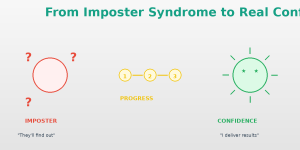
The Voice in Your Head (That Keeps Lying to You)
Overcoming Imposter Syndrome. You land a high-paying client. Your first thought: “They made a mistake. When they realize what I can actually do, they’ll find someone better.”
You deliver great work. Client is happy. You think: “It was luck. I won’t be able to do this next time.”
Someone compliments your skills. You think: “They’re just being nice. They don’t know I’m actually just faking it.”
You’ve been freelancing for three years. You still feel like you’re pretending. Like any day now, someone will expose you as a fraud.
This is imposter syndrome. And if you’re a freelancer, you’ve definitely felt it.
Here’s the thing: That voice in your head is lying to you. And you believe it because the lie feels true.
The Imposter Syndrome Paradox: The more skilled you are, the more imposter syndrome you feel. Because you know what you don’t know. Beginners are confident because they don’t know how much they don’t know.
What Is Imposter Syndrome? (The Real Definition)
Imposter syndrome is the persistent belief that your success is due to luck, timing, or deception—not actual competence. It’s the feeling that you’re a fraud who will eventually be exposed.
Key point: It’s not lack of confidence. It’s persistent doubt despite evidence of competence.
You can have:
- High income (proving you deliver value)
- Repeat clients (proving you’re trustworthy)
- Positive testimonials (proving quality work)
- Years of experience (proving you know what you’re doing)
And still feel like a fraud. That’s imposter syndrome.
Also Read: Handling Difficult Clients: Strategies That Actually Work
Why Freelancers Feel It More
You’re Entirely Responsible for Your Success
In a job, there’s a company behind you. There’s a brand, a team, a system. If the work is good, it’s because of the company. If something goes wrong, it’s because of circumstances.
As a freelancer, the credit and blame fall entirely on you. This creates intense pressure and doubt.
You Have No External Validation
In a job, you get promoted, get raises, get performance reviews. External signals that you’re doing well.
As a freelancer, the only validation is: Do clients keep hiring you? Are they happy? That’s it.
You can’t point to a job title or promotion. You’re constantly proving yourself.
You Compare Yourself to the Best Version of Others
You see another freelancer’s finished portfolio. You see their confident social media. You see their testimonials.
You don’t see their struggling years, their bad clients, their moments of doubt. You compare your behind-the-scenes to their highlight reel.
You’re Not an Expert, So You Feel Like a Fraud
You know there are people more skilled than you. So you think: “If I’m not the best, I’m not good enough.”
This is false. You don’t need to be the best. You need to be good enough for your clients. And clearly you are, or they wouldn’t hire you.
5 Signs You Have Imposter Syndrome
Sign 1: You Attribute Success to Luck or Timing
“I got this client because they were desperate. Not because I’m actually good.”
“My work came out well by accident, not skill.”
Reality: Clients aren’t desperate. They found you. They chose you. They paid you. That’s not luck.
Sign 2: You Minimize Compliments
Client: “Your work is amazing.”
You: “Oh, it’s not a big deal. Anyone could do it.”
Reality: Not anyone could do it. That’s why they hired you.
Sign 3: You Overestimate Other Freelancers’ Skills
You look at a competitor and think they’re SO much better than you. Their portfolio seems perfect. Their prices seem justified.
Reality: They’re probably thinking the same thing about you. And they probably have the same doubts.
Sign 4: You’re Afraid of Raising Your Rates
You’ve raised your skills. You’ve gotten better. But you can’t bring yourself to charge more because “What if they realize I’m not worth it?”
Reality: If you’re raising rates, it’s because you’re worth more. Your results prove it.
Sign 5: You Feel Like You’re Faking It
Even when work goes well, you feel like you’re pretending. Like you’re fooling everyone. Like you don’t really know what you’re doing.
Reality: This feeling persists because you’re learning and growing. The learning never stops, and that’s good.
Common Thought Patterns (And Why They’re Wrong)
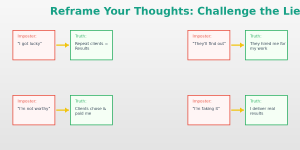
| Imposter Thought | Why It’s Wrong | Real Truth |
|---|---|---|
| “I got lucky.” | Luck is one-time. Repeat clients aren’t luck. | You delivered results. That’s why they returned. |
| “They’ll find out I’m not good.” | They hire you based on your work. If it was bad, they’d notice immediately. | Your work quality is exactly what they paid for. |
| “I don’t deserve this income.” | Income is determined by market value. If clients pay, you’re worth it. | Your price reflects what clients believe your work is worth. |
| “I’m not a real professional.” | You have clients. You deliver. You get paid. That’s literally the definition of a professional. | You are exactly as professional as your results show. |
| “Better freelancers exist.” | True. But your clients didn’t hire them. They hired you. | You’re good enough for your clients. That’s all that matters. |
Thought Reframing: Challenge the Lies
Imposter syndrome works through automatic thoughts. You don’t consciously decide to believe them. They just happen.
The solution: Challenge them. Consciously. In writing, if possible.
The Reframing Process
Step 1: Notice the thought
“I got this project because they were desperate.”
Step 2: Question it
“Is that actually true? What evidence is there that they were desperate?”
Step 3: Find counter-evidence
“They found me through referral. They had other options. They chose me specifically.”
Step 4: Reframe with truth
“They hired me because someone recommended me AND they trusted my work enough to pay for it.”
Real Examples
Original thought: “My design is mediocre. The client is just being nice about it.”
Reframed: “The client hired me for my design style. They approved it quickly. They’re paying the full rate. These are actions, not just words.”
Original thought: “I can’t raise my rates. People will realize I’m not worth the higher price.”
Reframed: “I’m raising rates because my skills improved and my results are better. If clients think I’m overpriced, they’ll say no. And that’s okay—I only want clients who value my work.”
Original thought: “I’m just getting lucky with these projects.”
Reframed: “I’ve had 20+ repeat clients over three years. That’s not luck, that’s a track record.”
Track Your Evidence of Competence
Imposter syndrome makes you forget your wins. You focus on mistakes. You remember the one project that was hard, not the five that were easy.
Solution: Track evidence. In writing. Where you can’t argue with it.
Create Your Evidence File
Collect:
- Testimonials: Save every client compliment (they prove people think you’re good)
- Repeat clients: List clients who came back more than once (they prove you’re trustworthy)
- Successful projects: Document work you’re proud of
- Income growth: Track how much you earn (market validation of your value)
- Skills gained: List what you’ve learned (proof you’re improving)
- Recognition: Any mentions, awards, features (external validation)
When imposter syndrome hits, review this file. You can’t argue with documented evidence.
Identity Shift: From Pretender to Professional
Imposter syndrome persists because your identity hasn’t caught up with your results.
You think: “I’m someone pretending to be a designer” instead of “I’m a designer.”
The shift happens when you align identity with action.
Identity Exercise
Current identity: “I’m someone learning to be a freelancer.”
Shifted identity: “I’m a freelancer who’s still learning.” (Small shift, huge difference)
See the difference? The first puts you in “student” mode. The second puts you in “professional” mode.
How to Shift Identity
- Stop saying “I’m trying to be a freelancer.” You ARE one.
- Stop saying “I’m not very good.” You’re good enough for your clients.
- Stop saying “I’m learning.” Say “I’m developing my skills.” (Everyone is.)
- Start saying “I’m a [your skill] professional.”
This isn’t denial. It’s alignment. Your identity catches up with your reality.
Avoid the Comparison Trap
Imposter syndrome LOVES comparison. “They’re better than me. Look at their portfolio. Look at their prices.”
The Comparison Trap
You see:
- Their finished work (not their process or struggle)
- Their confident presentation (not their doubts)
- Their success stories (not their failures)
- Their current skill (not their journey)
And you compare your everything to their highlight reel.
The Solution
Stop comparing to others. Compare to yourself.
- Am I better than I was last year? (Yes.)
- Am I delivering more value than last year? (Yes.)
- Are my clients happier? (Yes.)
That’s the comparison that matters. Improvement over time.
Get Real Feedback (Not Just Compliments)
Imposter syndrome dismisses compliments: “They’re just being nice.”
But it respects real, specific feedback. Because you can’t argue with it.
Ask for Specific Feedback
Instead of: “Did you like the work?” (Yes/no, easy to dismiss as polite)
Ask: “What about this work impressed you most?” (Specific, hard to dismiss as flattery)
Instead of: “Am I good?” (Vague)
Ask: “Which specific parts of my work made you hire me again?” (Concrete, evidence-based)
Celebrate Your Wins (You Deserve It)
Imposter syndrome minimizes wins. You land a big client? “It’s nothing.” You get a testimonial? “They’re just being nice.”
This is exhausting. You achieve things and don’t let yourself feel good about them.
The Practice
When something good happens, pause. Acknowledge it. Say it out loud:
“I just landed a $5,000 project. I did that. I’m capable.”
Don’t minimize it. Don’t explain it away. Just acknowledge your role in it.
Also Read: Health Insurance for Freelancers
Find Mentors & Community
Imposter syndrome thrives in isolation. You think you’re alone, struggling.
In community, you realize: Everyone feels this. Even the successful ones.
Seek Out
- Mentors: Find someone a few years ahead. Ask them about their doubts. You’ll be shocked.
- Peer groups: Join freelancer communities. See that you’re not alone.
- Support systems: Find people who understand freelance life.
Sharing your imposter syndrome feelings (instead of hiding them) helps enormously.
60-Day Confidence Building Plan
Week 1-2: Awareness & Evidence
- Day 1-3: Notice imposter thoughts. Write them down.
- Day 4-5: Create your evidence file (testimonials, repeat clients, wins)
- Day 6-7: Review evidence daily
- Day 8-14: Challenge 3 imposter thoughts using the reframing process
Week 3-4: Identity Shift
- Day 15-18: Change how you talk about yourself (identity statements)
- Day 19-21: Ask clients for specific feedback
- Day 22-28: Document feedback and results daily
Week 5-6: Celebration & Community
- Day 29-33: Celebrate wins (no minimizing allowed)
- Day 34-35: Share wins with community or mentor
- Day 36-42: Find support community or mentor
Week 7-8: Alignment & Action
- Day 43-49: Continue evidence tracking and feedback seeking
- Day 50-53: Identify where you’re holding back (pricing, proposals, etc.)
- Day 54-60: Take one action you’ve been avoiding (raise rates, pitch bigger clients, etc.)
60-Day Result: Your imposter syndrome won’t disappear. But you’ll have tools to challenge it. Evidence to counter it. And confidence in your competence backed up by real results.
Final Thought
Imposter Syndrome Isn’t a Sign You’re Bad—It’s a Sign You Care
The fact that you doubt yourself means you take your work seriously. You want to be good. You want to deliver value.
That’s not a weakness. That’s integrity.
The problem isn’t that you’re doubtful. The problem is that you’re doubtful despite evidence of competence. So the solution isn’t to become overconfident. It’s to let your evidence catch up with your doubt.
Remember: Your clients didn’t hire you by accident. They didn’t pay you by mistake. Your results are real. Your competence is real. Your professional identity is real. Your imposter syndrome is just the voice in your head being wrong.
About The Author
