
Health Insurance for Freelancers
The Fear That Keeps Freelancers Awake at Night
Health Insurance for Freelancers. You’re earning good money as a freelancer. Maybe $60K, $80K, or even $100K a year. But there’s one thing that scares you more than a slow month: getting sick without health insurance.
One unexpected hospital visit. One accident. One diagnosis. And suddenly all that income doesn’t matter. Medical debt can destroy a freelancer’s finances faster than anything else.
So you do what many freelancers do: You skip health insurance. You tell yourself “I’m healthy, I’ll be fine.” Or you think it’s too expensive. Or you’re confused about your options.
But here’s what most freelancers don’t know: Health insurance is actually cheaper than you think. And it’s more important than any business expense.
This guide shows you exactly what health insurance options exist for freelancers, how to compare them, what they actually cost, and how to get the coverage you need without breaking your budget.
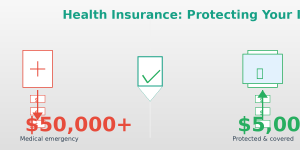
The Insurance Truth: One medical emergency can cost $10,000-$100,000+. Health insurance costs $200-600/month. The math is simple: insurance protects everything you’ve built.
Also Read: Taxes for Freelancers
Why Health Insurance Matters for Freelancers
The Risk of Being Uninsured
Medical debt is the #1 cause of bankruptcy in America. Even with health insurance, you’re protected. Without it, one hospital visit can wipe out years of savings.
Real scenarios:
- Emergency room visit: $2,000-$5,000
- Surgery: $10,000-$50,000
- Cancer treatment: $100,000-$500,000+
- Heart attack: $50,000-$150,000
With insurance, your out-of-pocket maximum is typically $5,000-$10,000. Without it, you pay everything.
The Tax Deduction Benefit
Health insurance premiums are 100% tax deductible for self-employed people. This is huge.
Example: You pay $400/month ($4,800/year) for health insurance. That’s a $4,800 deduction. At 25% tax rate, that saves you $1,200 in taxes. Your real cost: $3,600/year.
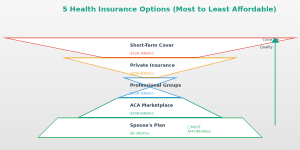
5 Health Insurance Options for Freelancers
| Option | Monthly Cost | Best For | Coverage |
|---|---|---|---|
| ACA Marketplace | $200-600 | Most freelancers | Comprehensive |
| Private Insurance | $300-800 | Good health, want choice | Varies |
| Spouse’s Plan | $0-300 | Married to employed spouse | Usually comprehensive |
| Professional Groups | $250-700 | Members of associations | Good coverage |
| Short-Term | $100-300 | Temporary/bridge coverage | Limited |
ACA Marketplace (Most Popular Option)
What Is It?
The Affordable Care Act (ACA) created online marketplaces where you can compare and buy health insurance. Healthcare.gov is the federal site (used by most states).
How It Works
- Go to healthcare.gov (open enrollment period: Nov 1 – Dec 15)
- Enter your information (age, income, state, zip code)
- See available plans with prices
- Choose a plan and enroll
- Pay your premium each month (usually less after subsidies)
The Cost Breakdown
Monthly premiums vary by age, location, and income. But here’s the key: Subsidies.
Example (Age 35, Single, $60K income):
- Full premium: $550/month
- Your subsidy: -$300/month (based on income)
- You pay: $250/month
Why ACA Is Popular
- Most affordable option (especially with subsidies)
- Wide choice of plans and doctors
- Comprehensive coverage
- Subsidies available if income qualifies
- No exclusions for pre-existing conditions
Private Insurance Plans
What Is It?
Direct insurance from companies like Blue Cross, Aetna, etc. You buy through their website or a broker.
Pros vs ACA
Pros:
- More plan options
- Can enroll anytime (not just open enrollment)
- Sometimes cheaper if you’re very healthy
Cons:
- No subsidies available (you pay full price)
- Medical underwriting (they may deny you or charge more)
- Smaller networks sometimes
Best For
Young, healthy freelancers who can enroll outside open enrollment or don’t qualify for ACA subsidies.
Spouse’s Employer Plan
The Best Option (If Available)
If your spouse works a traditional job with health insurance, you can often get coverage as a dependent. This is usually the cheapest option.
Cost: $0-300/month (often much cheaper than standalone plans)
Pros:
- Usually comprehensive coverage
- Low/no employee contribution
- Large network
Cons:
- Only available if spouse is employed
- If spouse changes jobs, coverage ends
Professional Associations & Groups
What Are They?
Some professional organizations (writers, designers, freelancers groups) offer group health insurance to members.
Examples:
- Freelancers Union (some states)
- Professional associations in your industry
- Chamber of Commerce plans
Cost & Coverage
Usually $250-700/month with decent coverage. You may need to be a member (usually $50-200/year).
Pros: Community + insurance
Cons: Limited availability by location
Short-Term Coverage (Temporary)
When You Need It
You’re between jobs. You’re waiting for open enrollment. You need coverage for 3-12 months.
Cost
$100-300/month. Much cheaper than comprehensive plans.
Important: It’s Limited
Short-term plans don’t cover pre-existing conditions and have lower limits. Use only as a bridge, not long-term.
Cost Comparison Table
| Option | Monthly Premium | Deductible | Out-of-Pocket Max | Enrollment Period |
|---|---|---|---|---|
| ACA Bronze | $250-400 | $6,000-7,000 | $6,800-8,700 | Nov 1 – Dec 15 |
| ACA Silver | $300-500 | $3,000-4,000 | $4,000-5,600 | Nov 1 – Dec 15 |
| ACA Gold | $400-600 | $1,000-2,000 | $2,000-3,500 | Nov 1 – Dec 15 |
| Private Insurance | $300-800 | $500-5,000 | $3,000-7,000 | Anytime |
| Spouse’s Plan | $0-300 | Varies | Varies | When hired |
Tax Credits & Subsidies (Save Thousands)
Who Qualifies?
If your income is 100-400% of the Federal Poverty Level (roughly $13K-$55K for a single person), you likely qualify for a subsidy.
How Much?
Example (Single, Age 35, $50K income):
- Full ACA Silver premium: $500/month
- Subsidy amount: $350/month
- You pay: $150/month
That’s a $4,200/year savings. Huge.
How to Claim
You claim it when you enroll through healthcare.gov. You can also wait until tax time and claim it as a credit on your return.
Pro Tip: If your income is variable, estimate conservatively. If you overestimate income, you might have to repay subsidies. If you underestimate, you pay full price upfront, then get a refund (in the form of a credit).
Health Insurance Tax Deductions
Self-Employed Health Insurance Deduction
You can deduct 100% of your health insurance premiums (including spouse and dependents) if you’re self-employed.
Example:
- Monthly premium: $400
- Annual: $4,800
- Tax deduction: $4,800
- Taxes saved (at 25% rate): $1,200
This deduction happens whether you take the standard deduction or itemize.
How to Choose the Right Plan
Step 1: Understand Your Health Needs
- Are you healthy? (Bronze plan might be fine)
- Do you have chronic conditions? (Silver or Gold)
- Do you see specialists? (Need good out-of-pocket max)
- Do you take medications? (Check formulary)
Step 2: Calculate Total Cost
Don’t just look at premiums. Calculate:
Total annual cost = (Monthly premium × 12) + Expected deductibles/copays
Step 3: Check Doctor Networks
Make sure your doctors are in-network. Out-of-network costs are huge.
Step 4: Compare Side-by-Side
Healthcare.gov lets you compare plans. Look at:
- Premiums
- Deductibles
- Copays for regular visits
- Out-of-pocket maximums
- Prescription drug coverage
Also Read: Scaling Your Freelance Business Beyond Hourly Limits
30-Day Insurance Action Plan
Week 1: Assess & Research
- Day 1: List your health needs and regular doctors
- Day 2: Check if you qualify for ACA subsidies (estimate income)
- Day 3: Visit healthcare.gov and browse available plans
- Day 4: Research your state’s specific options
- Day 5-7: Compare costs using calculator (premium + out-of-pocket)
Week 2: Evaluate Options
- Day 8: If married, check spouse’s employer plan costs
- Day 9: Research private insurance alternatives
- Day 10: Check professional associations in your field
- Day 11: Compare total costs across all options
- Day 12-14: Narrow down to 2-3 best options
Week 3: Decide & Prepare
- Day 15: Choose your preferred plan
- Day 16: Check doctors in network one more time
- Day 17: Gather documents needed for enrollment (income proof, ID)
- Day 18: Review plan documents (deductibles, copays, coverage)
- Day 19-21: Prepare budget for premiums
Week 4: Enroll & Setup
- Day 22: Enroll in your chosen plan (during open enrollment)
- Day 23: Make first premium payment
- Day 24: Set up automatic monthly payments
- Day 25: Download insurance card and app
- Day 26: Add your health insurance deduction to tax planning
- Day 27-30: Document your insurance setup for records
30-Day Result: You’ll have health insurance in place, understand your coverage, and have saved the deduction for taxes.
Final Thought
Health Insurance Is Non-Negotiable
Every other business decision you make—which platform to use, how much to charge, when to scale—is negotiable.
Health insurance is not. One medical emergency can undo years of progress.
The good news? It’s affordable. Between subsidies, tax deductions, and various options, there’s a plan for every budget.
Remember: You’re not just protecting your health. You’re protecting your business, your income, and your future. That’s worth a few hundred dollars a month.
About The Author
