
What Is Islam? Everything you need to know.
What Is Islam? Starting With the Word Itself
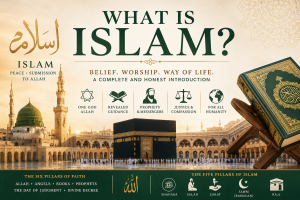
What Is Islam?. The word Islam is Arabic, and it comes from the root word salama, which carries the meanings of peace, safety, and submission. Islam as a religious term means the willing submission to the will of Allah, the Arabic name for God. A Muslim is a person who submits, one who has accepted Islam and lives according to its teachings. The connection between the word Islam and the word salam, meaning peace, is not coincidental. The religion presents itself as the path through which a human being finds genuine peace, both internally and in relation to their Creator, by surrendering their will to the One who created them.
This is the starting point for understanding Islam, not as a cultural identity, not as a political system, not as an ethnic heritage, but as a conscious act of submission to the one God, accompanied by belief, worship, and a way of living that flows from that belief. Everything else in the religion branches out from this single root.
Also Read: What Is Dhul Hijjah in Islam?
What Islam Actually Is
Islam is one of the three Abrahamic monotheistic religions, alongside Judaism and Christianity. Muslims believe that all three trace their origins to the same God and the same foundational message: that there is only one God, that He created everything, and that He sent guidance to humanity through prophets and messengers. Where Islam differs from the other two is in its claim that the Quran is the final, preserved, and uncorrupted revelation from God, and that the Prophet Muhammad, peace be upon him, is the final messenger in a long line of prophets that includes Adam, Noah, Abraham, Moses, and Jesus, peace be upon all of them.
Islam is not, therefore, a new religion in its own understanding of itself. It presents itself as the continuation and completion of the same message that Allah sent to every nation and every people throughout human history. The Quran says that Allah sent a messenger to every people, and that the core of every messenger’s message was the same: worship Allah alone and avoid all that He has prohibited. Muhammad, peace be upon him, was sent as the final messenger with the final revelation, completing the chain and sealing the prophethood.
This is why Muslims have deep respect for the prophets of the Torah and the Gospels. Believing in all the prophets sent by Allah, from Adam to Muhammad, is not optional in Islam. It is a pillar of faith. A Muslim who rejects Moses or Jesus as a prophet is not a Muslim in the theological sense, because belief in all the prophets is part of what it means to believe.
Islam in Arabic: Al-Islam
In Arabic, the religion is called Al-Islam. The word in its religious usage first appears in the Quran multiple times. One of the most direct is in Surah Al-Imran where Allah says: “Indeed, the religion in the sight of Allah is Islam.” Another well-known verse is in Surah Al-Maidah: “This day I have perfected your religion for you, completed My favor upon you, and have chosen Islam as your religion.” These verses establish the name of the religion as something given by Allah Himself, not a label applied by outsiders or historians.
The Arabic word muslim, meaning one who submits, is used in the Quran to describe the prophets themselves. Ibrahim, peace be upon him, is described as one of the muslimeen. This reinforces the Islamic teaching that submission to God alone was always the religion, across all times and all peoples.
The History of Islam
Islam as a historically distinct religion begins with the revelation of the Quran to the Prophet Muhammad, peace be upon him, in the city of Makkah in the Arabian Peninsula around 610 CE. The Prophet was 40 years old when the first revelation came through the angel Jibreel, or Gabriel, in a cave on Mount Hira. The command in that first revelation was simple and overwhelming: Iqra, meaning Read, or Recite.
Over the next 23 years, the Quran was revealed in portions, addressing the community of Muslims, guiding the Prophet through the challenges of building a new religious community in a society dominated by polytheism, tribal politics, and deeply entrenched social injustice. The Prophet and the early Muslims faced severe persecution in Makkah for 13 years. In 622 CE, they migrated to the city of Madinah in an event known as the Hijrah, which marks the beginning of the Islamic calendar. This migration was not a retreat. It was the beginning of Islam’s transformation from a persecuted minority into a functional community with its own governance, laws, and social structures.
By the time of the Prophet’s death in 632 CE, the Arabian Peninsula had largely accepted Islam, and the foundations of Islamic civilization had been laid. Within a century of the Prophet’s death, Islam had spread from Spain and Morocco in the west to Persia and Central Asia in the east. This expansion was not purely military. Much of it happened through trade, scholarship, the quality of Islamic governance relative to what people had experienced before, and the personal example of Muslim merchants, scholars, and travelers.
At its height, Islamic civilization produced some of the greatest advances in mathematics, medicine, astronomy, philosophy, architecture, and literature that the world had seen. The number zero as used in modern mathematics came through Islamic scholars. The foundations of algebra were laid by the Muslim mathematician Al-Khwarizmi, whose name gave us the word algorithm. Islamic hospitals in Baghdad in the ninth century had wards separated by illness, trained physicians, and pharmacies. The libraries of Cordoba in Islamic Spain held hundreds of thousands of books at a time when many European monasteries had a few dozen.
Islam today is the world’s second-largest religion, with approximately 1.9 billion followers as of the mid-2020s. It is practiced on every continent and in virtually every country. It is not a religion of any single ethnicity or culture. Arab Muslims make up only around 20 percent of the global Muslim population. The largest Muslim-majority country by population is Indonesia. There are more Muslims in South Asia than in the entire Arab world. In Nigeria alone, there are over 90 million Muslims. In the United States, the Muslim population has grown to over 3 million. Islam belongs to no single people and no single region.
Also Read: Prayer for the Dead in Islam: Salatul Janazah and Dua for the Deceased
What Muslims Believe: The Six Pillars of Faith
Islamic belief, known as iman, rests on six foundational articles. A Muslim is someone who affirms all six of these with sincere conviction.
The first is belief in Allah. Muslims believe that there is only one God, that He has no partners, no children, no rivals, and no equals. He is the Creator of everything that exists, He is eternal, and He is unlike anything in creation. This strict and uncompromising monotheism is the absolute foundation of Islam. Allah is not a tribal god or a national god. He is the God of all people, all times, and all places, whether they know it or not.
The second is belief in the angels. Muslims believe in a world of created beings made of light who worship Allah without ceasing, carry out His commands, and interact with the material world in ways that humans generally cannot perceive. The angel Jibreel, known in English as Gabriel, brought the revelation of the Quran to the Prophet. The angel Mikail oversees natural phenomena. Angels record the deeds of every human being. Belief in the angels is not metaphorical in Islam. It is literal.
The third is belief in the revealed books. Muslims believe that Allah sent scriptures to various prophets throughout history, including the Tawrah given to Moses, the Zabur given to David, the Injeel given to Jesus, and the Quran given to Muhammad. Muslims believe that the Quran is the only one of these scriptures that has been perfectly preserved in its original form. The earlier scriptures, though originally from Allah, have been altered over centuries through human transmission, translation, and editorial intervention. This is why the Quran is the authoritative reference.
The fourth is belief in all the prophets and messengers. As mentioned earlier, Muslims believe Allah sent prophets to every nation. The Quran mentions twenty-five of them by name. Muslims are required to believe in and respect all of them. The belief that Muhammad is the final prophet, the seal of the prophets, is also part of this article of faith. No prophet or messenger will come after him.
The fifth is belief in the Day of Judgment. Muslims believe that this world will end, that all of creation will be gathered, and that every human being will stand before Allah and be held accountable for everything they did during their life. The detailed teachings about the Day of Judgment, the questioning in the grave, the scales on which deeds are weighed, Paradise, and Hell, fill volumes of Islamic scholarship. The belief that actions have ultimate consequences and that justice will be complete even for the things that went unjudged in this world is a central driver of Islamic moral life.
The sixth is belief in divine decree, known as qadar. Muslims believe that everything that happens in creation, the good and the bad, the painful and the joyful, unfolds within the knowledge and permission of Allah. This does not mean that humans have no free will. Islam holds both truths simultaneously: that Allah has knowledge of all things before they occur, and that humans make genuine choices for which they are genuinely responsible. The tension between these two truths has produced rich theological discussion across Islamic history, but the belief in qadar itself is non-negotiable.
What Muslims Do: The Five Pillars of Islam
If the six articles of faith describe what a Muslim believes, the five pillars of Islam describe what a Muslim does. They are the structural framework of Islamic practice.
The first pillar is the Shahada, the declaration of faith. It is: Ash-hadu an la ilaha illallah wa ash-hadu anna Muhammadan rasulullah. I bear witness that there is no god but Allah, and I bear witness that Muhammad is the messenger of Allah. Saying this with sincere conviction and understanding is what makes a person a Muslim. It is the entry point into the religion and the sentence that should, if possible, be the last words a Muslim speaks before death.
The second pillar is Salah, the five daily prayers. Muslims pray five times a day: Fajr before sunrise, Dhuhr in the early afternoon, Asr in the late afternoon, Maghrib after sunset, and Isha at night. Each prayer involves specific postures, recitations, and a direct facing toward the Kaaba in Makkah. Prayer is not simply a personal spiritual practice in Islam. It is a duty, a conversation with Allah, and the most repeated act of worship in a Muslim’s day. It interrupts the world to remind the person praying that this world is not the point.
The third pillar is Zakat, the obligatory annual almsgiving. Muslims who possess wealth above a minimum threshold, known as the nisab, for a full lunar year are required to give 2.5 percent of that wealth to specific categories of recipients, including the poor, those in debt, and travelers in need. Zakat is not charity in the voluntary sense. It is a financial obligation with detailed rules, and it functions as a redistribution mechanism within the Muslim community.
The fourth pillar is Sawm, fasting during the month of Ramadan. Every adult Muslim who is physically able fasts from the pre-dawn meal, suhoor, until after sunset, iftar, for the entire month of Ramadan. This means no food, no drink, no smoking, and no sexual relations during the hours of daylight. The fast is not merely physical abstinence. It is meant to be accompanied by increased prayer, Quran recitation, charity, and restraint of the tongue and behavior.
The fifth pillar is Hajj, the pilgrimage to Makkah. Every Muslim who is physically and financially able is required to perform Hajj at least once in their lifetime. Hajj takes place during the first ten days of Dhul Hijjah and involves a series of rituals centered on the Kaaba, the plain of Arafah, and the valley of Mina. At its peak, Hajj gathers around two to three million Muslims from every corner of the earth in a single act of worship, all dressed in identical white garments, obliterating distinctions of class, nationality, and status.
Islam vs. Muslim: Clearing Up the Confusion
The screenshot shows the search query “what is Islam vs Muslim,” which reflects a genuine confusion that many people have. The answer is straightforward. Islam is the religion. Muslim is the person who follows it. You cannot be a Muslim without accepting Islam, and Islam without Muslims would be a body of belief with no one practicing it. The two words are not interchangeable, just as Christianity and Christian are not interchangeable.
There is also sometimes confusion between Arab and Muslim. Not all Arabs are Muslim, and the vast majority of Muslims are not Arab. There are Arab Christians, Arab Jews, and Arab atheists. And as already noted, the majority of the world’s Muslims live in South Asia, Southeast Asia, and Sub-Saharan Africa, with the Arab world representing a minority of the global Muslim population. Islam is a religion, not a race or an ethnicity, and treating it as though it belongs to any one people is a misunderstanding of its most fundamental character.
What Islam Is Not
Given how much misrepresentation surrounds Islam in global media and popular discourse, it is worth being direct about what Islam is not.
Islam is not a religion of violence. The Quran explicitly states that killing one person unjustly is as though you have killed all of humanity. The word used for the prohibited killing in Arabic is clear and unambiguous. The Islamic laws of warfare that the scholars developed over centuries are among the most detailed and protective of civilians of any pre-modern legal tradition.
Islam is not exclusively a religion of the Arab world. The Prophet was Arab and the Quran is in Arabic, but the religion was explicitly sent to all of humanity. The Quran itself says that Muhammad was not sent except as a mercy to all the worlds.
Islam is not a new religion. As explained already, Muslims understand their religion as the same monotheism that every prophet taught, completed and sealed in its final form.
And Islam is not merely a private spiritual practice disconnected from daily life. It is a comprehensive way of living that addresses worship, ethics, family, commerce, governance, and the inner life of the heart with equal seriousness. That comprehensiveness is one of the things that makes it both demanding and deeply coherent for the people who live it.
Also Read: How to Perform Ghusl Janabah
A Closing Word
Islam is, at its core, the answer to a single question: what does the Creator want from the created? The Muslim answer is: He wants you to know that He is One, to worship Him alone, to live according to the guidance He sent, to treat people with justice and kindness, and to remember that this life is a brief passage leading to a permanent one. Every detail of Islamic practice, from the prayers to the fasting to the pilgrimage to the laws of inheritance and trade, flows from that single answer. Understanding that is the beginning of understanding Islam.
About The Author
