
Prayer for the Dead in Islam: Salatul Janazah and Dua for the Deceased
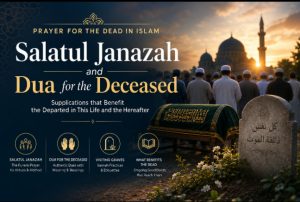
Death in Islam Is Not the End
Prayer for the Dead in Islam: Salatul Janazah and Dua for the Deceased. Islam has one of the most structured and compassionate approaches to death of any religious tradition on earth. When a Muslim dies, the community does not simply grieve and move on. There are specific obligations placed on the living toward the dead, and among the most important of these is the Salatul Janazah, the funeral prayer, along with the supplications made for the deceased both at the time of death and long after burial.
Understanding prayer for the dead in Islam means understanding two things that often get conflated: the formal Salatul Janazah, which is a structured prayer performed over the body before burial, and the informal but deeply important duas that a Muslim can make for a deceased person at any time, whether they died yesterday or twenty years ago. Both matter. Both have rules and etiquette. And both carry enormous weight in Islamic theology because Muslims believe that the prayers of the living genuinely benefit the dead.
This is not a metaphorical belief. It is a theological conviction grounded in the Quran and the Sunnah. The Prophet, peace be upon him, explicitly said that among the things that continue to benefit a person after death are the righteous children who supplicate for them. Praying for the dead is not a ritual of comfort for the living alone. According to Islamic belief, those prayers reach the deceased and intercede for them before Allah.
Salatul Janazah: The Funeral Prayer
What It Is and Why It Is Obligatory
Salatul Janazah is a fard kifayah, a communal obligation. This means the obligation falls on the Muslim community as a whole, and if a sufficient number of Muslims perform it, the obligation is lifted from the rest. If no one performs it, every Muslim who was aware and capable of attending has sinned by neglect. This classification reflects the seriousness with which Islam treats the rights of the deceased over the living.
The prayer is performed over the body of a deceased Muslim before burial. It is not performed inside a mosque in the same way as the five daily prayers, though scholars differ on whether it can be. It is typically performed in an open area, a funeral home, a hospital, or a designated prayer space near the place of burial. The body is present during the prayer, placed in front of the congregation, with the imam standing at the head of the deceased.
Also Read: How to Perform Ghusl Nifas in Islam
Who Can Lead and Who Should Attend Salatul Janazah
The Salatul Janazah is led by an imam. The most deserving person to lead it is, in order of priority according to the majority of scholars: the deceased’s appointed person if they left instructions, then the ruler or his representative, then the local imam, then the father of the deceased, then the closest male relatives. Women may attend, and in many communities do, though their attendance is not obligatory.
The congregation stands in rows. An odd number of rows is considered Sunnah, and the more people who attend and pray, the greater the intercession for the deceased. The Prophet said that if forty men who associate no partners with Allah pray over a deceased person, Allah will accept their intercession for that person. This is narrated in Sahih Muslim. The implication is clear: community turnout for a funeral prayer carries genuine spiritual weight for the person who has died.
The Structure of Salatul Janazah
Salatul Janazah is unique among Islamic prayers. There is no ruku (bowing) and no sujud (prostration). There are no rak’ahs in the conventional sense. The entire prayer is performed standing. It consists of four takbeers, four times saying Allahu Akbar, with specific recitations between each one. Here is how it is performed.
Before beginning, make the intention in your heart that you are performing Salatul Janazah for the deceased Muslim. Face the qiblah. The body should be in front of you.
After the first takbeer, recite Surah Al-Fatihah quietly. In the Shafi’i and Hanbali schools, this is obligatory. In the Hanafi school, Subhanakallahumma (the opening supplication) is recited instead of Al-Fatihah, as Hanafis hold that Surah Al-Fatihah is not recited in Janazah prayer.
After the second takbeer, send salawat upon the Prophet by reciting the Ibrahimiyyah salawat, which is the same supplication recited in the final sitting of regular prayer: Allahumma salli ala Muhammadin wa ala ali Muhammadin kama sallayta ala Ibrahima wa ala ali Ibrahim, innaka Hamidun Majeed. Allahumma barik ala Muhammadin wa ala ali Muhammadin kama barakta ala Ibrahima wa ala ali Ibrahim, innaka Hamidun Majeed.
After the third takbeer comes the most important part of the prayer: the dua for the deceased. This is where you sincerely supplicate for the person who has died. The most authentic and comprehensive dua narrated from the Prophet for this moment is:
Allahumma-ghfir lahu warhamhu wa afihi wa’fu anhu, wa akrim nuzulahu, wa wassi’ madkhalahu, waghsilhu bil-mai’ wath-thalji wal-barad, wa naqqihi min al-khataya kama naqqayta ath-thawb al-abyad min ad-danas, wa abdilhu daran khayran min darihi, wa ahlan khayran min ahlihi, wa zawjan khayran min zawjihi, wa adkhilhul jannata wa a’idhhu min adhabil-qabr wa min adhab an-nar.
The meaning of this supplication is: O Allah, forgive him and have mercy on him, grant him wellbeing and pardon him, honor his reception and widen his entrance, wash him with water, snow, and hail, cleanse him of sins as a white garment is cleansed of filth, give him a home better than his home, a family better than his family, a spouse better than his spouse, admit him into Paradise and protect him from the punishment of the grave and the punishment of the Fire.
If the deceased is female, the pronouns change from the male form to the female form: Allahumma-ghfir laha warhamha, and so on through the supplication.
After the fourth takbeer, some schools add a brief additional dua. In the Shafi’i school, a short supplication such as Allahumma la tahrimna ajrahu wa la taftinna ba’dahu waghfir lana wa lah is recited. Then the prayer is concluded with a single tasleem (saying As-salamu alaykum wa rahmatullah) to the right, and in some schools to both sides.
Also Read: How to Perform Ghusl Nifas in Islam
Dua for the Deceased Beyond the Funeral
Can You Pray for Someone Who Has Already Died?
Yes, absolutely. One of the most comforting teachings in Islam is that you can continue to pray for a deceased person indefinitely, whether they died yesterday, a decade ago, or before you were even born. There is no expiry on dua for the dead. The Prophet prayed for the people buried in Baqi’, the cemetery of Madinah, each time he passed. He taught his companions supplications to say when visiting graves. Praying for the deceased is an ongoing act of worship with no time limit attached.
The Dua for the Deceased in Arabic and English
The most well-known and authenticated dua for a deceased person, suitable for recitation at any time, is:
Allahumma-ghfir li (name) warfa’ darajatahu fil mahdiyyeen, wakhlufhu fi aqibihi fil ghabirin, waghfir lana wa lahu ya Rabbal alameen, wa afsah lahu fi qabrihi wa nawwir lahu fihi.
Meaning: O Allah, forgive (name), raise his rank among the guided, and be a successor to him among those he leaves behind. Forgive us and him, O Lord of the worlds, and make his grave spacious and illuminate it for him.
A shorter version that can be said at any moment is simply: Allahumma-ghfir lahu warhamhu, meaning O Allah forgive him and have mercy on him, or in the female form: Allahumma-ghfir laha warhamha.
For Jannatul Firdaus specifically, a dua that many Muslims use is: Allahumma-ghfir lahu wa adkhilhul firdaws, meaning O Allah forgive him and admit him to Al-Firdaus, which is the highest level of Paradise.
Dua for the Deceased in English
Many Muslims who are not fluent in Arabic worry about whether their dua counts if made in English. The answer from the majority of scholars is that dua, personal supplication, may be made in any language with sincerity. Salatul Janazah has specific Arabic recitations that must be in Arabic, just as the five daily prayers do. But personal dua made for the deceased outside of the formal prayer can be in any language.
In English, you might say: O Allah, forgive my mother and have mercy on her. Grant her a spacious and illuminated grave. Protect her from the punishment of the grave. Admit her to the highest level of Paradise. Forgive her sins, the small and the great, the hidden and the open. And be for her family a source of comfort and patience in her absence.
Speak to Allah the way you would speak to the most merciful being in existence, because that is what He is, and He hears every word.
Visiting the Graves and Praying for the Dead
The Prophet encouraged visiting graves, saying it reminds the visitor of death and benefits the deceased through supplication. When visiting a grave, the prescribed greeting is: As-salamu alaykum ahl ad-diyar min al-mu’minin wal-muslimin, wa inna in sha’Allahu bikum lahiqun, nas’alullaha lana wa lakum al-afiyah. Meaning: Peace be upon you, O people of this abode, from among the believers and Muslims. Indeed we will, if Allah wills, be joining you. We ask Allah for wellbeing for us and for you.
After this greeting, you may recite Surah Al-Fatihah and send its reward to the deceased, recite whatever you are able from the Quran, and then make sincere personal dua for the person buried there and for all Muslims in their graves.
What Actually Benefits the Dead After Death
The Prophet listed three things that continue to benefit a person after death: ongoing charity that they established in their lifetime, knowledge that continues to be benefited from, and righteous children who supplicate for them. This last one is why teaching children to pray for their deceased parents and grandparents is considered an act of great importance in Muslim families.
Beyond these three, scholars agree based on evidence that the reward of Quran recitation sent to the deceased, voluntary charity given on their behalf, hajj performed on their behalf if they were unable to perform it, fasting performed on their behalf for missed obligatory fasts, and dua made for them all benefit the deceased. These are not innovations. They are grounded in hadith and the practice of the companions.
Prayer for a Non-Muslim Who Has Died
This is a question many Muslims face when a non-Muslim friend, colleague, or even a family member dies. The Islamic ruling on this is clear and consistent across all four major schools: it is not permissible to perform Salatul Janazah over a non-Muslim, nor to make dua asking Allah for forgiveness and mercy for a deceased non-Muslim who died outside of Islam. This is based on a verse in Surah At-Tawbah where Allah prohibits the Prophet from praying for the forgiveness of the mushrikeen.
What is permissible is expressing grief, being kind to the surviving family members, and acknowledging the loss with appropriate condolences. The prohibition is specifically on asking for forgiveness and Paradise for one who died in a state of disbelief, because those matters are entirely in Allah’s hands and the Quran is explicit that shirk is the one thing Allah does not forgive if a person dies upon it.
Alsk Read: How to Bath After Menstruation in Islam
Final Reflection
Death is something every human being will face, and Islam does not allow its followers to look away from that reality. The prayer for the dead in Islam is a community act, a family act, and a deeply personal act. When you stand in the rows of Salatul Janazah, you are standing as part of a chain of intercession on behalf of someone who can no longer act for themselves. When you raise your hands at night and say Allahumma-ghfir laha, you are doing something that reaches across the boundary between this world and the next.
That is not a small thing. Make it a habit to pray for your deceased loved ones regularly, by name, with sincerity, and with the full belief that Allah hears and that those prayers land where they are sent.
About The Author
