
Seven Steps of Hajj
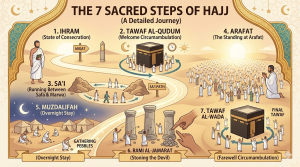
The Sacred Journey: A Detailed Guide to the Seven Steps of Hajj
Seven Steps of Hajj. Hajj is the fifth pillar of islam, in which every Muslim must do it if there is capacity. Hajj is a spiritual odyssey that represents the pinnacle of a Muslim’s devotion. It is a journey that retraces the footsteps of the Prophet Ibrahim and his family, serving as a powerful reminder of faith, sacrifice, and the ultimate equality of all human beings before the Creator. Performing Hajj is a transformative experience that is meant to strip away worldly attachments and renew the soul.
While the pilgrimage involves many intricate sunnah acts and supplications, it is generally structured around seven essential stages or steps. Understanding these steps in order is vital for any pilgrim intending to fulfill this pillar of Islam correctly.
Also Read: Six Articles of Faith (Iman)
1. Entering the State of Ihram
The journey begins before the pilgrim even enters the holy city of Mecca. Ihram is a sacred state of consecration that involves both physical and spiritual preparation. At designated boundaries known as Miqat, pilgrims perform a ritual bath and change into the Ihram garments. For men, this consists of two plain, white, unstitched cloths; for women, it is modest clothing that leaves the face and hands uncovered.
The physical uniform of Ihram is a profound symbol of equality. By removing all markers of wealth, social status, and nationality, millions of pilgrims stand as equals. Once the intention (Niyyah) is made and the Talbiyah prayer is recited, the pilgrim enters a state where specific actions—such as cutting hair, using perfume, or engaging in arguments—are forbidden. This stage is about cultivating absolute focus on the Divine.
2. Tawaf al-Qudum (The Welcome Circumambulation)
Upon arriving at the Masjid al-Haram in Mecca, the first major ritual is Tawaf. This involves circling the Kaaba seven times in a counter-clockwise direction, starting from the corner of the Black Stone (Hajar al-Aswad).
The Kaaba represents the metaphorical center of the Muslim world and the direction of prayer (Qibla). As the pilgrim moves in harmony with the vast crowd, the act of Tawaf symbolizes the soul’s orbit around its Creator. It is a time of intense supplication and remembrance, where the individual acknowledges God as the center of their existence.
3. Sa’i (The Journey Between Safa and Marwa)
Immediately following the Tawaf, pilgrims perform Sa’i. This ritual involves walking seven times between the two hills of Safa and Marwa, which are now enclosed within the mosque complex.
This act commemorates the desperate search for water by Hajar, the wife of Ibrahim, for her infant son Isma’il. Her perseverance and eventual reward—the miraculous springing of the Zamzam well—serve as a lesson in Tawakkul (trust in God) and maternal sacrifice. Walking this path allows the pilgrim to reflect on the importance of effort and patience in the face of life’s trials.
4. The Day of Arafat (The Standing)
On the 9th day of Dhul-Hijjah, pilgrims travel to the plain of Arafat. This is widely considered the most important day of Hajj; indeed, the Prophet Muhammad famously stated, “Hajj is Arafat.” From noon until sunset, pilgrims stand in prayer, seeking forgiveness and making heartfelt supplications.
Arafat is a rehearsal for the Day of Judgment. Under the open sky, millions stand in a state of vulnerability and hope. It is a time for deep self-examination and repentance. Many believe that if a pilgrim’s standing at Arafat is accepted, their past sins are forgiven, allowing them to start their life anew with a purified heart.
5. Muzdalifah and Collecting Pebbles
After sunset on the Day of Arafat, pilgrims travel to the nearby open plain of Muzdalifah. Here, they perform the evening prayers and spend the night under the stars.
Muzdalifah is a place of quiet reflection and rest after the intense emotional experience of Arafat. During the night, pilgrims also gather small pebbles (usually 49 or 70) to be used for the ritual of the following days. This simple task of picking up stones serves as a transition back into the more active phases of the pilgrimage.
6. Rami al-Jamarat (Stoning the Pillars)
The 10th of Dhul-Hijjah marks the beginning of Eid al-Adha. On this day, pilgrims return to Mina to perform Rami, the stoning of the Jamarat. This involves throwing seven pebbles at the largest of three pillars representing the devil. In the following days, all three pillars are stoned.
This ritual commemorates Ibrahim’s rejection of the devil’s temptations when he was commanded to sacrifice his son. Symbolically, stoning the pillars represents the pilgrim’s personal commitment to resisting evil, overcoming their own lower desires, and casting away the internal “devils” of arrogance, greed, and selfishness. It is an act of spiritual defiance.
Also Read: Five Pillars of Islam
7. Tawaf al-Wada (The Farewell Circumambulation)
The final step of the Hajj, before the pilgrim leaves Mecca to return home, is the Tawaf al-Wada, or the Farewell Tawaf. Like the initial Tawaf, the pilgrim circles the Kaaba seven times.
This is an emotional moment of parting. It is a time to thank God for the opportunity to complete the pilgrimage and to ask for the strength to maintain the spiritual gains made during the journey. As the pilgrim takes their final looks at the Kaaba, they carry with them the lessons of humility, unity, and devotion, hoping that their Hajj will be Mabrur (accepted and blessed).
Conclusion: The Impact of the Journey
The seven steps of Hajj are a meticulously designed curriculum for the soul. Each stage builds upon the previous one, leading the pilgrim from outward submission to inward transformation.
By the time a person completes the Farewell Tawaf, they have ideally shed their old self and emerged with a clearer vision of their purpose and a deeper connection to the global community of believers. The true Hajj, however, begins when the pilgrim returns home, as they strive to integrate the values of the journey into their daily lives.
About The Author
