
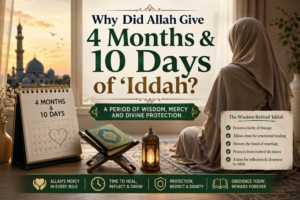
Why Did Allah Give 4 Months & 10 Days of ‘Iddah?
The fact is that concept of ‘iddah in Islam is one of the most profound and often misunderstood aspects of Islamic law. To someone unfamiliar with its wisdom, it may seem like a restriction placed upon women. But when understood deeply, ‘iddah reveals itself as a period filled with mercy, dignity, emotional protection, and divine wisdom.
Among all forms of ‘iddah, the waiting period of four months and ten days for a widow stands out. Many people ask: Why exactly this duration? Why not shorter or longer? What is the real purpose behind it?
This article explores those questions in a sincere, reflective, and practical way.
Iddah After Death of Husband
When a husband passes away, Islam prescribes a waiting period for the wife known as ‘iddah. This period lasts four months and ten days, as mentioned in the Qur’an.
During this time, a woman is encouraged to remain in her home, avoid beautification, and focus on reflection, patience, and healing. It is not meant to imprison her or make her suffer more. Rather, it is a structured period that helps her transition from one stage of life to another.
Losing a spouse is one of the most painful experiences a person can go through. In many cultures, people are expected to “move on” quickly. Islam, however, recognizes that grief cannot be rushed. It provides a sacred space for mourning.
This waiting period:
- Honors the bond of marriage
- Allows emotional healing
- Prevents rushed decisions
- Protects dignity and lineage
Instead of leaving a grieving widow to figure things out alone, Islam gives her a defined, respectful process.
Also Read: Social Media and Its Impact on Iman
What Breaks Iddah
Understanding what breaks ‘iddah is important because this period comes with specific guidelines.
Contrary to some cultural misconceptions, ‘iddah is not broken by small everyday actions like:
- Speaking to others
- Using a phone
- Going out for necessities
However, ‘iddah can be affected by actions that contradict its purpose, such as:
- Remarrying during the waiting period
- Engaging in romantic or marital relationships
- Leaving the home unnecessarily for long periods without valid reason
Islam allows flexibility for genuine needs. A widow can leave her home for:
- Work (if necessary for survival)
- Medical reasons
- Essential errands
The goal is balance, not hardship. Islam never intends to make life unbearable. Instead, it sets boundaries that preserve the dignity and meaning of the period.
Why Is Iddah 4 Months and 10 Days
This is the central question, and the answer is layered with wisdom.
At a basic level, the duration is divinely prescribed. That alone is enough for a believer. But beyond that, scholars have reflected on the deeper reasons.
Ensuring No Pregnancy Confusion
One practical wisdom is to confirm whether the woman is pregnant. This protects lineage (nasab), which is extremely important in Islam.
Though modern science can detect pregnancy early, Islamic rulings are timeless and apply across all eras.
Emotional Healing Period
Four months and ten days is not random. It is long enough for:
- Initial shock to settle
- Grief to be processed
- A person to regain some emotional stability
Grief comes in waves. This period allows space for that without external pressure.
Honoring the Marriage Bond
Marriage in Islam is not a casual contract. It is sacred. When a husband dies, the waiting period reflects the value of that relationship.
It shows that a marriage does not end without recognition, it is honored even after death.
Psychological Transition
A widow is not just losing a partner. She may be losing:
- Financial support
- Companionship
- Stability
This period helps her mentally adjust to a new reality.
Spiritual Reflection
During ‘iddah, a woman has time to reconnect with Allah. In moments of loss, people often turn deeply toward faith. This time supports that spiritual reconnection.
Iddah in Quran
The ruling of ‘iddah is clearly mentioned in the Qur’an:
“And those who are taken in death among you and leave wives behind—they shall wait for four months and ten days…”
This verse is direct and clear. It establishes the duration and the obligation.
The Qur’an often introduces laws with wisdom, not just rules. In the case of ‘iddah, the tone reflects care and structure, not punishment.
It’s important to understand that ‘iddah is not cultural, it is divine guidance.
Alao Read: Mufti Menk: Life, Family, Lectures, Net Worth, and Influence
Iddah After Death of Husband (IslamQA Perspective)
Scholars across different schools of thought have consistently agreed on the obligation of ‘iddah.
They emphasize that:
- It is mandatory (fard) for a widow
- It applies regardless of age
- It is observed whether the marriage was long or short
Even if a woman was married for a short time, the ‘iddah still applies. This shows that the purpose is not only emotional, it is also spiritual and legal.
Scholars also highlight that ‘iddah should not be turned into unnecessary hardship. Cultural additions that make it difficult are not part of Islam.
Is Iddat Compulsory
Yes, ‘iddah is compulsory in Islam.
It is not optional or based on personal preference. Like prayer and fasting, it is an act of obedience to Allah.
However, compulsion in Islam does not mean cruelty. It means:
- Structured guidance
- Clear boundaries
- Protection of individuals and society
A widow observing ‘iddah is not being restricted, she is being honored and protected.
Reward for Widow in Islam
Islam gives immense value to patience during hardship.
A widow observing ‘iddah with sincerity earns:
- Spiritual reward for obedience
- Reward for patience (sabr)
- Closeness to Allah
The Prophet taught that those who endure loss with patience are elevated in status.
A widow is not forgotten in Islam. She is given special care and recognition. Supporting widows is also highly rewarded.
Her ‘iddah is not just a waiting period, it is an act of worship.
Iddah for Men
This is a common question: Do men have ‘iddah?
Men do not have a waiting period like women. However, this does not mean they are free from responsibility.
Men are expected to:
- Show respect for the deceased spouse
- Avoid rushing into remarriage immediately out of insensitivity
- Fulfill financial and family responsibilities
The difference in rulings is based on biological and social realities, not inequality.
Women observe ‘iddah partly to ensure clarity of lineage, which does not apply in the same way to men.
Deeper Wisdom Behind ‘Iddah
Beyond the commonly discussed reasons, there are deeper layers of wisdom.
1. Protection from Exploitation
A grieving widow may be emotionally vulnerable. Without a waiting period, she could be pressured into quick decisions.
‘Iddah protects her from that.
2. Social Respect
The waiting period signals to society that this woman is in mourning. It discourages inappropriate proposals or expectations.
3. Emotional Stability Before Remarriage
Marriage requires emotional readiness. Entering it too soon after loss can lead to problems.
‘Iddah ensures time for emotional clarity.
4. Dignity and Honor
Instead of being treated as someone who must quickly “move on,” a widow is given a dignified pause.
Common Misunderstandings About ‘Iddah
1. “It is a punishment”
This is false. It is a period of care, not punishment.
2. “Women are trapped at home”
Islam allows necessary movement. The idea is moderation, not isolation.
3. “It is outdated”
The wisdom of ‘iddah applies in every era, emotionally, socially, and spiritually.
4. “It is only cultural”
It is clearly rooted in the Qur’an and Sunnah.
Modern Reflection: Why ‘Iddah Still Matters Today
In today’s fast-paced world, people are expected to recover quickly from loss. Social pressure often pushes individuals to “move on” before they are ready.
Islam offers something different: a pause.
A structured time to:
- Grieve properly
- Reflect deeply
- Rebuild slowly
Even from a psychological perspective, this is incredibly healthy.
The Emotional Reality of ‘Iddah
Imagine losing your spouse.
The home feels empty. Memories are everywhere. Life suddenly changes.
Now imagine being told:
“You have time. You don’t need to rush. You are allowed to grieve.”
That is what ‘iddah provides.
It is not about restriction, it is about permission to heal.
Also Read: Imam Abu Hanifa: The Life, Legacy, and Impact of a Great Islamic Scholar
Balancing Law and Compassion
Islamic rulings often combine structure with compassion. ‘Iddah is a perfect example.
It is:
- A legal obligation
- A spiritual opportunity
- An emotional support system
When practiced correctly, it brings peace rather than hardship.
Conclusion
The period of four months and ten days of ‘iddah is not random, harsh, or outdated. It is deeply thoughtful, balanced, and rooted in divine wisdom.
It protects:
- The dignity of women
- The clarity of lineage
- The emotional well-being of the widow
- The sanctity of marriage
Most importantly, it reflects the mercy of Allah. Even in loss, Islam provides guidance, structure, and care.
When understood properly, ‘iddah is not a burden, it is a blessing disguised as patience.
About The Author
