
Architectural Visionary of Digital Infrastructure: A Comprehensive Biography of Nandan Nilekani
Architectural Visionary of Digital Infrastructure: A Comprehensive Biography of Nandan Nilekani
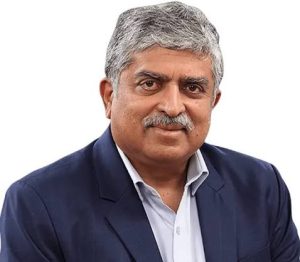
A Comprehensive Biography of Nandan Nilekani. Nandan Nilekani stands among the most influential technocrats, entrepreneurs, and civic architects of modern India. As a co-founder of Infosys, the founding chairman of the Unique Identification Authority of India (UIDAI), and a key architect of India’s Digital Public Infrastructure (DPI), his work has reshaped global technology services and transformed public service delivery for over one billion citizens.
From his early days as an engineering student in Mumbai to leading global corporate boards and directing transformative national infrastructure projects, Nilekani has consistently championed the idea that technology, when applied at scale, serves as the ultimate equalizer for social and economic mobility.
Nandan Nilekani Early Life, Ancestry, and Educational Foundation
Nandan Nilekani was born on June 2, 1955, in Bangalore (now Bengaluru), Karnataka, into a Konkani-speaking family. His father, Mohan Rao Nilekani, worked as a manager at the Minerva Mills textile company, while his mother, Durga Nilekani, was a homemaker who emphasized academic discipline and civic duty.
Due to his father’s frequent professional transfers across southern India, Nilekani spent parts of his early childhood living in various towns before moving to Sirsi, Karnataka, to reside with his uncle for his secondary schooling. Studying at the Bishop Cotton Boys’ School in Bengaluru and later St. Joseph’s High School in Sirsi helped instill adaptability, self-reliance, and intellectual curiosity.
In 1973, Nilekani earned admission to the Indian Institute of Technology (IIT) Bombay, one of India’s elite engineering institutions. During his university years, he developed a deep interest in systems analysis, organizational management, and public policy, while actively participating in student governance and academic competitions. His time at IIT Bombay provided both his technical foundation and the professional relationships that would later define his career.
Co-Founding of Infosys and the Indian IT Revolution
After graduating from IIT Bombay in 1978, Nilekani began his career at Patni Computer Systems in Mumbai. It was during his job interview at Patni that he met N.R. Narayana Murthy, who was serving as the head of the software division. Recognizing Nilekani’s analytical acumen, Murthy hired him immediately, marking the beginning of a historic professional alliance.
The Genesis of Infosys (1981)
In 1981, Narayana Murthy, Nandan Nilekani, Kris Gopalakrishnan, S.D. Shibulal, K. Dinesh, N.S. Raghavan, and Ashok Arora decided to leave Patni Computer Systems to embark on an ambitious entrepreneurial journey. With an initial capital of 10,000 rupees provided by Murthy’s wife, Sudha Murty, the team founded Infosys Consultants Private Limited in Pune.
Nilekani played a central role in shaping Infosys’s global delivery model. His ability to build relationships with multinational clients, navigate international business regulations, and structure complex software engineering processes proved instrumental in establishing Infosys as a trusted global brand.
Also Read: Saurabh Das CJP Biography: Age, Education, Career, RTI Activism, Journalism, and Public Life
Corporate Leadership Roles and CEO Tenure
Over three decades at Infosys, Nilekani held several leadership positions, including Managing Director, President, and Chief Operating Officer, before assuming the role of Chief Executive Officer in March 2002.
During his five-year tenure as CEO (2002–2007), Infosys experienced explosive growth:
- Revenue Expansion: Annual revenues grew sixfold, reaching $3 billion by 2007.
- Global Footprint: The company expanded its workforce to tens of thousands of engineers and established delivery centers across North America, Europe, and Asia.
- Brand Prestige: Infosys solidified its status as the benchmark for corporate governance, transparency, and employee equity in emerging markets.
Nilekani stepped down as CEO in April 2007 to serve as Co-Chairman of the Board of Directors, shifting his focus toward global strategy and broader public policy initiatives.
Imagining India and the Shift to Public Service
In 2008, Nilekani published his milestone book, Imagining India: The Idea of a Renewed Nation. The book analyzed India’s economic trajectory, demographic dividend, and structural challenges, proposing tech-driven public policy solutions across primary education, labor laws, energy infrastructure, financial inclusion, and governance.
The publication attracted widespread attention from policymakers, economists, and global leaders. Nilekani argued that India’s growth relied on moving from informal, fragmented systems to open, scalable national digital platforms. His insights caught the attention of Prime Minister Dr. Manmohan Singh, leading to a transition from corporate leadership to national governance.
Aadhaar and the Unique Identification Authority of India (UIDAI)
In July 2009, Nilekani resigned from Infosys after Prime Minister Manmohan Singh invited him to head the newly established Unique Identification Authority of India (UIDAI), holding the cabinet-minister rank.
The Blueprint of Aadhaar
The objective of UIDAI was to issue a verifiable, 12-digit unique identification number—known as Aadhaar—to all residents of India. The project aimed to address a fundamental challenge in Indian public administration: millions of impoverished citizens lacked recognized identity documents, preventing them from accessing state welfare benefits, opening bank accounts, or receiving subsidized food grains without intermediary leakage and corruption.
Nilekani applied enterprise-grade software principles to build the program:
- Biometric Authentication: Collecting fingerprints, iris scans, and basic demographic data to guarantee uniqueness across a billion-plus population.
- Minimalist Architecture: Storing only identity verification data rather than tracking personal transactions, preserving privacy through structural design.
- Open APIs: Enabling third-party developers, banks, and telecom providers to authenticate identities instantly and digitally (e-KYC), lowering customer onboarding costs.
Under Nilekani’s leadership from 2009 to 2014, UIDAI established a biometric system that scaled faster than any identity enrollment project in human history, laying the technical groundwork for digital governance in India.
India Stack and Financial Transformation
The completion of the Aadhaar identity layer paved the way for a broader ecosystem known as India Stack—a unified set of open Application Programming Interfaces (APIs) designed to facilitate digital payments, data exchange, and paperless documentation.
Unified Payments Interface (UPI)
Working closely with the National Payments Corporation of India (NPCI) and the Reserve Bank of India (RBI), Nilekani played a advisory and technical role in designing the Unified Payments Interface (UPI). Launched in 2016, UPI allowed instant, interoperable money transfers between bank accounts using mobile devices. The platform revolutionized commerce in India, reducing transaction costs and bringing hundreds of millions of unbanked citizens and small business owners into the formal economy.
Open Network for Digital Commerce (ONDC) and Account Aggregator
Nilekani also helped guide the development of the Account Aggregator framework—which gives individuals control over sharing their financial data—and served on the advisory council for the Open Network for Digital Commerce (ONDC). ONDC was established to decentralize digital retail environments, enabling small-scale vendors to participate on open networks on equal footing with major e-commerce platforms.
Nandan Nilekani Political Foray, Corporate Return, and Continued Public Advisory
In 2014, Nilekani entered electoral politics, contesting the Indian General Election as an Indian National Congress candidate for the Bangalore South parliamentary constituency. Though he lost the election to the late Ananth Kumar of the Bharatiya Janata Party, Nilekani remained an active contributor to cross-party public policy initiatives.
Stabilizing Infosys (2017)
In August 2017, following a public dispute between the Infosys board and its founding members that led to the sudden resignation of then-CEO Vishal Sikka, the board turned to Nilekani. He returned to Infosys as Non-Executive Chairman, restoring institutional stability, realigning corporate strategy around cloud and artificial intelligence capabilities, and rebuilding stakeholder confidence.
Institutional and National Advisory
Nilekani’s expertise in digital infrastructure has made him a trusted advisor across political administrations:
- G20 Digital Public Infrastructure (DPI): In January 2023, he was appointed Co-Chair of the G20 Task Force on Digital Public Infrastructure for Economic Transformation, Financial Inclusion, and Development.
- National Examination Reforms: Governments have repeatedly tapped Nilekani to address complex administrative challenges, including appointing him to head high-level technology task forces to reform national examination systems and prevent security leaks.
Nandan Nilekani Philanthropy and Social Impact
Beyond corporate leadership and public administration, Nandan Nilekani and his wife, Rohini Nilekani, are active philanthropists. The couple signed The Giving Pledge, committing at least half of their wealth to philanthropic causes.
- EkStep Foundation: Co-founded by Nilekani, EkStep is a non-profit initiative that builds technology-led open platform infrastructure to improve basic literacy and numeracy for millions of primary school children.
- Higher Education Giving: In 2023, Nilekani donated $38 million (315 crore rupees) to his alma mater, IIT Bombay, marking one of the largest individual alumni donations in Indian history to expand scientific research and campus infrastructure.
- Avanti Finance: Partnered with Ratan Tata to establish Avanti Finance, a microfinance entity leveraging digital rails to provide affordable credit to underserved communities.
Key Life Milestones and Positions Held
| Era / Year | Role / Initiative | Core Contribution |
|---|---|---|
| 1955 | Entry into Life | Welcomed into the world in Bengaluru, Karnataka, India. |
| 1978 | Graduated IIT Bombay | Completed B.Tech in Electrical Engineering; joined Patni Computer Systems. |
| 1981 | Launched Infosys | Founded Infosys in partnership with Narayana Murthy and five fellow associates. |
| 2002–2007 | Infosys Executive Leadership | Guided global corporate scaling, expanding total organizational earnings six times over to hit $3 billion. |
| 2006 | Awarded Padma Bhushan | Received India’s third-highest civilian honor for contributions to IT and trade. |
| 2008 | Published Imagining India | Authored landmark book outlining tech-driven solutions for national reform. |
| 2009–2014 | Founding Chairman, UIDAI | Designed and executed Aadhaar, the world’s largest biometric ID system. |
| 2016 | Architectural Leader for UPI | Guided digital infrastructure frameworks enabling instant mobile payments. |
| 2017–Present | Non-Executive Chairman, Infosys | Returned to lead Infosys board and oversee AI-driven corporate transformation. |
| 2023 | G20 Task Force Co-Chair | Appointed to champion Digital Public Infrastructure on the global stage. |
Also Read: Okoth Obado Biography: Political Career, Achievements, Controversies
Frequently Asked Questions (FAQs)
What is Nandan Nilekani’s primary contribution to India’s digital ecosystem?
Nandan Nilekani is best known for conceptualizing and executing Aadhaar, the world’s largest biometric identity framework. He also helped design India Stack, which serves as the underlying technical foundation for the Unified Payments Interface (UPI), e-KYC, and digital financial inclusion.
What role did Nandan Nilekani play at Infosys?
Nilekani was one of seven co-founders of Infosys in 1981. He served as its CEO from 2002 to 2007, guiding the company through rapid international expansion. He returned as Non-Executive Chairman in 2017 to provide strategic direction and board stability.
What is Digital Public Infrastructure (DPI), and why is Nilekani associated with it?
Digital Public Infrastructure refers to open, interoperable technology platforms—such as digital identity, payment rails, and data-sharing frameworks—built as public goods. Nilekani pioneered this approach in India through Aadhaar and UPI, demonstrating how governments can foster private-sector innovation while expanding access to public services.
What major books has Nandan Nilekani authored?
Nilekani authored Imagining India: The Idea of a Renewed Nation (2008), a work outlining a strategic blueprint for national governance and societal reform. He also co-authored Rebooting India: Realizing a Billion Aspirations (2015) with Viral Shah, focusing on scalable technological approaches to governance.
What are Nandan Nilekani’s primary philanthropic focus areas?
Through the Giving Pledge, the EkStep Foundation, and direct donations to higher education institutions like IIT Bombay, Nilekani focuses on primary learning outcomes, urban infrastructure, scientific research, and microfinance access for underserved communities.
Conclusion
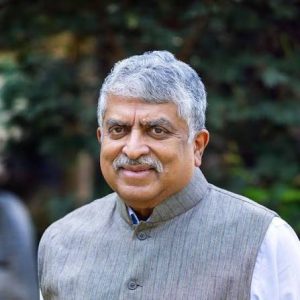
Nandan Nilekani’s career offers a compelling model for how private sector expertise can be harnessed to solve large-scale public challenges. By building Infosys into a global IT leader and subsequently designing digital frameworks like Aadhaar and UPI, Nilekani demonstrated that open-source, tech-driven infrastructure can bring hundreds of millions of citizens into the formal economy. His ongoing work in philanthropy, educational innovation, and global Digital Public Infrastructure continues to shape public policy and technological governance worldwide.
About The Author
