
Anna Hazare Biography: Life, Movements, and Legacy of India’s Gandhian Crusader
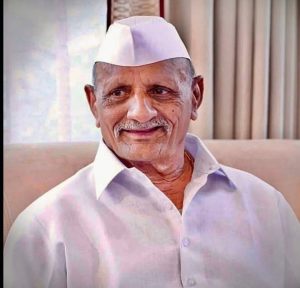
Anna Hazare Biography: Life, Movements, and Legacy of India’s Gandhian Crusader
Anna Hazare Biography. In the history of post-independence India, few individuals have managed to capture the collective conscience of the nation quite like Kisan Baburao Hazare, universally known as Anna Hazare. Born into simple rural circumstances, Hazare transitioned from his role as an Indian military driver to become one of the nation’s most influential forces for social change.
His life is a testament to the power of grassroots mobilization, self-discipline, and unyielding ethical conviction. Through his pioneering work in rural self-sufficiency and his historic national crusade against systemic corruption, Hazare reshaped the landscape of Indian civil society.
This comprehensive biography explores the remarkable journey of Anna Hazare, detailing his early struggles, military service, revolutionary rural reforms, state-level activism, the historic anti-corruption movement of 2011, and his enduring legacy.
Anna Hazare Early Life, Family Background, and Financial Hardships
Kisan Baburao Hazare was born on June 15, 1937, in Bhingar, a small town near Ahmednagar in the Bombay Presidency of British India (now Maharashtra). He was the eldest son of Baburao Hazare and Laxmi Bai. His father was an impoverished laborer who worked in a local pharmacy, struggling constantly to provide for a growing family of seven children.
Faced with severe financial distress, the family eventually relocated to their ancestral village of Ralegan Siddhi, located in the parched, drought-prone district of Ahmednagar. The transition did not alleviate their poverty. Realizing that the family could not support his education, a relative took young Kisan to Mumbai, then Bombay, in the hope of providing him with better opportunities.
In Bombay, Kisan managed to study up to the seventh grade. At a tender age, he began working, selling flowers at the Dadar railway station to send money back to his struggling parents in the village. This period of early hardship exposed him to the harsh realities of urban poverty and instilled in him a deep sense of resilience.
Also Read: Ridheema Tiwari Biography: The Life, Career, and Movies of the Versatile Indian Actress
Anna Hazare Military Service and the Spiritual Turning Point
In 1962, following the Sino-Indian War, the Indian government launched an urgent recruitment drive for the armed forces. Drawn by a sense of duty and the promise of stable employment, Kisan Hazare enlisted in the Indian Army. He was selected as a driver in the Army Service Corps.
While his time in the military was marked by strict order, a narrow escape from death during the 1965 conflict between India and Pakistan completely shifted the direction of his life.
Hazare was stationed on the Khem Karan border sector. During an enemy air raid, the vehicle he was driving came under heavy bombardment. Everyone in his immediate vicinity perished; Hazare was the sole survivor.
This extraordinary survival drove him into a profound period of self-reflection about the meaning of life.
He began questioning the purpose of his survival, wondering why his life had been spared when so many others were lost.
During this period of spiritual searching at a railway station bookstall, he came across a booklet featuring the teachings of Swami Vivekananda. The philosopher’s call to dedicate one’s life to the service of the poor and down-trodden resonated deeply with the young soldier. Hazare realized that his spared life belonged not to himself, but to the service of humanity. He resolved to remain unmarried, practice celibacy, and devote his future to social reform.
He continued to serve in the Indian Army for another decade, primarily in challenging terrains like Jammu and Kashmir, before taking voluntary retirement in 1975 to return to his ancestral home.
Anna Hazare Transformation of Ralegan Siddhi
By the time Anna Hazare returned to Ralegan Siddhi in 1975, The village had turn to another thing. The region was plagued by chronic water scarcity, failing agriculture, and extreme poverty. Despair had driven a vast majority of the villagers into alcoholism, and the village had become notorious for hosting dozens of illegal liquor dens. Untouchability and caste-based discrimination were deeply entrenched, and debt-traps had forced many families to abandon their land.
Hazare chose the village temple as his home, symbolizing his detachment from material pursuits. He began his reforms by addressing the root cause of the social decay: alcoholism.
War on Alcohol and Moral Reconstruction
Hazare understood that economic development was impossible without social discipline. He convened meetings at the local temple, convincing the villagers to voluntarily shut down the illegal distilleries. For those who resisted, he instituted strict community punishments, which occasionally drew criticism for their severity but succeeded in entirely eradicating alcoholism from the village.
To reinforce moral values, he established a youth forum (Tarun Mandal) and encouraged community prayers. He insisted on clean living, vegetarianism, and the complete prohibition of tobacco and intoxicating substances.
Watershed Development and Agricultural Revolution
The most enduring legacy of Ralegan Siddhi is its revolutionary water conservation model. Hazare recognized that the key to reviving the agrarian economy was harvesting rainwater. He rallied the villagers to offer their physical labor for free, a communal practice called Shramdaan.
Under his leadership, the villagers built:
- Nala bunds and contour trenches to prevent soil erosion and retain surface water.
- Percolation tanks to recharge the depleted underground aquifers.
- Massive reforestation initiatives, planting over 300,000 trees to restore the ecological balance.
The results were miraculous. The groundwater table rose dramatically, turning a barren wasteland into a lush, multi-cropping agricultural oasis. The village, once dependent on food aid, began exporting grains, fruits, and vegetables to urban markets.
Social Equality and Educational Reform
Hazare actively fought against the caste system. He insisted that water from the community wells be shared equally, regardless of caste. He organized community feasts where upper-caste villagers and Dalits cooked and ate together.
He also established a high school focused on providing quality education to marginalized children, ensuring that the next generation would not be trapped in the cycle of poverty. Today, Ralegan Siddhi stands as a globally recognized model of sustainable development, attracting environmentalists, policymakers, and researchers from around the world.
Transition to State-Level Activism and the RTI Movement
By the late 1980s, Hazare realized that local development could not survive in isolation if the surrounding administrative machinery remained corrupt and unresponsive. He expanded his focus to challenge institutional corruption in Maharashtra.
He initiated the Bhrashtachar Virodhi Jan Andolan (People’s Movement Against Corruption) in 1991.
He targeted corrupt forest officials, cooperative bank scams, and politicians who embezzled public funds. His primary weapon was Satyagraha—peaceful protest, fasts, and returning government honors. In 1990, he was awarded the Padma Shri, and in 1992, the Padma Bhushan, both of which he threatened to return in protest of government inaction against corrupt officials.
Architect of the Right to Information (RTI)
Perhaps Hazare’s most significant institutional contribution to Indian democracy was his relentless campaign for the Right to Information. He recognized that corruption thrives in secrecy. Throughout the late 1990s and early 2000s, he led massive protests demanding a robust law that would force the government to share official documents with the public.
His prolonged hunger strike in 2003 forced the Maharashtra government to pass the Maharashtra Right to Information Act. This state-level legislation served as the crucial blueprint for the historic national Right to Information Act of 2005, which empowered millions of Indian citizens to hold public officials accountable.
Anna Hazare 2011 Anti-Corruption Crusade: A National Awakening
In 2011, India was reeling from a series of high-profile corruption scandals involving telecom spectrum allocations, coal block mining, and the Commonwealth Games. The public was frustrated, and the political establishment seemed indifferent. It was against this backdrop that Anna Hazare entered the national stage, launching a movement that would shake the foundations of Indian politics.
Anna Hazare Fast at Jantar Mantar
Under the banner of India Against Corruption (IAC), a coalition that included activists like Arvind Kejriwal, Kiran Bedi, and Prashant Bhushan, Hazare demanded the passage of the Jan Lokpal Bill. This proposed legislation sought to create an independent, powerful anti-corruption ombudsman (Lokpal) with the authority to investigate politicians and bureaucrats without government interference.
On April 5, 2011, Hazare began a fast unto death at Jantar Mantar in New Delhi. The protest struck an immediate chord with the public. Fueled by 24-hour news coverage and social media, thousands of citizens—students, corporate professionals, auto-rickshaw drivers, and homemakers—flocked to Jantar Mantar to show solidarity. Protests erupted in dozens of cities across India.
Sensing the overwhelming public anger, the union government capitulated. On April 9, after 98 hours of fasting, Hazare broke his fast after the government agreed to form a joint committee comprising ministers and civil society representatives to draft the bill.
Ramlila Maidan Showdown
When the government presented a weakened version of the bill in parliament later that year, Hazare declared another fast. In August 2011, he was pre-emptively arrested by the Delhi Police, sparking national outrage. From his cell in Tihar Jail, Hazare refused to back down, forcing the government to release him.
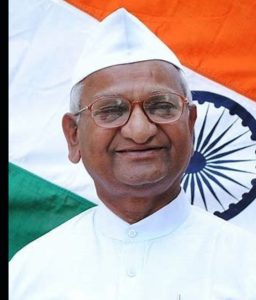
He was escorted to Ramlila Maidan, where he continued his fast for 12 days in front of tens of thousands of cheering supporters. The lasting visual of the delicate, elderly reformer in his traditional white dhoti and Gandhi cap, fearlessly challenging a powerful government, became the definitive representation of a modern crusade for liberty. The protest concluded only after Parliament formally agreed to consider his key demands.
Aftermath and Political Divergence
While the 2011 movement successfully forced the passage of the Lokpal and Lokayuktas Act in late 2013, the cohesive coalition of India Against Corruption began to fracture.
A prominent faction within the movement, led by Arvind Kejriwal, argued that real systemic change could only be achieved by entering electoral politics. Hazare strongly disagreed. True to his Gandhian philosophy, he believed that civil society must remain non-partisan and act as an external watchdog over the government. He refused to join or endorse Kejriwal’s newly formed Aam Aadmi Party (AAP).
Despite this parting of ways, Hazare continued his quiet, persistent activism from Ralegan Siddhi, occasionally issuing statements, writing letters to the Prime Minister, and staging localized hunger strikes whenever he felt public accountability was being compromised.
Anna Hazare Philosophy, Lifestyle, and Criticisms
Anna Hazare’s life is deeply rooted in Gandhian principles. He lives in a single, austere room at the Sant Yadavbaba Temple in Ralegan Siddhi, owning nothing more than a few sets of khadi clothes, a plate, and a bed. He has never accumulated wealth or property.
However, his methods have not been free of controversy. Critics have pointed out that his rural development model at Ralegan Siddhi relied on paternalistic control and occasional corporal punishment, such as tying alcoholics to trees and beating them to enforce discipline.
Others have criticized his reliance on hunger strikes, arguing that fasts unto death are a form of political blackmail that bypasses democratic parliamentary processes. Despite these debates, his absolute personal integrity has rarely been questioned.
Also Read: Jennifer Winget Biography: The Ultimate Reigning Queen of Indian Television
Timeline of Major Defining Moments in Anna Hazare’s Journey
| Year | Milestone / Event | Significance and Impact |
|---|---|---|
| 1937 | Birth in Bhingar, Maharashtra | Born into an impoverished rural family. |
| 1962 | Enlisted in the Indian Army | Served as a driver; survived a near-death air raid in 1965. |
| 1975 | Returned to Ralegan Siddhi | Began his lifelong mission to transform the drought-prone village. |
| 1991 | Launched Bhrashtachar Virodhi Jan Andolan | Initiated state-level anti-corruption protests in Maharashtra. |
| 1992 | Awarded the Padma Bhushan | Honored with India’s third-highest civilian award for social work. |
| 2003 | Led Maharashtra RTI Campaign | Paved the way for the historic national Right to Information Act of 2005. |
| 2011 | Headed India Against Corruption Movement | Mobilized millions across the country demanding the Jan Lokpal Bill. |
| 2013 | Passage of the Lokpal Bill | Parliament enacted the anti-corruption ombudsman legislation. |
Frequently Asked Questions (FAQ)
What is the real name of Anna Hazare?
His birth name is Kisan Baburao Hazare. The honorific title “Anna,” which means “elder brother” in Marathi, was affectionately bestowed upon him by the villagers of Ralegan Siddhi in recognition of his leadership and guidance.
How did Anna Hazare transform Ralegan Siddhi?
He transformed the drought-prone, impoverished village through water conservation projects, watershed development, mass tree plantation, educational reforms, and by strictly banning alcohol, tobacco, and caste discrimination. He used community voluntary labor (Shramdaan) to build all major infrastructure.
What was the main objective of the 2011 India Against Corruption movement?
The primary objective of the movement was to pressure the Indian Parliament to pass the Jan Lokpal Bill, a law to establish an independent anti-corruption ombudsman with the power to investigate public officials, including the Prime Minister and ministers.
Why did Anna Hazare refuse to join politics with Arvind Kejriwal?
Hazare believed that social organizations should remain non-political watchdogs. He argued that entering electoral politics would dilute the moral authority of the anti-corruption movement and divide the public, choosing instead to remain an independent social reformer.
What civilian honors has Anna Hazare received from the Indian government?
He was awarded the Padma Shri in 1990 and the Padma Bhushan in 1992 for his outstanding contributions to social work and rural development.
Conclusion
Anna Hazare’s life journey bridges the gap between traditional Gandhian philosophy and the demands of modern democratic governance. At a time when public faith in political institutions was wavering, he proved that a single individual, armed only with moral conviction and peaceful determination, could mobilize an entire nation.
From the dusty lanes of Ralegan Siddhi to the crowded expanse of Ramlila Maidan, Hazare demonstrated that true development begins at the grassroots, and true democracy requires active, vigilant citizens. His legacy lies not just in the laws he helped enact, but in the awakening of public consciousness that continues to demand transparency, accountability, and integrity from those in power.
About The Author
