
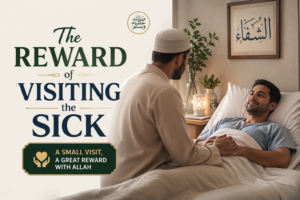
Let Talk about The Reward of Visiting the Sick
The Reward of Visiting the Sick. There are some acts in life that don’t require money, status, or influence, just a sincere heart and a willingness to show up. Visiting the sick is one of those acts. It’s simple on the surface: you go, you sit, you ask how they’re doing, maybe you make a short du‘a, and then you leave. But in Islam, this seemingly small act carries a weight that many people overlook.
We live in a time where people are constantly busy. Messages replace visits. Emojis replace empathy. A quick “get well soon” text has become the norm. But there’s something irreplaceable about physical presence, about sitting beside someone who is struggling and reminding them, without saying much, that they are not alone.
The teachings of Prophet Muhammad (peace be upon him) didn’t just encourage visiting the sick, they elevated it. They gave it spiritual depth, emotional meaning, and a reward that goes far beyond what we can see.
This isn’t just about kindness. It’s about faith in action.
Alao Read: The Sunnah of Smiling and Kindness
Reward of Visiting the Sick Hadith
One of the most powerful ways to understand the importance of visiting the sick is through the sayings of the Prophet Muhammad (peace be upon him).
There is a narration that says:
“When a Muslim visits his sick brother, he is walking among the fruits of Paradise until he sits. And when he sits, he is enveloped in mercy.”
Think about that imagery for a moment.
You’re not just walking into someone’s house or hospital room—you’re walking through the gardens of Jannah. Every step you take carries reward. Every moment you sit carries mercy.
Another narration describes how Allah will say on the Day of Judgment:
“O son of Adam, I was sick and you did not visit Me.”
The person will respond, “How could I visit You when You are the Lord of the worlds?”
Allah will say, “Did you not know that My servant was sick, and you did not visit him? Had you visited him, you would have found Me with him.”
This hadith shifts the entire perspective. Visiting the sick is not just about the person, it’s about your relationship with Allah.
Hadith on Visiting the Sick
The Sunnah of the Prophet Muhammad (peace be upon him) is filled with examples of compassion, and visiting the sick was a consistent part of his life.
He visited:
- Companions
- Family members
- Even those who were not Muslim
There’s a well-known story of a young boy who used to serve the Prophet. When the boy fell ill, the Prophet visited him. This visit eventually became a turning point in the boy’s life.
This shows something important: visiting the sick is not limited by relationship, status, or background. It’s a universal act of mercy.
Visiting the Sick Sunnah
Visiting the sick is not just recommended, it is part of the Sunnah.
But like many acts in Islam, it comes with etiquette.
The Prophet (peace be upon him) taught us how to visit:
- Keep the visit short
- Offer comfort, not stress
- Make du‘a for the sick person
- Speak words of hope
This matters.
Sometimes people visit and unintentionally make things worse, talking too much, staying too long, or bringing negativity. That’s not the Sunnah.
The Sunnah is gentle. Thoughtful. Balanced.
Visiting the Sick Hadith Angels
There is a beautiful narration that mentions angels in connection with visiting the sick.
It states that when a person visits someone who is ill, angels accompany them and make du‘a for them.
Just imagine that.
You think you’re going alone, but you’re not.
You’re being surrounded by unseen beings, praying for you, supporting you, and witnessing your act.
It’s one of those reminders that in Islam, actions have layers. What you see is only part of the story.
70,000 Angels Pray for You When You Visit the Sick
There is a well-known narration that says:
“Whoever visits a sick person in the morning, seventy thousand angels send blessings upon him until the evening. And if he visits in the evening, seventy thousand angels send blessings upon him until the morning.”
Seventy thousand.
That number alone should make anyone pause.
We spend so much time chasing validation, from people, from social media, from the world. But here’s a moment where unseen creation is making du‘a for you… just because you chose to visit someone who is struggling.
No camera. No audience. Just reward.
Visiting a Sick Person Is Called What?
In Islamic tradition, visiting the sick is often referred to as ‘Iyadah.
But beyond terminology, what matters is the meaning behind it.
It’s not just a visit, it’s an act of care, a form of worship, and a reflection of community.
When someone is sick, they are vulnerable. Physically weak, emotionally drained, sometimes even spiritually shaken.
Your presence reminds them:
- They are remembered
- They are valued
- They are not alone
And in many cases, that means more than medicine.
Visiting the Sick Du‘a
One of the most beautiful parts of visiting the sick is making du‘a for them.
The Prophet Muhammad (peace be upon him) taught specific supplications, including:
“La بأس طهور إن شاء الله”
“No harm, it is purification, if Allah wills.”
This simple phrase carries deep meaning.
It reminds the sick person that their illness is not pointless, it’s a means of purification, a way their sins are being erased.
Du‘a brings comfort. It brings hope. And sometimes, it brings healing.
Visiting the Sick Bible Verses
Even outside Islam, visiting the sick is recognized as an act of compassion and righteousness.
In the Bible, caring for the sick is also emphasized as a reflection of faith and love.
This shows something universal: humanity recognizes the value of showing up for those who are suffering.
But in Islam, this act is not only moral, it is spiritual, deeply tied to reward and accountability.
The Emotional Impact of Visiting the Sick
Let’s step away from the religious texts for a moment and talk about reality.
When someone is sick, especially for a long time, loneliness becomes part of the struggle.
People stop visiting. Calls become less frequent. Life moves on.
And that’s when your visit matters the most.
You might think:
- “It’s just a short visit”
- “I don’t have much to say”
But to the person on the bed, it means everything.
It breaks the silence. It lifts the mood. It reminds them that they still matter.
Why People Avoid Visiting the Sick
Let’s be honest, many people avoid it.
Not because they don’t care, but because:
- They don’t know what to say
- They feel uncomfortable
- They’re afraid of seeing someone in pain
That’s human.
But Islam teaches us to push past that discomfort.
Because sometimes, doing good doesn’t feel easy. It feels awkward. It feels unfamiliar.
But that’s where growth happens.
Also Read: 7 People Who Will Be Under Allah’s Shade on the Day of Judgment
Not Overwhelming the Sick
Here’s something important—the Sunnah teaches balance.
Visiting the sick is good. But overwhelming them is not.
Don’t:
- Stay too long
- Bring stress
- Ask too many questions
Sometimes the best visit is short, calm, and sincere.
The Hidden Rewards
One of the most beautiful aspects of Islam is that many rewards are unseen.
You visit someone, you leave and that’s it.
But behind the scenes:
- Your sins may be forgiven
- Your rank may be raised
- Your du‘as may be accepted
You don’t see it. But it’s happening.
A Reminder About Life
Visiting the sick does something else—it reminds you of your own reality.
Health is temporary. Strength is temporary.
Seeing someone struggle puts things into perspective.
It softens the heart.
And sometimes, that’s exactly what we need.
Final Reflection
Here’s a simple question:
When was the last time you visited someone who was sick?
Not texted. Not called. Actually visited.
If the answer takes time to remember, maybe it’s something to work on.
Because this is one of those acts that doesn’t require much, but gives a lot.
Conclusion
The reward of visiting the sick is not just in the act itself, it’s in everything surrounding it.
- The mercy.
- The angels.
- The du‘as.
- The connection with Allah.
The teachings of Prophet Muhammad (peace be upon him) show us that sometimes, the simplest acts carry the greatest weight.
In a world that moves fast and forgets easily, choosing to slow down and show up for someone who is struggling is a powerful act of faith.
And maybe, ljust maybe, the next time you visit someone who is sick, you won’t just see it as a visit.
You’ll see it as an opportunity.
- An opportunity for reward.
- For connection.
- For mercy.
About The Author
