
Introduction: A Problem Many People Don’t Fully Understand
Let’s start with something honest.
Most Muslims today know that riba (interest) is not allowed in Islam. But knowing something is haram and truly understanding why it is dangerous are two very different things.
For many people, riba has become normalized:
- Loans with interest
- Credit systems
- Banking structures
- Financial “opportunities”
It’s everywhere.
So the real struggle is not just avoiding it—it’s understanding how serious it actually is.
Because in Islam, riba is not treated like a small mistake. It is described in some of the strongest warnings you will find.
This article is not just to inform you.
It’s to help you see riba clearly, its meaning, its impact, its consequences, and why Islam takes such a firm stance against it.
Consuming Riba Meaning
Before going deeper, we need clarity.
What does “consuming riba” actually mean?
Riba refers to any guaranteed increase in a loan or financial transaction without real effort or risk.
In simple terms:
- You lend money
- You demand more in return just because of time
This extra amount is riba.
“Consuming riba” includes:
- Taking interest
- Paying interest (in many cases, out of necessity discussions exist, but it is still serious)
- Writing or witnessing such contracts knowingly
It’s not limited to one role.
It involves an entire system.
And that’s why it’s so widespread and dangerous.
Also Read: Halal Ways to Make Money Online in 2026
Prohibition of Riba in Quran and Hadith
One of the strongest proofs of how serious riba is comes from how clearly it is prohibited.
The Qur’an does not just discourage it.
It strongly condemns it.
Riba is mentioned alongside severe warnings—unlike many other sins.
In Islamic teachings, engaging in riba is described as being in opposition to divine command. This is not symbolic language, it shows the gravity of the act.
In the teachings of the Prophet:
- Those who consume riba
- Those who give it
- Those who record it
- Those who witness it
Are all held accountable.
This shows that riba is not just a personal issue.
It is a systemic problem that affects society.
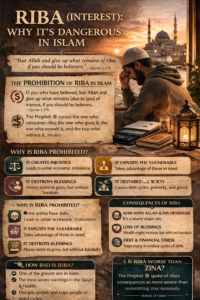
Why Riba Is Prohibited in Islam
Now let’s understand the wisdom behind it.
Islam does not prohibit something without reason.
1. It Creates Injustice
Riba allows one party to benefit without effort, while the other carries the burden.
The lender:
- Gains without risk
The borrower:
- Struggles with increasing debt
This creates an imbalance.
2. It Exploits the Vulnerable
Most people who take loans are already in need.
Adding interest:
- Increases their hardship
- Traps them in cycles of debt
Instead of helping, it takes advantage.
3. It Destroys Barakah
Even if money increases, something feels missing:
- No peace
- No satisfaction
- Constant stress
This is what happens when income lacks barakah.
4. It Encourages Greed
Riba shifts focus from:
- Effort
- Productivity
To:
- Passive gain
- Financial control over others
5. It Damages Society
On a larger scale, riba leads to:
- Wealth inequality
- Financial crises
- Economic instability
How Bad Is Riba?
Let’s not soften this.
Riba is one of the most serious financial sins in Islam.
It is not:
- A minor mistake
- A small issue
- Something to ignore
It is placed among the major sins.
Why?
Because it affects:
- Individuals
- Families
- Entire societies
It’s not just about personal accountability.
It’s about widespread harm.
Punishment for Riba in Islam
This is where things become very serious.
Islamic teachings describe severe consequences for engaging in riba.
The warnings include:
- Spiritual consequences
- Loss of peace
- Accountability in the Hereafter
The strong language used in Islamic texts is meant to:
- Wake people up
- Emphasize the danger
- Prevent normalization
This is not to scare without reason.
It is to protect.
Consequences of Riba in Islam
Let’s break this down practically.
1. Loss of Barakah
You may earn more, but feel less satisfied.
2. Constant Financial Pressure
Interest creates a cycle:
- Debt grows
- Payments increase
- Stress builds
3. Emotional and Mental Stress
Debt is not just financial.
It affects:
- Mental health
- Relationships
- Stability
4. Spiritual Distance
Engaging in something clearly prohibited affects your connection with Allah.
5. Social Impact
Riba contributes to:
- Economic imbalance
- Poverty cycles
- Wealth concentration
Is Riba Worse Than Zina?
This is a question many people ask.
Islam does not encourage comparing sins casually.
But what is important to understand is:
Riba is described with extremely strong warnings—sometimes even stronger than what people expect.
Why?
Because:
- Zina affects individuals
- Riba affects entire systems
Both are serious.
Both are major sins.
But riba has a wider societal impact, which is why it is treated with such gravity.
Trade in Islam
Here is something important.
Islam does not discourage business or profit.
In fact, it encourages trade.
But there is a key difference:
Trade:
- Involves effort
- Includes risk
- Creates value
Riba:
- Guarantees profit
- Removes risk
- Exploits need
That’s why trade is allowed and riba is not.
Practical Challenges in Today’s World
Let’s be real.
Avoiding riba today is not easy.
It’s part of:
- Banking systems
- Loans
- Financial structures
But difficulty does not change the ruling.
It just means:
- You need awareness
- You need effort
- You need alternatives
How to Avoid Riba in Modern Life
Start with what you can control.
- Avoid unnecessary loans
- Use halal financial options where available
- Stay informed
- Make conscious choices
You may not eliminate everything immediately.
But you can reduce your involvement step by step.
A Personal Reflection
Let me speak to you directly.
If you are involved in riba in any way, this is not a message of judgment.
It is a message of awareness.
Because many people:
- Don’t fully understand
- Feel stuck
- Think there is no way out
But change starts with understanding.
And then:
- Intention
- Effort
- Gradual action
The Role of Tawbah (Repentance)
Islam does not close doors.
If someone has engaged in riba:
- They can repent
- They can change
- They can move forward
Tawbah includes:
- Recognizing the mistake
- Feeling sincere regret
- Making a firm decision to avoid it
Also Read: Preparing for the Hereafter in a Fast-Paced World
Final Thoughts: It’s About Protection, Not Restriction
At first, riba may seem like a normal part of modern life.
But when you understand it deeply, you see why Islam prohibits it so strongly.
It is not just about money.
It is about:
- Justice
- Balance
- Integrity
- Spiritual well-being
Conclusion
Riba is not just another financial rule in Islam.
It is a major issue with deep consequences.
So don’t ignore it.
Understand it.
Reflect on it.
And take steps, however small, to move away from it.
Because in the end:
Clean income brings peace.
And peace is worth more than profit.
About The Author
