
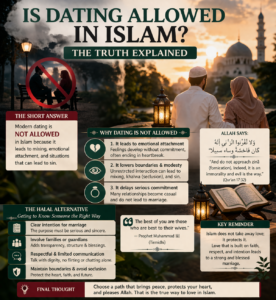
Introduction: Let’s Address What Many People Are Quietly Wondering
Let’s be honest.
Dating is everywhere today. It’s normal in many societies, talked about openly, and often seen as the standard way to find a partner. So naturally, many Muslims, especially young people, find themselves asking:
“Is dating actually allowed in Islam?”
Some hear a strict “no” and feel confused. Others try to justify modern dating within an Islamic framework. And many are simply stuck in between, wanting love, companionship, and marriage, but unsure how to approach it in a way that aligns with their faith.
This is not just a theoretical issue. It’s real. It affects decisions, emotions, and sometimes even people’s relationship with Allah.
So instead of giving a short, oversimplified answer, let’s talk about it properly. Let’s break it down in a way that is honest, practical, and rooted in Islamic understanding.
Understanding What “Dating” Means Today
Before we answer the question, we need to be clear about something important:
What exactly do we mean by “dating”?
In modern society, dating often includes:
- Private interactions between unmarried men and women
- Emotional attachment before commitment
- Physical intimacy (in many cases)
- Casual relationships without clear long-term intentions
And sometimes:
- Multiple partners over time
- Relationships that are not leading to marriage
This is the common understanding of dating.
So when Islam addresses relationships between men and women, it is addressing these types of interactions, not just the idea of “getting to know someone.”
Also Read: Common Marriage Mistakes Muslims Make (And How to Avoid Them)
The Clear Islamic Principle: Protecting Boundaries
Islam places strong emphasis on protecting:
- Modesty
- Emotional well-being
- Moral boundaries
This is why certain guidelines exist, such as:
- Avoiding unnecessary private interaction between non-mahram men and women
- Lowering the gaze
- Avoiding physical intimacy outside marriage
These are not random restrictions. They exist to prevent harm—both emotional and spiritual.
So when we apply these principles to modern dating, a clear conflict appears.
Is Dating Allowed in Islam?
Let’s answer directly.
The typical form of modern dating is not allowed in Islam.
This is because it often involves:
- Unrestricted interaction
- Emotional attachment without commitment
- Situations that can lead to haram actions
Islam does not support relationships that exist outside the framework of marriage.
But Here’s What Many People Miss
Saying “dating is not allowed” does not mean:
- You cannot get to know someone
- You cannot consider someone for marriage
- You must marry blindly without interaction
That is not the Islamic approach either.
Islam allows getting to know a potential spouse—but within clear boundaries.
This is where confusion often happens.
The Halal Alternative: Getting to Know Someone the Right Way
Islam encourages marriage, but it also encourages making informed decisions.
So how do you get to know someone without dating?
Here’s the balanced approach:
1. Clear Intention from the Start
The purpose must be marriage—not entertainment, not casual interaction.
When intention is clear, behavior changes.
2. Involving Families or Guardians
This does not mean losing your voice.
It means adding structure, seriousness, and protection.
3. Respectful, Limited Communication
You can talk, ask questions, and understand each other.
But:
- Conversations should be respectful
- No flirting or inappropriate language
- No emotional dependency before commitment
4. Avoiding Seclusion (Khalwa)
Being alone in private settings is discouraged because it removes accountability.
5. Observing Character, Not Just Words
Pay attention to:
- Behavior
- Consistency
- How they treat others
This process allows you to know someone—without falling into the risks of dating.
Why Islam Restricts Dating: The Deeper Wisdom
At first glance, it may seem restrictive.
But if you look deeper, there is wisdom behind it.
1. Emotional Protection
Dating often leads to emotional attachment without guarantee.
This can result in:
- Heartbreak
- Trust issues
- Long-term emotional impact
Islam protects you from giving your heart to someone who may not stay.
2. Preventing Gradual Boundaries Crossing
Most relationships don’t start with major mistakes.
They start small:
- Talking frequently
- Sharing personal details
- Becoming emotionally close
And slowly, boundaries fade.
Islam closes the door early to prevent bigger problems later.
3. Preserving the Value of Marriage
When relationships are casual, commitment loses value.
Islam preserves marriage as something meaningful and intentional.
The Reality Many People Experience
Let’s talk honestly again.
Many people who engage in dating experience:
- Emotional exhaustion
- Repeated disappointment
- Loss of trust
Even if it feels good at the beginning, it often becomes complicated.
This is not always—but often enough to recognize a pattern.
Islamic guidelines are not meant to make life difficult.
They are meant to prevent these cycles.
What About “Halal Dating”?
You may have heard this term.
“Halal dating” is often used to describe:
- Talking with boundaries
- Avoiding physical contact
- Intending marriage
But here’s the key point:
If it follows Islamic guidelines, it is no longer “dating” in the modern sense.
It becomes a structured process of getting to know someone for marriage.
The label is less important than the method.
Islam does not ignore human emotions.
Attraction is natural. Wanting companionship is natural.
But Islam teaches discipline—not suppression.
It guides you to:
- Channel your feelings in a halal way
- Control your actions
- Build relationships with responsibility
Common Mistakes People Make
Let’s address some real situations.
1. “We’re Just Talking”
Many relationships start like this.
But without boundaries, “just talking” quickly becomes emotional attachment.
2. Delaying Marriage While Staying in a Relationship
Some people stay in long-term relationships without commitment.
This creates uncertainty and emotional strain.
3. Hiding the Relationship
If something has to be hidden, it usually means something is not right.
Transparency brings accountability.
A Practical Approach for Today’s World
Let’s be realistic.
We live in a different time. Interaction is easier. Communication is constant.
So how do you apply Islamic principles today?
1. Be Clear About Your Intentions
If you’re not ready for marriage, don’t start something that leads toward it.
2. Set Boundaries Early
Don’t wait until emotions grow.
Define what is acceptable from the beginning.
3. Limit Emotional Dependency
Don’t rely on someone emotionally before commitment.
4. Move Toward Clarity
Don’t stay in indefinite situations.
Either move toward marriage—or step away.
A Personal Reflection
Let me speak to you directly.
If you’re currently in a relationship that doesn’t align with Islamic values, it doesn’t mean you’re beyond hope.
It means you have a choice.
You can:
- Continue and hope for the best
- Or step back and realign with your faith
It’s not easy. But it’s worth it.
Because peace does not come from following desires without limits.
It comes from balance.
The Role of Tawbah (Repentance)
If someone has been involved in dating, Islam does not shut the door.
Repentance is always open.
This means:
- Recognizing the mistake
- Feeling sincere regret
- Making a firm decision to change
And moving forward.
Final Thoughts: It’s Not About Restriction, It’s About Protection
At the end of the day, the question is not just:
“Is dating allowed?”
The deeper question is:
“What kind of relationship leads to peace, stability, and long-term success?”
Islam does not aim to take away love.
It aims to guide it.
Also Read: Signs You Should Marry Someone in Islam (A Real, Honest Guide)
Conclusion
Dating, as commonly practiced today, does not align with Islamic teachings.
But Islam does not leave you without options.
It provides a clear, balanced, and respectful way to:
- Get to know someone
- Build a connection
- Move toward marriage
Without unnecessary harm.
So don’t see these guidelines as limitations.
See them as protection for your heart, your faith, and your future.
Frequently Ask Questions
Can I talk to someone I want to marry?
Yes, as long as the intention is clear and communication stays respectful and within Islamic boundaries.
Is it haram to have feelings for someone?
No. Feelings are natural. What matters is how you act on them.
What should I do if I’m already in a dating relationship?
Reflect honestly. Set boundaries, involve family if possible, and move toward a halal path or step away.
About The Author
