
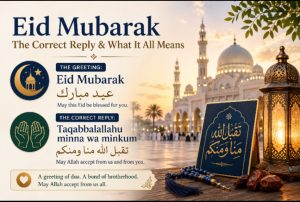
The Greeting That Comes Once or Twice a Year
Eid Mubarak Reply in Islam. There are two days in the Islamic year when Muslims greet each other with a particular warmth and energy that feels different from ordinary days. Eid Al-Fitr, which comes at the end of Ramadan, and Eid Al-Adha, which falls on the tenth of Dhul Hijjah. On both of these days, Muslims pour out of the mosques after the Eid prayer, hug each other, shake hands, and exchange greetings. Phones light up with messages. Family gatherings ring with the same phrases being passed back and forth. Children hear the words and repeat them without always knowing what they mean or what the proper response is.
The most common greeting exchanged is Eid Mubarak. Two words that most Muslims have said hundreds of times in their lives. But if you asked the average Muslim what those words actually mean, what the correct Islamic response to them is, and whether there is a more complete and authentic greeting that the Prophet and the companions used, many would not be able to tell you. That gap between habit and understanding is exactly what this article is here to fill.
What Eid Mubarak Actually Means
Breaking the phrase down word by word gives you its real meaning. Eid comes from the Arabic root aada, meaning to return or to come back. It is called Eid because it is a celebration that returns every year, a recurring joy built into the Islamic calendar. The word carries within it the idea of something that comes back to you, something you can anticipate and return to.
Mubarak is an adjective derived from the root baraka, meaning blessing. Mubarak means blessed, full of blessing, or may it be blessed. You hear the same root in the name Mubarak, in the phrase Allahu Akbar, and in the supplication Barakallahu feek, meaning may Allah bless you.
So Eid Mubarak, taken together, means blessed Eid, or may this Eid be blessed for you. It is a supplication dressed up as a greeting. When you say it to someone, you are not just offering a seasonal salutation. You are making a dua for them, asking that this celebration be a source of genuine blessing in their life. That is a meaningful thing to say, and understanding it changes the way you say it.
Also Read: What to Do on the Day of Arafah
The Correct Islamic Reply to Eid Mubarak
If someone says Eid Mubarak to you, the response that most Muslims default to is simply saying Eid Mubarak back. That is acceptable and fine. There is nothing wrong with it. But it is worth knowing that there is a more complete and Islamically grounded response that reflects the spirit of the greeting more fully.
The appropriate reply, and the one that mirrors the dua nature of the original greeting, is: Taqabbalallahu minna wa minkum.
This phrase appears in the screenshot specifically as one of the most searched responses, and there is good reason for that. It is the response most authentically connected to the practice of the companions of the Prophet. Its meaning is: May Allah accept from us and from you.
That phrase deserves a moment of reflection. When the companions greeted each other on Eid, what they said was not simply a celebration of the day. They were acknowledging that they had just spent a month fasting, praying, giving charity, and striving in worship, and their primary concern on the day of celebration was not that the food was good or the clothes were new. Their primary concern was whether Allah had accepted their deeds. Taqabbalallahu minna wa minkum is a dua that expresses exactly that concern: O Allah, accept from us and from them.
It turns the Eid greeting into a moment of genuine spiritual humility. We just did something. We hope it was accepted. We hope yours was accepted too. That is a remarkably grounded way to celebrate.
The Full Form of the Greeting and Reply
The complete form of the greeting used by the companions, as narrated in various athar, reports from the companions, collected by scholars including Ibn Hajar in Fath Al-Bari, is:
Taqabbalallahu minna wa minkum wa ahalallahu alayk.
Meaning: May Allah accept from us and from you, and may Allah make it return to you again.
Some narrations record the greeting as: Taqabbalallahu minna wa minkum salihul amal. Meaning: May Allah accept from us and from you our righteous deeds.
When someone says Eid Mubarak to you, you can reply with Taqabbalallahu minna wa minkum, and you can add Eid Mubarak back to them. Both together is completely appropriate and reflects both the popular custom and the Sunnah of the companions.
Is Saying Eid Mubarak Itself Correct?
Some Muslims have encountered the view that saying Eid Mubarak is not from the Sunnah and that it should be replaced entirely with the Taqabbal supplication. This view comes from scholars who note that there is no hadith in which the Prophet himself said Eid Mubarak specifically.
The majority scholarly position, including that of major contemporary scholars, is that Eid Mubarak is a permissible and good greeting. It is a dua, a supplication for blessing, and making dua for a fellow Muslim is always a good act. The fact that a specific phrasing is not narrated in a hadith does not make it prohibited, as long as it does not involve anything impermissible. Greeting someone with a dua for blessing on a day of celebration is precisely the kind of thing that falls under Islamic custom, urf, which the scholars recognize as acceptable in matters not specifically legislated.
What is established from the companions specifically is the Taqabbal greeting, narrated from the likes of Ibn Umar and Abu Hurairah and their exchanges with other companions. This is why many scholars recommend it as the more complete and preferable greeting, not as a replacement for Eid Mubarak but as the fuller expression that adds real meaning to the celebration.
Eid Mubarak Reply in English
For Muslims whose first language is not Arabic or who are greeting non-Muslims on Eid, the question of how to express the greeting and its reply in English comes up naturally. The straightforward English translation of Eid Mubarak is Blessed Eid or Have a blessed Eid. These are perfectly appropriate and carry the meaning of the Arabic.
For the reply in English, May Allah accept from us and from you is the direct translation of Taqabbalallahu minna wa minkum and is entirely appropriate to use. You can also combine it: Have a blessed Eid, and may Allah accept from us all.
For non-Muslims who may wish you a Happy Eid or who ask about the celebration, responding with Thank you, and wishing you and your family well is perfectly fine. The spirit of Eid is generosity and warmth, and extending goodwill to non-Muslim neighbors and colleagues on this day is consistent with the Islamic value of good relations with those around you.
Eid Mubarak in Arabic: The Written Form
In Arabic script, Eid Mubarak is written as: عيد مبارك
Taqabbalallahu minna wa minkum in Arabic is: تقبل الله منا ومنكم
These are the forms you will see on Eid cards, messages, and social media posts from Arabic-speaking Muslim communities. Knowing what the Arabic says helps you read and understand the messages rather than simply forwarding them as images without engagement.
The Etiquette of Eid Greetings
The etiquette around Eid greetings is worth understanding because Eid is one of the moments in Islamic life when community bonds are explicitly renewed and strengthened.
The Eid prayer itself is followed immediately by the exchange of greetings. After the imam concludes the khutbah and the prayer is complete, Muslims turn to those around them, shake hands, embrace, and exchange the greeting. This moment is one of the most tangible expressions of Muslim brotherhood and sisterhood in the entire year. There are no class distinctions in this exchange. The person standing next to you in the Eid prayer lines, whether they are wealthy or poor, old or young, a stranger or a lifelong friend, receives the same greeting with the same warmth.
The greeting should be given and received with genuine feeling, not as a formality. If you say Taqabbalallahu minna wa minkum and you understand what you are saying, you are making a real dua for the person in front of you. You are asking Allah to accept their month of Ramadan or their days of Dhul Hijjah from them. That is an act of brotherhood that goes deeper than a seasonal pleasantry.
It is also Sunnah to visit family and relatives on Eid specifically to exchange greetings in person. The phone call or text message has its place, but the in-person visit, especially to parents, grandparents, and elderly relatives, carries a special weight on this day. The Prophet’s companions would visit each other on Eid specifically for the purpose of exchanging these greetings, and this practice is considered among the expressions of maintaining family ties that Islam encourages so strongly.
Eid Mubarak Quotes: Beyond the Standard Greeting
The screenshot shows searches for Eid Mubarak quotes, which reflects people looking for something meaningful to say or send beyond the standard two-word greeting. There are several beautiful expressions rooted in Islamic tradition that carry real meaning and can be used in messages to family and friends.
One that is deeply rooted in tradition is: Taqabbalallahu minna wa minkum, wa kulla aam wa antum bikhair. This means: May Allah accept from us and from you, and may you be well every year. The second part, kulla aam wa antum bikhair, is widely used across Arabic-speaking communities and is the equivalent of a yearly blessing, wishing the person good health and wellbeing for the entire year ahead.
Another expression that captures the spirit of Eid beautifully and that Muslims often share is built around gratitude: Alhamdulillah ala niamah al-eid, meaning praise be to Allah for the blessing of Eid. Beginning any expression of celebration with gratitude to Allah is always the right instinct.
For messages to parents specifically, combining the Taqabbal greeting with a direct dua for them is more meaningful than any generic quote. Something like: Taqabbalallahu minna wa minkum. May Allah grant you health, long life, and the best of both worlds in this Eid and every Eid that follows, lands as a genuine expression of love and care rather than a forwarded message.
Also Read: Power of Istighfar: Why Seeking Forgiveness Changes Everything
How to Reply When a Non-Muslim Wishes You Eid Mubarak
This is a question that comes up particularly for Muslims living in non-Muslim majority countries where colleagues, neighbors, and friends have learned to wish Muslims Eid Mubarak. The Islamic position is clear and straightforward: when someone wishes you well, you wish them well in return. The Prophet said that when you are greeted with a greeting, respond with one that is better, or at least return the equivalent.
Responding to a non-Muslim’s Eid Mubarak with a warm Thank you, and I wish you and your family well is entirely appropriate. You can add something about what Eid means if the person seems genuinely curious: it is our day of celebration after the month of fasting, or it is our festival of sacrifice commemorating Prophet Ibrahim. These brief explanations are good opportunities for sharing the meaning of Islam with those around you in a natural and welcoming way.
What you do not need to do is feel awkward about receiving these greetings or treat them as something complicated. A neighbor who has learned to say Eid Mubarak to you is doing something kind and respectful. Receive it with the same spirit..
Why These Words Matter
The question of how to reply to Eid Mubarak might seem like a small detail in the grand scheme of Islamic practice. And taken in isolation, any single greeting is indeed a small thing. But the cumulative practice of greeting fellow Muslims correctly, with words that carry real dua and real meaning, is part of how a Muslim community maintains its spiritual identity and its bonds of brotherhood.
Every time you say Taqabbalallahu minna wa minkum on Eid, you are connecting yourself to a practice that goes back to the companions who stood with the Prophet. You are saying the same words that Umar ibn Al-Khattab exchanged with Abu Hurairah on the day after Ramadan ended fourteen centuries ago. That continuity is one of the most beautiful things about Islam. The words survive because the meaning is real, and the meaning is real because it points to something that every Muslim, in every era, genuinely wants: for their deeds to be accepted by Allah, and for the same blessing to reach every person they love.
That is what Eid Mubarak means, and that is what Taqabbalallahu minna wa minkum says in return. May Allah accept from us and from you.
About The Author
