
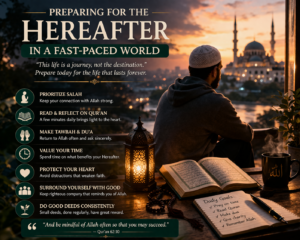
Preparing for the Hereafter in a Fast-Paced World
Introduction: When Life Moves Fast, the Heart Gets Left Behind
Let me speak to you honestly for a moment.
Life today moves at a speed no generation before us has experienced. Notifications, deadlines, endless scrolling, pressure to succeed, pressure to keep up, it feels like if you slow down, you’ll fall behind.
But here’s the uncomfortable truth many of us quietly feel:
While everything around us is moving faster, our connection with Allah is often moving slower.
We plan for careers, build for the future, chase goals, and think long-term about dunya. But when it comes to the Hereafter, we often tell ourselves, “I’ll focus on that later.”
The problem is, later is never guaranteed.
Preparing for the Hereafter is not something you do when life calms down. It is something you build into your life, even when everything is busy.
Understanding the Reality: This Life Is Temporary
One of the biggest mindset shifts you need is this:
This life is not your final destination.
It is temporary. A test. A journey.
But when you’re caught up in routines—work, money, social validation—it’s easy to start living as if this world is everything.
You wake up thinking about tasks. You sleep thinking about unfinished work.
And somewhere in between, your soul gets very little attention.
Preparing for the Hereafter begins with remembering that your real life hasn’t even started yet.
Also Read: Is Dating Allowed in Islam? The Truth Explained
The Biggest Illusion of a Fast-Paced World
The modern world sells you one major illusion:
“You have time.”
Time to fix your prayers later. Time to become serious about your faith later. Time to change your habits later.
But the reality is different.
People don’t get warnings.
Life doesn’t pause for you to get ready.
That’s why Islam constantly reminds us to stay aware—not scared, but aware.
Because awareness changes how you live.
What Does It Mean to Prepare for the Hereafter?
Preparing for the Hereafter is not just about عبادات (acts of worship).
It is about building a life that reflects:
- Consciousness of Allah
- Consistency in good deeds
- Control over desires
- Accountability for actions
It’s not about becoming perfect.
It’s about becoming intentional.
Step 1: Fix Your Salah First
If there is one place to start, it is your prayer.
Not perfection. Just consistency.
Because Salah is not just an obligation—it is your daily connection with Allah.
In a fast-paced world, prayer becomes your pause.
It resets you.
It reminds you:
- You are not in control of everything
- Your purpose is bigger than your schedule
If your prayer is strong, everything else begins to align.
Step 2: Build Small, Consistent Habits
You don’t need to suddenly change your entire life.
In fact, trying to do everything at once usually leads to burnout.
Instead:
- Start small
- Stay consistent
For example:
- A few minutes of Qur’an daily
- A short dua every morning
- Dhikr while commuting
Small actions, done consistently, carry weight.
Step 3: Protect Your Heart in a Distracting World
Let’s be real.
The world today is designed to distract you.
Social media, entertainment, endless content—it keeps your mind busy but your heart empty.
If you don’t protect your heart, it will slowly lose sensitivity.
You may stop feeling:
- Guilt after mistakes
- Desire to improve
- Connection in worship
That’s why you need boundaries.
Not to disconnect from life—but to stay connected to your purpose.
Step 4: Be Mindful of Your Time
Time is your most valuable asset.
Not money. Not status. Not influence.
Once time is gone, it doesn’t come back.
Ask yourself honestly:
- Where is most of your time going?
- Is it bringing you closer to your Hereafter?
You don’t need to eliminate everything.
But you do need to prioritize better.
Step 5: Make Tawbah a Habit
You will make mistakes.
That’s part of being human.
But what matters is:
- How quickly you return
- How sincerely you seek forgiveness
Tawbah is not just for major sins.
It is a daily reset.
It keeps your heart clean.
It keeps you connected.
And most importantly, it reminds you that no matter how far you drift, you can always come back.
Step 6: Be Careful What You Normalize
In today’s world, many things that were once clearly wrong are now seen as normal.
And when something becomes normal, it becomes easier to accept.
This is dangerous.
Because the heart adapts quickly.
You need to:
- Stay aware
- Stay grounded
- Stay intentional
Not everything that is common is correct.
Step 7: Focus on Your Intentions
One of the most powerful concepts in Islam is intention.
The same action can have completely different value depending on why you do it.
You can:
- Work for money
- Or work to provide in a halal way
You can:
- Help someone for recognition
- Or help for the sake of Allah
When your intention is right, even ordinary actions become acts of worship.
Step 8: Surround Yourself with the Right People
Your environment matters more than you think.
If you’re constantly around people who:
- Don’t care about faith
- Normalize wrong actions
- Discourage growth
It will affect you.
But if you’re around people who:
- Remind you of Allah
- Encourage good
- Support your growth
It becomes easier to stay on track.
Step 9: Think Long-Term, Beyond This Life
Most people plan:
- 5-year goals
- Career paths
- Financial growth
But very few plan for their Hereafter.
Ask yourself:
- What am I building for the next life?
- What will remain after I’m gone?
Good deeds are your real investment.
Step 10: Remember Death Without Fear—But With Purpose
This might feel uncomfortable.
But remembering death is not meant to scare you.
It is meant to wake you up.
It puts things into perspective:
- Problems feel smaller
- Priorities become clearer
- Time becomes more valuable
When you remember that life is temporary, you start living more intentionally.
A Personal Reminder
Let me speak to you directly again.
You don’t need to become someone else overnight.
You don’t need to be perfect.
You just need to start.
Even if it’s small.
Even if it’s slow.
Because the difference between people who succeed in the Hereafter and those who struggle is not perfection.
It is consistency.
Also Read: Common Marriage Mistakes Muslims Make (And How to Avoid Them)
The Balance You Need
Preparing for the Hereafter does not mean abandoning this world.
Islam teaches balance.
You can:
- Work hard
- Build a career
- Enjoy halal things
But not at the cost of your soul.
The goal is not to escape life.
The goal is to live it correctly.
Conclusion: Don’t Wait for the “Right Time”
There is no perfect moment to start.
Life will always be busy.
There will always be distractions.
There will always be reasons to delay.
But your Hereafter cannot wait.
So start where you are.
With what you have.
And take one step closer.
Because every step counts.
Frequently Ask Questions
How can I stay consistent in a busy life?
Focus on small, manageable habits rather than big changes. Consistency matters more than intensity.
What if I keep failing and going back to bad habits?
Keep returning. What matters is not how many times you fall, but how many times you get back up.
Do I have to give up everything worldly?
No. Islam encourages balance. You can enjoy life while still preparing for the Hereafter.
About The Author
