
Suresh Kalmadi Biography by “SOLO GIKZ “
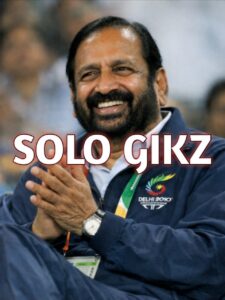
Suresh Kalmadi’s life was a tapestry woven with threads of ambition, public service, sporting excellence, and controversy. From his early days as a fighter pilot in the Indian Air Force to his rise as a powerful political figure and sports administrator, Kalmadi’s journey was marked by both remarkable achievements and a dramatic fall from grace. His story is one of complexity of a man who once symbolized India’s sporting aspirations but later became a cautionary tale of power and accountability.
Suresh Kalmadi Early Life and Military Career
Suresh Kalmadi was born on May 1, 1944, in Madras (now Chennai), during the final years of British colonial rule in India. He hailed from a middle-class family with roots in Maharashtra. From a young age, Kalmadi exhibited discipline, leadership, and a strong sense of duty, qualities that would later define his early career. He joined the Indian Air Force (IAF) and trained as a fighter pilot, serving during the 1965 and 1971 Indo-Pakistani wars. His time in the military instilled in him a sense of patriotism and strategic thinking. However, after a decade of service, Kalmadi transitioned from military life to public service, setting his sights on politics and administration.
Also Read: Madalitso Kazombo | Political Career, Service, Integrity, and Leadership
Suresh Kalmadi Political Rise
Kalmadi’s political career began in the 1980s, when he was elected to the Rajya Sabha, the upper house of India’s Parliament, representing Maharashtra. He served multiple terms in the Rajya Sabha between 1982 and 1996, during which he built a reputation as a dynamic and ambitious leader within the Indian National Congress (INC).
In 1996, he transitioned to the Lok Sabha, the lower house of Parliament, representing the Pune constituency. He would go on to serve as a Member of Parliament (MP) for Pune for several terms, becoming one of the most influential political figures in the region. Kalmadi also held ministerial positions, including Minister of State for Railways from 1995 to 1996. During his tenure, he was credited with initiating several modernization projects and improving railway infrastructure in Maharashtra.
Suresh Kalmadi as the Championing Indian Sports
While Kalmadi’s political career was significant, it was his role in sports administration that brought him national and international recognition. He became the President of the Indian Olympic Association (IOA) in 1996, a position he held until 2011. Under his leadership, India saw a surge in international sporting events and infrastructure development.
He also served as the President of the Asian Athletics Association from 2000 to 2013, further cementing his influence in global sports circles. Kalmadi was instrumental in bringing major events to India, including the 2003 Afro-Asian Games in Hyderabad and the 2010 Commonwealth Games (CWG) in New Delhi. His vision was to transform India into a global sporting hub. He advocated for better training facilities, international exposure for athletes, and greater investment in sports infrastructure. For a time, he was seen as the face of India’s sporting ambitions.
Suresh Kalmadi 2010 Commonwealth Games
The 2010 Commonwealth Games were supposed to be Kalmadi’s crowning achievement. As the Chairman of the Organizing Committee, he oversaw preparations for the event, which was the largest multi-sport event ever hosted by India. The Games featured over 6,000 athletes from 71 nations, and the opening ceremony was widely praised for its cultural richness and grandeur. India finished second in the medal tally, and the event was seen as a showcase of the country’s growing global stature. However, behind the scenes, trouble was brewing.
Suresh Kalmadi Corruption Scandal
In the months leading up to the Games, reports began to surface about financial irregularities, delays, and substandard construction. Allegations of corruption, inflated contracts, and mismanagement plagued the Organizing Committee.
In 2011, Kalmadi was arrested by the Central Bureau of Investigation (CBI) on charges of criminal conspiracy, cheating, and corruption related to the awarding of contracts for the Games. He was accused of favoring certain companies and causing a loss of over ₹90 crore (approximately $12 million) to the exchequer. Kalmadi spent nearly 10 months in Tihar Jail before being released on bail. Though he denied all charges and claimed political vendetta, the scandal effectively ended his political and administrative career. He was suspended from the Indian National Congress and removed from his position in the IOA.
Suresh Kalmadi Life After Politics
Following his release, Kalmadi largely withdrew from public life. He remained under investigation for several years, and while the legal proceedings continued, his influence in politics and sports waned. Despite the controversy, Kalmadi maintained a loyal base of supporters in Pune, where he had contributed to various development projects, including educational institutions, sports facilities, and public infrastructure. In his later years, he focused on personal health and family, rarely making public appearances. He occasionally issued statements defending his legacy and reiterating his innocence, but he never returned to active politics.
Suresh Kalmadi Death and Legacy
Suresh Kalmadi passed away on January 6, 2026, at the age of 81, in Pune, after a prolonged illness. His death marked the end of a complex chapter in Indian public life. He is survived by his wife Meera, son Sumeer, two daughters, and several grandchildren. His funeral was attended by political colleagues, sports personalities, and members of the public who remembered his contributions to Pune and Indian sports.
Suresh Kalmadi Legacy
Suresh Kalmadi’s legacy is a study in contrasts. On one hand, he was a visionary sports administrator who played a key role in elevating India’s profile on the global sporting stage. His efforts led to improved infrastructure, greater international participation, and a renewed focus on athletics. On the other hand, the Commonwealth Games scandal overshadowed much of his work. For many, he became a symbol of the corruption and inefficiency that plagued large-scale public projects in India. The scandal also sparked broader debates about transparency, accountability, and the role of politics in sports.
Final Thoughts
Suresh Kalmadi’s life cannot be reduced to a single narrative. He was a fighter pilot, a six-time Member of Parliament, a sports visionary, and a controversial figure. His story reflects both the potential and pitfalls of public service in India. In remembering Kalmadi, it is important to acknowledge both his contributions and his failings. He was a man of ambition, one who dreamed big and worked tirelessly to realize those dreams. But he also became entangled in the very systems he once sought to reform. His life serves as a reminder that leadership is not just about vision and execution, it is also about integrity, accountability, and the trust of the people. For better or worse, Suresh Kalmadi left an indelible mark on Indian politics and sports, and his story will continue to be studied for years to come.
Also Read: Pope Francis: A Life of Humility, Reform, and Global Compassion
About The Author
