
Isaac Newton Biography By “SOLO GIKZ “
Isaac Newton Biography: The Genius Who Measured the Universe. In the grand narrative of human discovery, few names shine as brightly as Sir Isaac Newton. A man of unmatched intellect and insatiable curiosity, Newton transformed the way we understand the world. His laws of motion and universal gravitation laid the foundation for classical physics, while his work in optics, mathematics, and astronomy reshaped the scientific landscape of the 17th century. But Newton was more than just a scientist, he was a philosopher, theologian, and alchemist, a man whose mind reached for the heavens while his feet remained firmly planted in the soil of inquiry.
Isaac Newton Early Life and Education
Isaac Newton was born on January 4, 1643 (December 25, 1642, Old Style calendar) in the small village of Woolsthorpe-by-Colsterworth, in Lincolnshire, England. He was born prematurely and was not expected to survive. His father, also named Isaac Newton, had died three months earlier, and his mother, Hannah Ayscough Newton, remarried when Isaac was just three years old. She left him in the care of his maternal grandmother, a separation that left a lasting emotional impact on the young boy.
Newton’s early education began at The King’s School in Grantham, where he showed a knack for mechanics and drawing. He was known to build sundials, windmills, and even a working model of a wind-powered mill. In 1661, he entered Trinity College, Cambridge, where he immersed himself in the works of classical philosophers and the emerging ideas of thinkers like Descartes, Galileo, and Kepler. Though the curriculum was still rooted in Aristotelian philosophy, Newton pursued his own studies, laying the groundwork for his revolutionary ideas.
Also Read: Wicketkeeper, Run-Machine, Record-Setter: The Rise of Ishan Kishan
Isaac Newton Plague Years and the “Year of Wonders”
In 1665, the Great Plague forced Cambridge to shut down, and Newton returned to Woolsthorpe. What followed was one of the most extraordinary periods of intellectual productivity in history. Between 1665 and 1667 when he was just in his early twenties, Newton developed:
- The foundations of calculus
- The law of universal gravitation
- The three laws of motion
- Groundbreaking theories in optics and light
This period, often referred to as Newton’s “Annus Mirabilis” (Latin for “Year of Wonders”), was a time of intense solitude and creativity. It was during this time, legend has it, that Newton observed an apple falling from a tree and began to ponder the force that governs both falling objects and planetary motion.
Isaac Newton Mathematical Innovations
Newton’s contributions to mathematics were as profound as his work in physics. He developed what he called the “method of fluxions”, now known as calculus, to describe changing quantities and motion. Although Gottfried Wilhelm Leibniz independently developed calculus around the same time, a bitter dispute over priority ensued, leading to a long-standing controversy between British and Continental mathematicians.
Beyond calculus, Newton made significant advances in algebra and geometry. He generalized the binomial theorem, introduced Newton’s identities, and developed Newton’s method for approximating the roots of a function. His mathematical rigor provided the tools necessary for the precise formulation of physical laws.
Isaac Newton Principia and the Laws of Motion
In 1687, Newton published his magnum opus, Philosophiæ Naturalis Principia Mathematica (Mathematical Principles of Natural Philosophy), commonly known as the Principia. This work laid out:
The three laws of motion, which describe the relationship between a body and the forces acting upon it
The law of universal gravitation, which states that every mass attracts every other mass with a force proportional to the product of their masses and inversely proportional to the square of the distance between them
A mathematical framework for planetary motion, building on Kepler’s laws and explaining the elliptical orbits of planets
The Principia unified terrestrial and celestial mechanics under a single theory, marking the birth of classical physics and the Scientific Revolution. It was hailed as one of the most important scientific books ever written and remains a cornerstone of physics to this day.
Isaac Newton Optics and Light
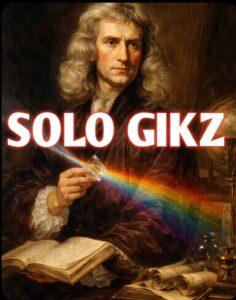
Newton also made pioneering contributions to optics. He demonstrated that white light is composed of a spectrum of colors, which he observed by passing sunlight through a glass prism. This discovery challenged the prevailing belief that white light was pure and that colors were modifications of it.
He also built the first practical reflecting telescope, known as the Newtonian telescope, which used a curved mirror instead of a lens to avoid chromatic aberration. This innovation improved image clarity and became a standard design in astronomy.
In 1704, Newton published Opticks, a comprehensive work on the nature of light and color. Unlike the Principia, which was written in Latin, Opticks was published in English, making it more accessible to a broader audience.
Isaac Newton Public Life and Later Years
In 1696, Newton was appointed Warden of the Royal Mint, and later became its Master. In this role, he led efforts to reform England’s currency and combat counterfeiting. His meticulous work helped stabilize the British economy and earned him national recognition.
In 1703, Newton was elected President of the Royal Society, a position he held until his death. He was knighted by Queen Anne in 1705, becoming Sir Isaac Newton.
Despite his scientific achievements, Newton was also deeply interested in alchemy and theology. He wrote extensively on biblical chronology, prophecy, and the nature of God, although much of this work remained unpublished during his lifetime. He believed that science and faith were not mutually exclusive but rather complementary paths to understanding the universe.
Isaac Newton Personality and Legacy
Newton was known for his intense focus, solitary nature, and occasional bouts of paranoia. He guarded his work closely and was often reluctant to publish, fearing criticism. His disputes with contemporaries like Robert Hooke and Leibniz were marked by bitterness and personal animosity.
Yet his intellectual legacy is unparalleled. Newton’s work laid the groundwork for centuries of scientific inquiry and inspired generations of physicists, including Albert Einstein, who famously said, “Newton was the greatest genius who ever lived.”
Also Read: Reporting Without Borders: The Life and Career of Mike Tobin
Isaac Newton Death and Commemoration
Isaac Newton died on March 31, 1727, at the age of 84, in Kensington, London. He was buried with great honor in Westminster Abbey, a rare distinction for a scientist at the time.
Today, Newton’s name is synonymous with scientific genius. His laws of motion and gravitation remain foundational in physics, and his influence extends beyond science into philosophy, mathematics, and even economics.
Final Conclusions
Isaac Newton’s biography is not just a chronicle of discoveries, it is the story of a man who redefined the boundaries of human knowledge. From the falling apple to the orbit of the moon, Newton saw the universe as a grand, ordered system governed by laws that could be understood through reason and mathematics.
And yet, for many, Newton himself remains the greatest giant of them all.
About The Author
