
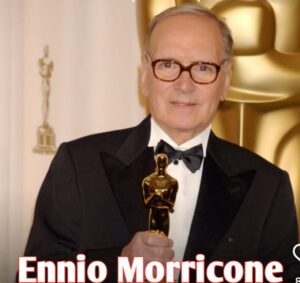
If you’ve ever felt a chill down your spine while watching a lone cowboy squint into the desert sun, or if you’ve felt your heart swell during a scene of pure, cinematic nostalgia, you’ve likely been under the spell of Ennio Morricone. He wasn’t just a composer; he was a revolutionary who took the “noise” of the world, whistles, cracking whips, ticking clocks and turned them into high art.
Talking about Ennio is like talking about the very soul of cinema. He scored over 500 films, but numbers don’t do him justice. To understand him, you have to understand the man who lived and died in Rome, who never learned English because he felt his music was a universal language, and who stayed married to the same woman, Maria, for 64 years. This is the story of a genius who never stopped being a student of sound.
Ennio Morricone Early Life in Rome
Ennio Morricone was born on November 10, 1928, in Rome. Music wasn’t just a hobby in the Morricone household; it was the family trade. His father, Mario, was a professional jazz trumpeter, and he didn’t give Ennio much of a choice about his future. He handed the boy a trumpet and told him that this would be his livelihood.
Also Read: Untold Secret Behind Abhinandan Singh Biography
Prodigy in the Conservatory
By the age of six, Ennio was already writing his first compositions. By twelve, he entered the prestigious National Academy of Santa Cecilia. Imagine a young boy, barely a teenager, sitting in rooms filled with serious scholars, absorbing harmony and counterpoint like a sponge. He finished a four-year program in six months.
He studied under Goffredo Petrassi, a giant of Italian classical music. Petrassi taught him the discipline of “absolute music,” but life in post-war Italy required a different kind of hustle. To support his family, Ennio began playing trumpet in jazz bands and arranging popular songs for radio and television. This “dual life” the serious academic and the practical pop arranger is exactly what gave him the tools to eventually reinvent film music.
From Pop Arranger to Spaghetti Western Legend
In the late 1950s and early 60s, Ennio was the secret weapon of the Italian recording industry. He was the guy who could take a simple pop song and make it sound experimental. He wasn’t afraid to use a typewriter as a percussion instrument or add a strange, dissonant chord to a love song.
Meeting That Changed Cinema
In 1964, a director named Sergio Leone, who, as it turns out, had been in the same elementary school class as Ennio, approached him to score a low-budget Western called A Fistful of Dollars. Leone didn’t have the budget for a full orchestra, so Ennio had to get creative.
Instead of sweeping violins, he used:
- The human whistle (specifically the “Golden Whistle” of Alessandro Alessandroni)
- Electric guitars (which were unheard of in Westerns at the time)
- Jew’s harps and church bells
- The “coyote howl” vocalizations
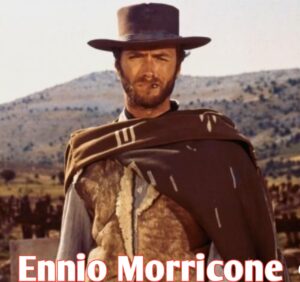
The result was the “Spaghetti Western” sound. It was gritty, ironic, and larger than life. When you hear the theme for The Good, the Bad and the Ugly, you aren’t just hearing a song; you’re hearing the birth of a genre.
Ennio Morricone Career of Infinite Variety
It’s a bit of a tragedy that many people only know Ennio for his Westerns. The man was a shapeshifter. After the success with Leone, he became the most sought-after composer in Europe and eventually Hollywood. He worked with everyone: Brian De Palma, John Carpenter, Roland Joffé, and Quentin Tarantino.
Ennio Morricone Spiritual Height of The Mission
If you want to hear Ennio at his most sublime, you listen to The Mission (1986). The way he blends liturgical choral music with indigenous South American woodwinds and a soaring oboe melody is nothing short of a miracle. Many critics consider it the greatest film score ever written. When it lost the Oscar that year to Round Midnight, it was considered one of the biggest snubs in Academy history.
Ennio Morricone Heart of Cinema Paradiso
Then there is Cinema Paradiso (1988). If The Mission is about the spirit, Cinema Paradiso is about the heart. His music for Giuseppe Tornatore’s masterpiece captured the bittersweet pain of growing up and the love of movies. It’s the kind of music that makes you feel nostalgic for a childhood you never even had.
Maestro’s Process and Philosophy
Ennio was a creature of habit and discipline. He didn’t use a piano to compose; he said the piano “distracts” the mind with its own sound. Instead, he sat at a desk with a pencil and paper and wrote out full orchestral scores from the “hearing” in his head.
Norme con Ironie, Rules with Irony
He belonged to an avant-garde collective called Nuova Consonanza, where they experimented with free improvisation and “found” sounds. He lived by the motto Norme con Ironie (Rules with Irony). He respected the traditions of Bach and Stravinsky, but he loved to subvert them. He believed that a film score should never just be “background music” it should be a character that says what the actors cannot.
Man of Faith and Family
Despite his fame, Ennio remained incredibly humble. He lived in the same apartment in Rome for decades. He credited his wife, Maria Travia, for much of his success, as she was the first person to hear and critique his melodies. He was a man of deep faith, though he rarely talked about it, preferring to let his “Mass for Pope Francis” or his spiritual cantatas speak for his beliefs.
Long Road to Oscar Gold
For decades, the Academy Awards seemed to have a blind spot for Ennio. He was nominated five times, for Days of Heaven, The Mission, The Untouchables, Bugsy, and Malèna, but he never took home the competitive statue.
In 2007, they gave him an Honorary Oscar for his lifetime of work. It was a beautiful moment, with Clint Eastwood translating his speech from Italian. Most people thought that would be his final bow.
The Hateful Eight and Final Victory
But then came Quentin Tarantino.
Tarantino had been using Ennio’s old music for years, but for The Hateful Eight (2015), he convinced the Maestro to write an original score. Ennio delivered a tense, clock-like, brooding masterpiece that felt entirely fresh. In 2016, at the age of 87, Ennio Morricone finally won his competitive Academy Award. The world stood up and cheered for a man who had already been a legend for fifty years.
Also Read: Anshika Verma IPS
Ennio Morricone Legacy
Why Ennio Morricone Still Matters
Ennio passed away on July 6, 2020, at the age of 91. He even wrote his own obituary, titled “I, Ennio Morricone, am dead,” in which he said goodbye to his family and friends with the same quiet dignity he lived his life.
His influence is everywhere. You can hear it in the music of Radiohead and Metallica (who use “The Ecstasy of Gold” as their intro). You can see it in the way modern directors like Hans Zimmer and Christopher Nolan use soundscapes to build tension.
He taught us that music doesn’t have to be “pretty” to be beautiful. It just has to be true. He proved that a simple three-note motif can be more powerful than a hundred-piece orchestra if it captures the right emotion. He was the Maestro of our memories, and as long as there are people who love movies, the music of Ennio Morricone will never fade.
Conclusion
Ultimately, Ennio Morricone was more than a composer; he was the heartbeat of twentieth-century cinema. By blending avant-garde experimentation with melodies that felt ancient and universal, he proved that film music could stand alone as high art. His journey from a young trumpeter in Rome to a global icon serves as a masterclass in discipline, creative risk, and emotional honesty. While the Maestro has passed, his “sound” remains immortal, echoing through every desert vista and cinematic heartbreak. He leaves behind a legacy that challenges every future artist to listen to the world’s noise and find the music within.
About The Author
