
Ai Weiwei uses art to question power, freedom, and the cost of truth.
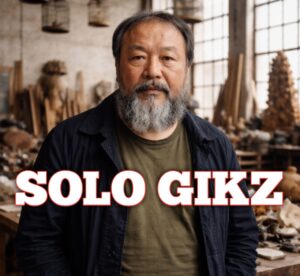
Ai Weiwei was born on 28 August 1957 in Beijing, China. He is the son of Ai Qing, one of China’s most celebrated poets, who was later persecuted during Mao Zedong’s political campaigns. When Ai Weiwei was still a child, his father was labeled an enemy of the state, and the family was exiled to remote labor camps in Heilongjiang and later Xinjiang.
Growing up in harsh conditions, Ai Weiwei witnessed censorship, humiliation, and political repression firsthand. These early experiences left a deep imprint on him and became central themes in his later work, power, memory, surveillance, and resistance.
Ai Weiwei Biography
Ai Weiwei is one of the most influential contemporary artists in the world, known not only for his groundbreaking art but also for his fearless activism and criticism of authoritarian power. Blurring the lines between art, politics, and human rights, Ai Weiwei has built a global reputation as a creative rebel—using sculpture, architecture, film, and social media to challenge censorship, injustice, and state control.
Ai Weiwei Education and Artistic Formation
After Mao’s death and the end of the Cultural Revolution, Ai Weiwei returned to Beijing. He studied animation at the Beijing Film Academy, where he became part of the emerging avant-garde art movement in China.
In 1981, he moved to the United States, living mainly in New York City for over a decade. During this period, he was heavily influenced by Western art and philosophy, particularly Marcel Duchamp, Andy Warhol, and Dadaism. He experimented with conceptual art, photography, and performance, developing a style that rejected traditional authority and artistic convention.
Ai Weiwei Return to China and Artistic Breakthrough
Ai Weiwei returned to China in 1993, shortly before his father’s death. Back in Beijing, he became a central figure in China’s contemporary art scene. He co-founded experimental art spaces and published underground art books that challenged official narratives.
His work often used traditional Chinese materials, such as ancient pottery, wood, and furniture, reassembled or destroyed to question ideas of history, nationalism, and cultural control. One of his most famous acts involved deliberately dropping and smashing a Han Dynasty urn, a powerful statement about how societies treat history and truth.
Ai Weiwei Architecture and the Beijing Olympics
Ai Weiwei gained international attention as a co-designer of the Beijing National Stadium, also known as the “Bird’s Nest,” for the 2008 Olympic Games. While the stadium became an architectural icon, Ai later distanced himself from the project, criticizing the Chinese government for using the Olympics as propaganda.
This marked a turning point where his role as an artist-activist became even more pronounced.
Ai Weiwei Activism and Clash With the Chinese Government
Following the 2008 Sichuan earthquake, Ai Weiwei launched a citizen investigation into the deaths of thousands of schoolchildren caused by poorly constructed buildings. His efforts to name the victims directly challenged government secrecy and corruption.
As a result, he faced increasing harassment, surveillance, and censorship. In 2011, Ai Weiwei was detained by Chinese authorities for 81 days without formal charges. His arrest sparked international outrage and cemented his status as a global symbol of artistic resistance.
After his release, he remained under heavy monitoring, and his passport was confiscated for several years.
Ai Weiwei Exile and Global Recognition
In 2015, Ai Weiwei regained his passport and left China, eventually settling in Europe. Living in self-imposed exile, he expanded his work to focus on global issues such as:
Refugee crises
Mass surveillance
Free speech
Authoritarianism worldwide
He created large-scale installations, documentaries, and exhibitions across major cities, including Berlin, London, New York, and Paris.
His art became more explicitly global, emphasizing that human rights violations are not limited to any single country.
Film
Ai Weiwei Books, and Digital Presence
Beyond visual art, Ai Weiwei is also a filmmaker and writer. His documentaries explore migration, displacement, and state power. He is highly active on social media, using digital platforms as tools of resistance and communication.
His memoir, “1000 Years of Joys and Sorrows,” provides an intimate account of his life, his father’s persecution, and his own struggle with authority.
Also Reed: Ranveer Singh: Biography, Age, Wife, Net Worth, Movies, Family, Career
Ai Weiwei Personal Life
Ai Weiwei is married to Lu Qing, an artist and photographer. They have one son, Ai Lao. Despite his public profile, Ai maintains a balance between his personal life and his political commitments, often reflecting on fatherhood and legacy in his work.
Ai Weiwei Artistic Style and Philosophy
Ai Weiwei’s art is conceptual, provocative, and deeply political. He believes that art is inseparable from freedom, and that silence in the face of injustice is a form of complicity.
Rather than offering easy answers, his work asks difficult questions about power, truth, and responsibility, forcing viewers to confront uncomfortable realities.
Ai Weiwei Legacy and Influence
Ai Weiwei’s influence extends far beyond the art world. He is regarded as:
A symbol of artistic freedom
A voice against censorship
A chronicler of modern authoritarianism
In 2026, he remains one of the most important cultural figures of the 21st century, proof that art can still challenge power and provoke global conversation.
Conclusion
Ai Weiwei’s biography is a story of courage, exile, and relentless truth-telling. From a childhood shaped by political persecution to global recognition as an artist and activist, his life embodies the cost and necessity of speaking freely.
More than an artist, Ai Weiwei is a reminder that creativity can be a form of resistance, and that art, at its most powerful, refuses to stay silent.
About The Author
