
Introduction
How to Pray Salah Step by Step (Beginner’s Guide)
If you’ve ever felt unsure about how to pray Salah properly, you’re not alone. A lot of people, new Muslims, young Muslims, or even those who grew up in practicing homes, quietly carry the same uncertainty. Some feel embarrassed to ask. Others think they should already know.
So let me say this clearly: it’s okay.
Learning how to pray isn’t about perfection. It’s about sincerity. It’s about showing up before Allah with a heart that wants to connect, even if your steps are not flawless yet.
Think of this guide as a conversation between us. I’ll walk you through Salah step by step, explain what you’re doing and why, and help you build confidence. By the end, you won’t just know the actions—you’ll understand the meaning behind them.
What Is Salah and Why It Matters
Salah is the five daily prayers that every Muslim performs. It’s not just a ritual, it’s your direct connection with Allah.
Imagine having five guaranteed moments in your day where you pause everything, stress, noise, worries—and stand in front of your Creator. That’s what Salah is.
It’s mentioned repeatedly in the Qur’an because it:
- Keeps your heart grounded
- Protects you from wrongdoing
- Builds discipline
- Strengthens your relationship with Allah
And here’s something important: Salah is not meant to burden you. It’s meant to support you.
The Five Daily Prayers (Quick Overview)
Before we get into how to pray, you should know the five daily Salah:
- Fajr – before sunrise (2 units)
- Dhuhr – midday (4 units)
- Asr – afternoon (4 units)
- Maghrib – just after sunset (3 units)
- Isha – night (4 units)
Each “unit” is called a rak’ah. Once you learn one rak’ah, you can repeat it for all prayers.
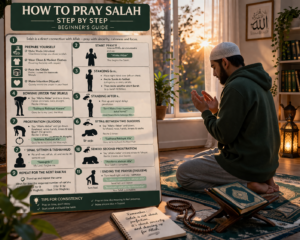
Step One: Preparing for Salah
1. Cleanliness (Wudu)
Before you pray, you need to be in a state of purity. This is done through Wudu (ablution).
You wash:
- Hands
- Mouth
- Nose
- Face
- Arms
- Head (wipe)
- Ears
- Feet
Take your time with this. Don’t rush. Think of it as preparing yourself mentally and spiritually—not just physically.
2. Dress Properly
Make sure your body is covered according to Islamic guidelines:
- For men: from navel to knees (but better to cover more)
- For women: everything except face and hands
Wear clean clothes. You’re standing before Allah—dress with respect.
3. Find the Qiblah (Direction)
Face the direction of the Kaaba in Makkah. Most people use a prayer mat or an app to find it.
4. Make Your Intention (Niyyah)
You don’t need to say anything out loud.
Just know in your heart: “I am about to pray Fajr (or any prayer) for the sake of Allah.”
That’s it. Keep it simple.
Step Two: Starting the Prayer
1. Takbir (Opening)
Raise your hands and say:
Allahu Akbar (Allah is the Greatest)
This is how you enter Salah. From this moment, your focus shifts completely to your prayer.
2. Standing (Qiyam)
Place your hands on your chest (right over left).
Now begin with:
- Opening supplication (optional for beginners)
- Surah Al-Fatihah (required)
Take your time reciting. Don’t rush.
Step Three: Recitation
Surah Al-Fatihah (Essential)
This is the most important part of Salah. Every rak’ah must include it.
If you’re still learning, start slowly. Even if you read from memory imperfectly, keep practicing.
After Al-Fatihah, recite another short surah (like Surah Al-Ikhlas).
Step Four: Bowing (Ruku)
Say:
Allahu Akbar
Then bow down, placing your hands on your knees.
Keep your back straight.
Say:
Subhana Rabbiyal Azeem (3 times)
Meaning: Glory be to my Lord, the Most العظيم.
Take a moment here. Don’t rush through it.
Step Five: Standing Again
Rise from Ruku and say:
Sami’Allahu liman hamidah
(Rabbana lakal hamd)
Meaning: Allah hears those who praise Him. Our Lord, to You belongs all praise.
Step Six: Prostration (Sujood)
This is the most powerful position in Salah.
Say:
Allahu Akbar
Then go into prostration. Your:
- Forehead
- Nose
- Hands
- Knees
- Toes
should touch the ground.
Say:
Subhana Rabbiyal A’la (3 times)
Meaning: Glory be to my Lord, the Most High.
This is the closest you are to Allah. Make silent dua here if you want. Speak to Him in your own words.
Step Seven: Sitting
Sit up and say:
Rabbighfir li (My Lord, forgive me)
Pause briefly.
Step Eight: Second Sujood
Go back into prostration again and repeat:
Subhana Rabbiyal A’la (3 times)
That’s One Rak’ah Completed
Now stand up again and repeat the same process.
Final Sitting (Tashahhud)
After your last rak’ah, sit and recite:
At-tahiyyatu lillahi…
If you don’t know it yet, learn it gradually. Don’t overwhelm yourself.
Then send blessings upon the Prophet.
Ending the Prayer (Tasleem)
Turn your head to the right and say:
Assalamu alaikum wa rahmatullah
Then to the left:
Assalamu alaikum wa rahmatullah
And that’s it—you’ve completed your Salah.
Common Mistakes Beginners Make
Let me be honest with you—mistakes are part of the process.
Some common ones:
- Rushing through movements
- Not focusing on meaning
- Skipping parts accidentally
- Feeling discouraged
Don’t let these stop you.
Allah is not looking for perfection, He’s looking at your effort.
How to Build Consistency in Salah
This is where many people struggle.
Start small:
- Focus on one prayer consistently (like Fajr)
- Set reminders
- Pray even if you feel lazy
Discipline comes before motivation.
Over time, it becomes part of you.
Understanding the Spiritual Side of Salah
Salah is not just physical movements.
It’s:
- A conversation with Allah
- A break from the dunya
- A moment of healing
When you understand what you’re saying, your prayer changes completely.
A Personal Note to You
If you’re just starting, don’t pressure yourself.
You don’t need to become perfect overnight.
Even if your Salah feels “empty” at first, keep going.
One day, you’ll stand in prayer and feel something different. Peace. Calm. Connection.
That’s when you’ll realize: This was never just a routine. It was a lifeline.
Frequently Asked Questions
1. What if I forget something during Salah?
Don’t panic. Continue your prayer. Over time, you’ll improve. There are also ways to correct mistakes (Sujood As-Sahw), which you can learn later.
2. Can I pray in English if I don’t know Arabic?
The required parts of Salah should be in Arabic, but you can make personal dua in your own language, especially in sujood.
3. What if I miss a prayer?
Pray it as soon as you remember. Don’t give up just because you missed one.
Final Thoughts
Learning how to pray Salah is one of the most important steps in your life as a Muslim.
Take it seriously, but don’t make it stressful.
Build it slowly. Practice daily. Stay sincere.
And remember: Every time you stand to pray, you are answering a call from Allah.
That alone makes it worth everything.
About The Author
