
Swami Vivekananda Biography by SOLO GIKZ
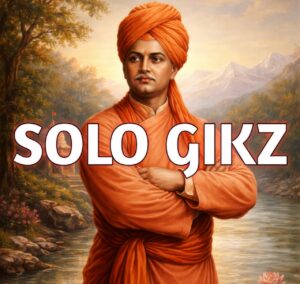
Swami Vivekananda was born as Narendranath Datta on January 12, 1863, in Calcutta (now Kolkata), during a time when India languished under British colonial rule and struggled with profound social and spiritual crises. His birth occurred in an aristocratic Bengali family known for its progressive outlook, cultural refinement, and charitable disposition. His father, Vishwanath Datta, was a successful attorney at the Calcutta High Court, known for his rational mind, generosity, and liberal attitudes. His mother, Bhuvaneshwari Devi, was deeply religious, possessing a strong character and progressive ideas about women’s independence.
Young Narendra grew up in an atmosphere that uniquely blended Western rationalism with Eastern spirituality. The household maintained traditional Hindu practices while remaining open to modern Western education and thought. This dual influence would profoundly shape Narendra’s worldview and later become central to his mission of bridging Eastern and Western civilizations.
From childhood, Narendra exhibited extraordinary qualities that set him apart from his peers. He possessed a prodigious memory, sharp intellect, and insatiable curiosity about life’s fundamental questions. Stories from his childhood reveal a boy who would meditate before clay images of gods and goddesses, sometimes entering deep states of absorption. Yet he was also mischievous, energetic, and showed leadership qualities that made him the natural center of any group he joined.
His parents recognized his exceptional nature early. His mother often recounted how she had prayed to Lord Shiva for a son and believed Narendra was a divine gift. However, she also noted that he possessed a strong will and independent spirit that sometimes made him difficult to control. This combination of spiritual inclination and fierce independence would characterize his entire life.
Also Read: Prashant Tamang Biography: Early Life, Music, Concert, Album, Acting in Nepali Cinema.
Swami Vivekananda Education and Intellectual Development
Narendra’s formal education began at the Metropolitan Institution, where he quickly distinguished himself as an exceptionally brilliant student. His intellectual appetite was voracious, spanning literature, philosophy, history, social science, art, and religion. He mastered Western logic, philosophy, and European history while simultaneously delving deep into Sanskrit scriptures, Indian philosophy, and Hindu theology.
In 1879, he enrolled at Presidency College in Calcutta and later transferred to the Scottish Church College, from where he graduated in 1884. During these college years, Narendra immersed himself in Western philosophy, studying the works of David Hume, Immanuel Kant, Johann Gottlieb Fichte, Baruch Spinoza, Georg Wilhelm Friedrich Hegel, Arthur Schopenhauer, Auguste Comte, John Stuart Mill, and Charles Darwin. This extensive exposure to Western thought equipped him with intellectual tools to later present Hindu philosophy in terms comprehensible to the Western mind.
Despite his Western education, Narendra remained deeply interested in Indian philosophy and spirituality. He studied the Vedas, Upanishads, Bhagavad Gita, Ramayana, Mahabharata, and the Puranas in their original Sanskrit. This thorough grounding in both Western and Eastern knowledge systems made him uniquely qualified to serve as a bridge between civilizations.
During his college years, Narendra joined the Brahmo Samaj, a reformist Hindu organization that rejected idol worship and emphasized monotheism and social reform. The Brahmo Samaj’s rational approach to religion initially appealed to his questioning mind. However, he found that intellectual discussions about God and spirituality left him unsatisfied. His burning question remained unanswered: “Have you seen God?” This question would lead him to his destined meeting with Sri Ramakrishna.
Transformative Encounter with Sri Ramakrishna
In November 1881, Narendra visited Sri Ramakrishna Paramahamsa at the Dakshineswar Kali Temple on the outskirts of Calcutta. This meeting would prove to be the pivotal moment of his life. When Narendra posed his characteristic question, “Sir, have you seen God?” Ramakrishna replied without hesitation, “Yes, I have seen God. I see Him as I see you here, only more clearly. God can be seen. One can talk to Him. But who cares for God? People shed torrents of tears for their wife and children, for wealth or property, but who weeps for the vision of God?”
This straightforward answer from someone who spoke from direct experience rather than theological speculation profoundly impacted Narendra. However, being naturally skeptical and trained in Western rationalism, he did not immediately accept Ramakrishna as his guru. What followed was a period of intense testing, questioning, and spiritual experiences that gradually transformed the rational skeptic into a devoted disciple.
Ramakrishna recognized in Narendra a spiritual giant, once remarking that Narendra was a “Nara” or leader among men who had been born to accomplish great work. Despite Narendra’s initial resistance and continued doubts, Ramakrishna’s unconditional love, profound spiritual realizations, and authentic embodiment of religious truths gradually won him over.
The relationship between guru and disciple was extraordinary. Ramakrishna treated Narendra with special attention, often declaring that Narendra had come to fulfill a divine mission. Under Ramakrishna’s guidance, Narendra underwent intense spiritual practices and experienced profound mystical states. These experiences convinced him of truths that mere intellectual study could never establish.
Swami Vivekananda Transformation and Monastic Life
When Sri Ramakrishna passed away in August 1886, Narendra was only twenty-three years old. The loss of his beloved teacher came at a time when Narendra’s family had fallen into financial difficulties following his father’s death. He faced the dual crisis of grinding poverty and spiritual bereavement. Despite opportunities to earn substantial income through his education and talents, Narendra chose the path of renunciation.
Along with other disciples of Ramakrishna, Narendra established the Ramakrishna Math, a monastic order dedicated to spiritual practice and service. In 1887, he took formal monastic vows and assumed the name Swami Vivekananda. The name Vivekananda, meaning “the bliss of discerning wisdom,” perfectly captured his mission of combining intellectual discrimination with spiritual realization.
As a monk, Vivekananda did not confine himself to monastery walls. Between 1888 and 1893, he traveled extensively throughout India, witnessing firsthand the dire poverty, ignorance, and social degradation afflicting millions. He walked thousands of miles across the length and breadth of India, from the Himalayas to Cape Comorin (now Kanyakumari), meeting people from all strata of society, from maharajas to the poorest outcasts.
These travels profoundly shaped Vivekananda’s understanding of India’s problems and potential solutions. He observed that while India possessed immense spiritual wealth, its people suffered from material poverty and social oppression. He witnessed the devastating effects of casteism, religious superstition, and colonial exploitation. These observations convinced him that India needed both spiritual rejuvenation and social reform, that religion must serve life and practical welfare alongside spiritual liberation.
Swami Vivekananda Religions and Global Recognition
In 1893, Swami Vivekananda traveled to America to attend the Parliament of the World’s Religions in Chicago, an event organized in conjunction with the World’s Columbian Exposition. This journey was undertaken despite having almost no money and no official credentials to speak at the Parliament. His determination to represent Hinduism and India on the world stage overcame all obstacles.
On September 11, 1893, when Vivekananda addressed the Parliament with his famous opening words, “Sisters and Brothers of America,” he received a standing ovation lasting several minutes. His simple greeting acknowledged the fundamental unity of humanity and contrasted sharply with the formal Victorian rhetoric of the time. This opening epitomized his message of universal brotherhood and the essential oneness of all religions.
Over the course of the Parliament, Vivekananda delivered several lectures that electrified audiences. He presented Hinduism not as a collection of strange rituals and polytheistic superstitions, as many Westerners believed, but as a profound philosophical system emphasizing the divinity of the soul, the unity of existence, and the harmony of religions. He explained concepts like Vedanta, yoga, and karma with remarkable clarity, making ancient Indian wisdom accessible to Western audiences.
His presentation had several revolutionary elements. He asserted that Hinduism was not merely one among many religions but represented a universal spiritual framework that embraced all paths to truth. He argued that sectarianism, bigotry, and fanaticism had long filled the earth with violence, and that only recognition of universal truths underlying all religions could bring peace. He famously declared, “I am proud to belong to a religion which has taught the world both tolerance and universal acceptance.”
The American press hailed him as the most impressive figure at the Parliament. Newspapers described him as “an orator by divine right” and “undoubtedly the greatest figure in the Parliament of Religions.” His success at Chicago opened doors throughout America and later Europe, where he spent the next four years lecturing, teaching, and establishing Vedanta societies.
Swami Vivekananda Teaching and Philosophical Contributions
Swami Vivekananda’s teachings synthesized various aspects of Hindu philosophy, particularly Advaita Vedanta, with practical application to individual and social life. His philosophy rested on several fundamental principles that he articulated with remarkable clarity and force.
Central to his teaching was the concept of the divinity of the soul. He proclaimed, “Each soul is potentially divine. The goal is to manifest this divinity within by controlling nature, external and internal. Do this either by work, or worship, or psychic control, or philosophy, by one or more or all of these, and be free. This is the whole of religion. Doctrines, or dogmas, or rituals, or books, or temples, or forms, are but secondary details.”
This fundamental idea had radical implications. If every soul is divine, then serving humanity becomes worship of God. This principle became the foundation of his practical Vedanta, which emphasized selfless service alongside meditation and knowledge. He taught that religion is not merely about personal salvation but about manifesting divinity through service to suffering humanity.
Vivekananda introduced four yogas as comprehensive paths to spiritual realization, suitable for different temperaments: Karma Yoga (path of selfless action), Bhakti Yoga (path of devotion), Raja Yoga (path of meditation and mental control), and Jnana Yoga (path of knowledge and discrimination). He presented these not as exclusive alternatives but as complementary approaches that could be combined according to individual needs and capacities.
His practical approach to spirituality was revolutionary. He rejected asceticism that turned away from the world’s suffering. He proclaimed, “Religion is not in books, nor in theories, nor in dogmas, nor in talking, not even in reasoning. It is being and becoming.” He emphasized that bread must precede religion for the starving, that education and economic empowerment were prerequisites for spiritual development.
Swami Vivekananda Return to India and Organizational Work
After four years in the West, Vivekananda returned to India in January 1897 to a hero’s welcome. His success abroad had made him famous in his homeland, and he was received with unprecedented enthusiasm. He utilized this platform to launch his vision for India’s regeneration.
In May 1897, he founded the Ramakrishna Mission, a philanthropic and spiritual organization dedicated to “Atmano Mokshartham Jagad Hitaya Cha” (For one’s own salvation and for the welfare of the world). The Mission would embody his ideal of combining spiritual practice with humanitarian service. Under its auspices, schools, hospitals, rural development centers, and disaster relief operations were established throughout India and eventually worldwide.
Vivekananda traveled extensively throughout India, delivering lectures that awakened national consciousness and self-confidence. He reminded Indians of their glorious heritage while urging them to adopt the organizational skills, technological knowledge, and social equality he had observed in the West. He challenged caste discrimination, championed women’s education and equality, and called for the uplifting of the poor and downtrodden.
His message to India’s youth was particularly powerful. He called them to reject self-pity and colonial mentality, declaring, “Arise, awake, and stop not till the goal is reached.” He urged young people to develop physical strength, mental discipline, and moral courage. He wanted to create a generation that combined the spirituality of the East with the dynamism and scientific temper of the West.
Swami Vivekananda Vision for Social Reform
Vivekananda’s vision for social reform was comprehensive and far ahead of his time. He recognized that India’s problems were interconnected, requiring simultaneous action on multiple fronts. His approach to social reform was unique because it was rooted in spiritual principles rather than mere socioeconomic analysis.
He was a fierce opponent of the caste system’s oppressive aspects, declaring that a nation that allowed millions to remain in ignorance and poverty could never rise. He proclaimed, “I consider that the great national sin is the neglect of the masses, and that is one of the causes of our downfall. No amount of politics would be of any avail until the masses in India are once more well-educated, well-fed, and well-cared for.”
His advocacy for women’s equality was revolutionary for nineteenth-century India. He recognized that no society could progress while half its population was subjugated. He championed women’s education, rejected customs that oppressed women, and envisioned women as equal participants in national regeneration. He stated, “There is no chance for the welfare of the world unless the condition of women is improved. It is not possible for a bird to fly on only one wing.”
Education occupied a central place in his reform vision. He advocated for an education system that developed character, strengthened willpower, and prepared students for practical life, not merely for passing examinations or securing employment. He wanted education to build self-confidence and teach students to stand on their own feet. His concept of education was holistic, addressing physical, mental, and spiritual development.
Swami Vivekananda Final Years and Mahasamadhi
Despite his robust appearance, Vivekananda’s health had been compromised by years of intense work, austere living during his wandering period, and possibly diabetes and asthma. Yet he continued working with undiminished intensity, as if aware that his time was limited.
In his final years, he focused on consolidating the work of the Ramakrishna Mission, training disciples, and writing. He established the Advaita Ashrama at Mayavati in the Himalayas and the Vedanta Society in major cities. He also planned educational institutions and continued corresponding with disciples worldwide, providing spiritual guidance and organizational direction.
On July 4, 1902, at the age of only thirty-nine, Swami Vivekananda attained Mahasamadhi (final conscious exit from the body) at Belur Math, the headquarters of the Ramakrishna Math and Mission. According to his disciples, he spent his final day in meditation, taught Sanskrit grammar to pupils, held discussions on philosophy, and finally entered meditation in the evening, never to emerge.
His passing sent shockwaves throughout India and among his followers worldwide. A young monk had touched countless lives and transformed how both India and the world understood Hindu philosophy. Though his physical presence lasted less than four decades, his impact would extend far beyond his lifetime.
Swami Vivekananda Enduring Legacy and Global Impact
Swami Vivekananda’s legacy is multidimensional and continues to influence millions worldwide. He single-handedly transformed how Hinduism was perceived globally, presenting it as a sophisticated philosophical system rather than primitive idol worship. His presentations made Vedanta and yoga respectable subjects of study in Western academic and spiritual circles.
In India, he sparked a renaissance of self-confidence and national consciousness. Leaders of India’s independence movement, including Mahatma Gandhi, Jawaharlal Nehru, Subhas Chandra Bose, and Aurobindo Ghosh, acknowledged their debt to Vivekananda’s teachings. His call for national regeneration through character-building, education, and social service inspired generations of freedom fighters and social reformers.
The Ramakrishna Mission he founded has grown into a global organization operating hundreds of centers worldwide. These centers run schools, colleges, hospitals, rural development projects, and disaster relief operations, embodying his ideal of service as worship. The Mission’s work during natural disasters, epidemics, and humanitarian crises has earned international recognition.
His philosophical contributions remain profoundly relevant. His interpretation of Vedanta as a practical philosophy for modern life, his synthesis of Eastern spirituality and Western rationalism, and his emphasis on the unity of religions speak directly to contemporary concerns about religious tolerance, interfaith dialogue, and meaningful spirituality in a scientific age.
Vivekananda’s influence on the development of yoga in the modern world cannot be overstated. His book “Raja Yoga” introduced meditation and yogic practices to Western audiences in systematic and accessible form. Today’s global yoga movement, with its emphasis on both physical and spiritual well-being, traces significant roots to his teachings.
His educational philosophy has inspired numerous institutions in India and abroad. Concepts he championed, such as value-based education, holistic development, and education for character-building, remain influential in pedagogical discussions. His vision of education that strengthens students rather than merely filling them with information resonates with contemporary critiques of conventional education systems.
Also Read: Prabhu Shelke: Humble Beginnings, Accidental Creator, Recognition and Impact
Conclusion
Swami Vivekananda remains one of the most influential spiritual leaders and philosophers of modern times. In his brief but luminous life, he accomplished what might have required several lifetimes. He awakened India to its spiritual heritage while urging practical reforms. He introduced Hindu philosophy to the West with unprecedented clarity and authority. He founded an organization dedicated to the welfare of humanity. He inspired countless individuals to lives of service and spiritual seeking.
His message transcends religious boundaries and cultural divisions. His emphasis on the potential divinity within every human being, the harmony underlying apparent religious differences, and the necessity of serving humanity continues to inspire people across faiths and nations. His call to “Arise, awake, and stop not till the goal is reached” remains a clarion call for anyone seeking purpose, meaning, and the courage to transform themselves and their world.
In Swami Vivekananda, we find a perfect synthesis of contemplation and action, ancient wisdom and modern relevance, Eastern spirituality and Western dynamism. His life demonstrates that true spirituality empowers rather than escapes, serves rather than withdraws, and transforms both individual and society. As the world continues grappling with questions of meaning, identity, and human solidarity, Vivekananda’s teachings offer timeless wisdom for navigating these eternal challenges.
About The Author
